
Golf for Beginners: How Golf Works and How to Get Started
To start playing golf, learn how each hole moves from the teeing area to the green and into the hole, then practise basic ball contact, short shots and putting. Try a beginner-friendly round when you can play safely, move the ball forward and keep pace with your group; nine-hole rounds, par-3 courses and suitable forward tees can make that first experience more manageable.

Your starting point
Golf, from the first tee to the first round
Two connected paths explain what you are learning and how to move from practice to course play.
How a hole works
- Start from the teeing areaBegin the hole with a tee shot.
- Advance the ballPlay successive strokes towards the green.
- Finish and recordHole the ball and record the result according to the format.
One round = the scheduled holes played in sequence, commonly 9 or 18.
How to begin playing
- Learn the gameUnderstand strokes, holes, scoring and basic conduct.
- Practise essential shotsBuild manageable contact, putting and short-game control.
- Assess safe participationCheck ball control, awareness of others and group pace.
- Choose a first roundConsider a shorter layout and confirm local course policies.
When to move onto the course: choose a suitable first-round format once you can make reasonable progress without endangering other golfers or repeatedly delaying your group. Otherwise, continue focused practice; there is no fixed score or number of practice hours required for every beginner.
The best route into golf also depends on course access, available practice facilities and local requirements. The sections below explain the game, the skills worth practising and the checks to make before arriving for a first round.
Table of Contents
How Golf Works for Beginners
Golf progresses hole by hole: a round is built from completing individual holes in sequence.
The illustration below shows the basic path of play through one hole, from the teeing area through the playing area to the green and the hole.
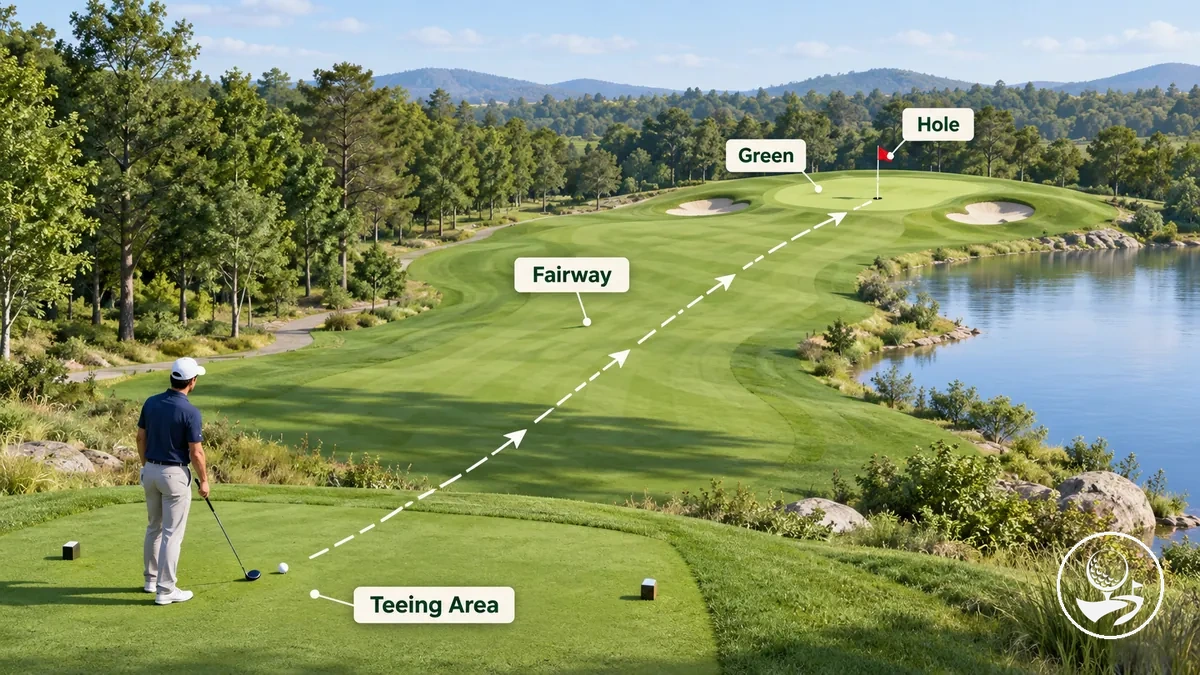
- One hole
- Start from the teeing area, advance the ball towards the green and finish by getting it into the hole.
- Stroke and result
- A stroke is the forward movement of the club made with the intention of striking the ball. An intended miss counts as a stroke; the hole result follows the format, including any applicable penalties.
- One round
- Record or resolve the hole result, then repeat the sequence across the scheduled holes. Nine and eighteen holes are common round lengths.
For example, on a first hole a beginner starts from the teeing area, plays successive strokes until the ball is holed, records the result, and then continues to the next hole.
The Objective of Golf
In regular stroke play, the objective is to complete the competition in the fewest total strokes, with the strokes taken to complete each hole contributing to the total score.
The R&A's Rules of Golf define regular stroke play by total strokes, including strokes made and applicable penalty strokes, across the holes and rounds being played.

Par is a reference score for a hole, not the player's actual score; the player's score reflects the strokes counted for that hole under the format being played.
Regular stroke play
Compare total strokes. The player's counted strokes across the round, including applicable penalties, determine the result.
Match play
Compare holes won. Each hole is a separate contest, so the number of holes won matters rather than the aggregate stroke total.
How a Hole and a Round of Golf Work
Play normally begins with a stroke from the teeing area, continues through successive strokes until the hole is completed, and then moves to the next hole.
The visual below maps that basic progression from the teeing area through the playing area to the green and hole completion.
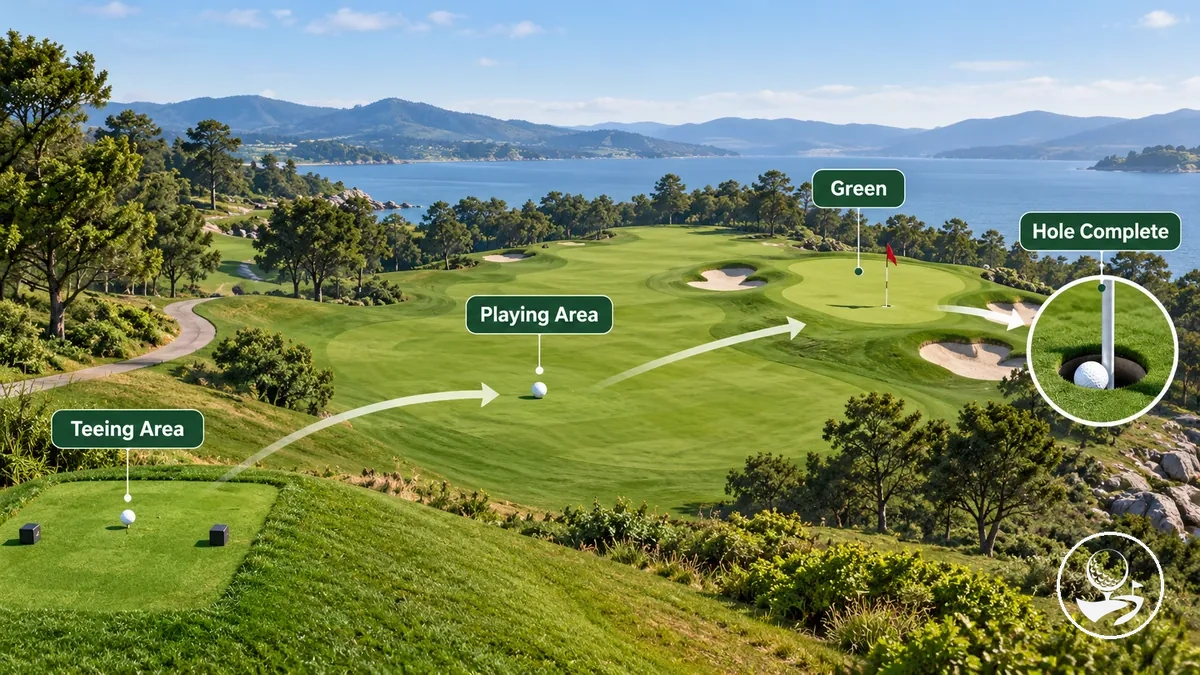
- Start from the teeing area. The hole begins with the first stroke played from its designated teeing area.
- Advance the ball toward the green. Successive strokes move the ball through the playing area toward the green and the hole.
- Complete the hole. In ordinary stroke play, the player continues until the ball is holed, so each counted stroke contributes to the score for that hole.
- Record or resolve the result. The score or result for the completed hole is handled according to the format being played.
- Move to the next hole. Play continues through the remaining holes in sequence until the scheduled round is complete.
A round can contain different numbers of holes, with nine-hole and eighteen-hole rounds being common examples, while the course format and local conditions can change the practical experience of moving through them.
How to Start Playing Golf as a Beginner
Starting golf as a beginner is a progression rather than a requirement to master the swing before playing: understand the game, build basic skills, practise in a lower-pressure setting and then move onto a course when you can participate safely and maintain reasonable pace.
This is a practical beginner path rather than a universal training prescription, because access to coaching, practice facilities and suitable courses can differ.
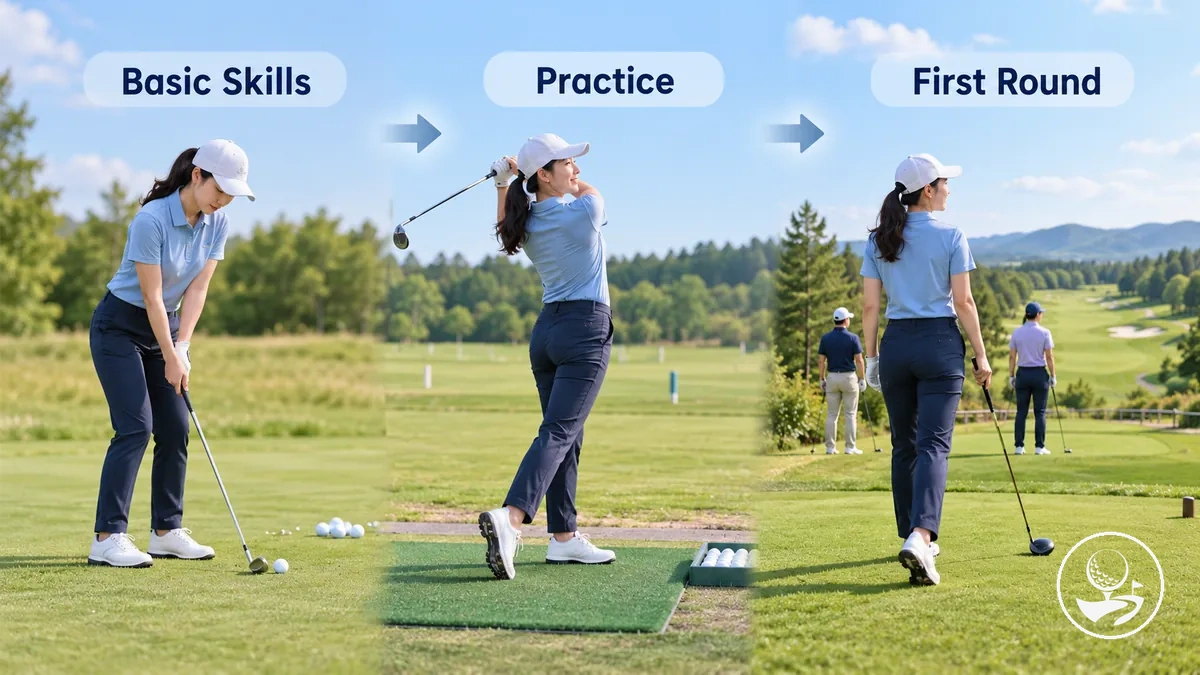
- Understand the basic game. Learn how a hole and round work, what a stroke represents and how play progresses around the course.
- Build a small set of basic skills. Develop enough contact and directional control to move the ball deliberately without treating advanced technique as a prerequisite for getting started.
- Practise in a lower-pressure setting. A practice facility can help a beginner build familiarity and control. Being ready to practise means using that setting safely; being ready to try a course also requires enough control and pace to participate without creating avoidable risk or delay.
- Learn essential course conduct. Before a first round, understand basic safety, where to stand around other players and how to keep play moving at an appropriate pace for the course.
- Try an appropriate first round. Choose a course or format that suits your current ability and available access, then use the round to apply the basic skills and course awareness developed during practice.
Readiness for a first round is better judged by safety, basic control and the ability to maintain reasonable pace than by reaching a particular score.
Start With Simple Practice Before Playing a Full Round
Simple, focused practice gives a beginner a lower-pressure way to build ball contact, short-game familiarity and workable control before attempting a first round.
The image below shows early practice focused on manageable, repeatable tasks rather than trying to reproduce every situation found on a course.

The amount of practice needed can vary with current skill, access to facilities and how quickly useful control develops, so an arbitrary number of practice hours is not a reliable readiness rule.
An unfocused bucket of balls mainly adds repetition, while returning to a small set of repeatable tasks makes it easier to build familiarity and judge whether control is becoming more dependable.
Early practice can therefore be organised around a few clear purposes:
- Build basic contact. Use practice to become more familiar with making usable contact and moving the ball deliberately.
- Include the short game. Give putting and simple shots around the green enough attention to make these common parts of play less unfamiliar.
- Repeat manageable tasks. Repetition should help the beginner recognise what they can reproduce with reasonable control rather than chase perfect consistency.
- Watch for course-readiness cues. A first round becomes more reasonable when the beginner can practise safely, control the ball often enough to continue play and maintain an appropriate pace on the course.
Detailed drill selection and full practice-routine design belong outside this subsection; here the goal is simply to make early practice purposeful before course play.
Build Enough Control to Play Safely and Keep Pace
Beginner course-readiness is better judged by workable control, safety and pace than by score, handicap or consistently clean ball striking.
The criteria below are practical indicators of readiness for ordinary course participation rather than fixed performance thresholds.
- Maintain reasonably safe directional control. If the beginner can usually keep the ball moving in a direction that does not repeatedly threaten nearby players or adjoining play areas, that level of control supports safer participation.
- Advance the ball through the hole. A beginner does not need consistent contact on every stroke, but being able to advance the ball often enough to continue play indicates a workable level of basic control.
- Keep awareness of other players. Recognising where other golfers are and waiting when someone could be within the intended line of play supports safety during the round.
- Be ready when it is time to play. Following the group and preparing for the next stroke without unnecessary delay supports an appropriate pace even when individual shots vary.
- Move on when repeated difficulty is holding up play. If repeated attempts are materially delaying the group, being willing to stop that sequence and continue appropriately under the format being played supports pace.
Normal beginner variability
Occasional mishits and inconsistent shots are expected; they do not, by themselves, mean a golfer is unready for a first round.
Reason to adjust your plan
Repeated difficulty that risks safety, prevents reasonable progress or consistently disrupts group pace calls for further practice or an easier playing format.
Begin on a Shorter or Beginner-Friendly Course
A shorter course or more accessible setup can reduce the time, shot count and course-management complexity a beginner faces while learning how real play flows.
A nine-hole round, par-3 course, executive course or use of forward tees may suit a first round when the format matches the golfer's current control and the expected pace of play.
Course labels are not universal indicators of difficulty or beginner suitability because facilities define formats, tee options and access policies differently.
The practical choice depends more on course length, expected pace, difficulty and local availability than on the label itself.
- Course length: A shorter layout or forward tees can reduce the distance a beginner must cover and may reduce the number of shots needed to progress through a hole.
- Expected pace: A format with a pace the beginner can reasonably maintain may provide a more manageable first-play environment.
- Difficulty: A shorter course is not automatically easy, so consider how demanding the layout is as well as its length.
- Availability and access: Nine-hole, par-3, executive and forward-tee options depend on the facilities and beginner policies available locally.
Basic Golf Terms Beginners Need to Know
Beginner golf terminology is most useful when it helps a new player understand where play happens, how scores are described, what common shots mean and how golfers communicate on the course.
The terms below are grouped by function rather than alphabetically so each word is tied to how it is used during ordinary play.
Course areas describe the main parts of a hole that a beginner will hear mentioned during play.
- Teeing area: The designated area where a player starts a hole; “tee box” is commonly heard as informal wording for this starting area.
- Fairway: The closely mown area between the teeing area and the green that commonly provides a clearer surface for advancing the ball.
- Rough: The longer grass beside or around the fairway where a ball can be more difficult to play.
- Green: The closely prepared area containing the hole and the surface on which players normally putt.
Scoring terms describe a player's score on a hole in relation to par.
- Par: The reference number of strokes assigned to a hole (commonly 3, 4 or 5), against which common score terms are described.
- Birdie: A score of one stroke under par on a hole.
- Bogey: A score of one stroke over par on a hole.
Common shot terms identify basic actions a beginner is likely to hear while playing or receiving simple instructions.
- Putt: A stroke normally played on the green with the intention of rolling the ball toward the hole.
- Tee shot: The first stroke played on a hole from the teeing area.
- Chip: A short shot commonly played from near the green to get the ball onto the green and moving toward the hole.
Course conduct terms help a beginner understand safety and the flow of play around other golfers.
- Fore: A shouted warning used when a golf ball may be heading toward other people, alerting them to possible danger.
- Pace of play: The rate at which a player or group progresses around the course, which matters because unnecessary delays can affect groups behind.
For example, on a par-4 hole, a score of 3 is a birdie and a score of 5 is a bogey, so the meaning of those score terms depends on the par assigned to that hole.
Clubs, Scoring, Rules and Etiquette in Beginner Golf
Clubs, scoring, rules and etiquette have different jobs, but all four help a beginner take part in a round confidently and considerately.
- Clubs
- Match the shot to its distance, trajectory and control needs.
- Scoring
- Record strokes and applicable penalties; use par to describe hole results.
- Rules
- Follow formal playing procedures that apply to the format and ball situation.
- Etiquette
- Keep others safe, maintain appropriate pace and look after the course.
Begin by understanding these core functions; you can learn finer club choices, scoring procedures and unusual Rules situations progressively through play.
Why Different Clubs Are Used for Different Shots
Golf clubs are designed for different shot roles because features such as loft, shaft length and clubhead design influence trajectory, distance and control.
These design differences make some club families more suited to longer shots and others to approach, short-game or putting tasks, while the actual distance a golfer produces with any club varies with the player and conditions.
- Woods: Woods generally combine longer shafts with clubhead designs intended to produce distance, so they are commonly used for longer shots from the tee or fairway.
- Hybrids: Hybrids combine characteristics associated with woods and irons, giving golfers another option for longer shots where a balance of distance and control is useful.
- Irons: Irons vary in loft and shaft length across the set, allowing golfers to use them for a range of approach and advancing shots where trajectory, distance and control need to be balanced.
- Wedges: Wedges have relatively high loft and are primarily used for shorter approach and short-game shots where height and control are more important than maximum distance.
- Putters: Putters are designed to roll the ball along the green rather than produce a normal airborne shot, making them the main club family for short-distance strokes toward the hole.
For example, a golfer may use a longer club to cover substantial distance earlier in a hole, a wedge for a shorter shot near the green and a putter once the ball is on the putting surface.
The clubs serve different functions because the required trajectory, distance and control change as the shot situation changes.
You do not need a full set to learn: a smaller selection can cover advancing the ball, short shots and putting. When playing under the Rules of Golf, the maximum is 14 clubs in a round; carrying fewer is permitted.
How Scoring Tracks Play Across a Round
In regular stroke play, add the counted strokes and applicable penalty strokes for each hole to get the round total. Other formats, including match play, can determine a result differently.
Par is a reference, not your recorded score: finishing in the par number is par, one stroke less is a birdie, and one more is a bogey. Those labels describe each hole; the round total continues to accumulate the actual counted strokes.
| Hole | Par | Strokes | Hole result | Running total |
|---|---|---|---|---|
| 1 | 4 | 5 | Bogey (+1) | 5 |
| 2 | 3 | 2 | Birdie (−1) | 7 |
Rules and Etiquette That Matter During Normal Play
Rules govern the formal procedures of play, while etiquette guides safety, pace and consideration for other golfers.
The exact procedure can depend on the format and local course policy, but a beginner only needs to recognise the main behaviours that affect ordinary play.
- Follow the applicable rules of play. When a ball position or situation requires a playing procedure, use the rule that applies to the format rather than treating course conduct as a substitute for the rules.
- Play in turn and use ready golf when appropriate. In stroke play, safe, responsible “ready golf” can help pace; in match play, the order of play has different rule consequences. Follow the competition format and course instructions.
- Protect other players from danger. Check that people are clear before making a stroke, and delay play when another golfer could be at risk.
- Call “fore” for an errant ball. If a shot may be heading toward other people, shouting “fore” provides a warning so they can react to the possible danger.
- Support course care. Repairing pitch marks, attending to divots where expected and leaving bunkers in reasonable condition helps preserve the playing surface for following golfers.
- Follow local instructions. Course signs, staff directions and local policies can affect where players go, how they move around the course and how pace or safety procedures are handled.
For example, a ball that requires relief calls for the appropriate Rules procedure, whereas a shot travelling towards another group calls for an immediate warning of “fore”. Both can happen during the same hole, but they involve different responsibilities.
What to Expect During Your First Round of Golf
A first round is usually less predictable than practice: shots, routines and decisions vary as you move around the course. Treat it as a chance to learn how play flows while prioritising safety, reasonable progress and group pace rather than a fixed score target.
- Arrive and prepare. Find the starting point, confirm check-in and course policies, and get ready with the group. Course length, weather and local procedures can make the opening holes feel unfamiliar.
- Play with the group. Make shots, move between them and learn the normal rhythm of turns. Mishits and uncertainty can occur; if problems repeatedly affect safety or pace, adjust your approach or move on when the format permits.
- Finish and learn. Notice how tee-off, shot selection, walking between shots and communication fit together. The round's length and duration vary with format, course, weather and pace; use the experience as an introduction rather than a time or scoring test.
What to Check Before You Arrive at the Course
Before arriving for a first round, confirm the course-specific requirements that affect when to arrive, what to bring and how you will access the facility.
Policies and available services can differ by course, so advance verification helps prevent avoidable confusion.
- Tee time: Confirm the booked tee time and any instructions about when the group should be ready to start.
- Check-in: Check where registration takes place and how far in advance the facility asks players to check in.
- Dress code: Verify whether the course has a dress code or clothing restrictions rather than assuming the same policy applies everywhere.
- Equipment access: Confirm whether clubs or other needed equipment can be rented or borrowed if you are not bringing your own.
- Balls: Check that you have access to enough golf balls for the round, whether brought with you or available at the facility.
- Tees: Confirm that you have tees if they are needed for the course and format you will be playing.
- Weather: Check the expected weather and course conditions so clothing and personal preparation match the likely conditions.
- Transport: Verify how you will reach the course, where to arrive and any parking or access instructions that affect your journey.
- Walking expectations: Check whether the course is normally walked, whether another transport option is available and whether any local policy affects how players move around the facility.
- Local policy: Confirm any beginner restrictions, local instructions or facility-specific requirements that could affect participation.
Requirements such as dress code, equipment access and transport arrangements are facility-specific, so verify them with the course rather than assuming they will match another venue.
How to Keep Pace and Play Safely With Other Golfers
Beginners can support pace and safety by staying ready to play when their turn comes, watching where other golfers are positioned and avoiding delays that repeatedly hold up the group.
What is appropriate can depend on the format and local policy, especially for ready-golf, searching and move-on decisions.
- Watch the players ahead. Do not play while another group or player is still within a position where the shot could create danger; maintaining safe spacing takes priority over playing quickly.
- Warn others about a dangerous errant shot. If a ball is heading toward people, call “fore” clearly so they have an immediate warning of the potential danger.
- Be ready to play when it is your turn. Prepare the next shot while others are playing when it is safe to do so, so normal decision-making does not become an avoidable delay.
- Keep searches efficient. Under the Rules of Golf, a ball is lost if it is not found within three minutes after you or your caddie begin searching. Follow the applicable format and local rules for how to continue rather than prolonging the delay.
- Move on when appropriate in casual play. If repeated attempts are materially delaying the group, picking up or continuing from another suitable point may help pace when the format and local policy permit it; formal competition procedures may require a different response.
- Maintain awareness of the whole group. Safe spacing, readiness and attention to other golfers work together: efficient play should never require rushing into a situation that creates risk.
A single missed shot followed by a brief search is a normal beginner delay if the group then continues without materially losing pace.
By contrast, repeatedly searching, remaining unready to play or hitting while players ahead are still within danger can create a genuine pace or safety problem.