
Golf Practice Routine for Beginners
A beginner golf practice routine should give each session one observable objective, allocate the available time across full swing, short game and putting with extra attention for a recurring weakness, and end with a brief review. There is no universal time split or ideal weekly frequency: use a schedule you can sustain, keep other core skills in maintenance, and change priorities when repeated results justify it.

Session planning tool
Plan your next practice session
Choose a current priority from recurring practice results, then adjust the minutes to fit your available time. The starting allocations are illustrative examples from this guide, not prescribed percentages.
Allocate practice minutes
Your session plan
Putting is the main priority: 7 minutes full swing, 8 minutes short game, 12 minutes putting and 3 minutes reviewing results. Add one observable objective before starting.
The priority block has the most allocated time in this example.
Before the next session: compare the objective with repeated observations, not a single shot. Keep maintenance work where practical, and adjust for fatigue, facility access and progress. The planner checks time totals; it does not assess your technique.
Structured practice gives each session a purpose; random ball-hitting can accumulate repetitions without showing what should receive more or less attention next time.
With a shorter practice window, follow the same sequence—objective, priority, time allocation and review—but use fewer or narrower practice blocks. With more time, keep the core skills represented without assuming they need equal time.
This guide focuses on planning practice time and priorities; full-swing, short-game and putting technique belong in their respective skill guides.
Table of Contents
How to Set Practice Priorities for Each Session
A practice priority should reflect the beginner golfer's current weakness, the importance of core skills, recent performance evidence, and the available time for the session.
The aim is to identify one area that deserves greater practice emphasis before deciding how much time to assign to it.
The following criteria help separate a genuine practice need from a temporary poor result or a skill that only feels more enjoyable to practise.

- Current weakness: a skill that shows a persistent problem across recent practice or play may justify greater emphasis than an isolated poor attempt.
- Recent performance evidence: repeated outcomes from recent sessions provide a stronger basis for changing practice priority than memory of a single shot or session.
- Core-skill importance: full swing, short game, and putting still require maintenance, so increasing attention to one weakness should not automatically remove stable core skills from the practice routine.
- Available time: when practice time is limited, selecting one clear priority skill keeps the session objective focused instead of spreading attention across several unrelated needs.
- Session objective: the chosen priority should translate into one specific practice focus for the next practice block, while other stable skills remain secondary or in maintenance.
A self-directed beginner can choose a practice priority from observed patterns in recent performance, while a coach may help interpret those patterns and select an appropriate focus area.
That distinction concerns how the priority is selected, not how much total practice time it should receive; once the evidence is reviewed, identify one priority for the next practice block.
Prioritize Current Weaknesses Without Neglecting Core Skills
A current weakness should receive extra practice emphasis when it forms a persistent pattern, while stable core skills remain in maintenance practice.
The priority is temporary: more attention goes to the weak area without removing established skills from the routine.

The amount of extra emphasis should reflect the weakness's severity, recurrence, importance to overall play, and whether the golfer already has a stable baseline in other skills.
A single poor session is not enough to establish a persistent weakness; look for a recurring pattern before reallocating practice time.
- Severity: a weakness that meaningfully disrupts normal play may justify greater practice emphasis than a minor inconsistency.
- Recurrence: a problem that appears repeatedly across recent practice or play provides stronger evidence for temporary priority work than an isolated result.
- Importance: a weakness affecting a frequently used or foundational skill may deserve more attention than one with limited influence on the golfer's current needs.
- Baseline stability: core skills that remain reasonably stable can stay in maintenance practice while the current weakness receives additional attention, with the balance adjusted again as the evidence changes.
Give Each Practice Block One Clear Objective
Each practice block should have one observable objective so every repetition has a clear focus and can be interpreted afterward.
The practice objective should connect one task to a relevant feedback cue and a completion check rather than rely on a vague goal such as trying to hit better.
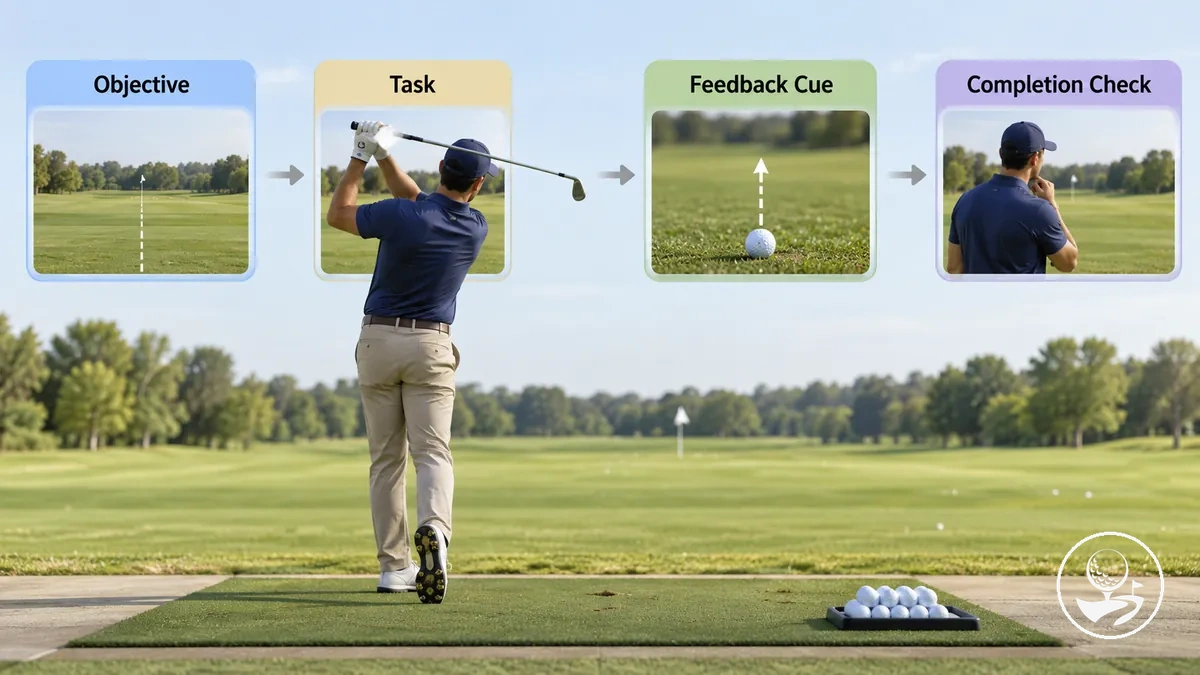
A specific objective such as improving start direction or making contact more consistent gives the beginner golfer something concrete to observe during the block.
Keep technical changes limited so the observed result remains connected to the chosen objective rather than several competing adjustments.
- Objective: choose one observable target, such as making the ball start closer to the intended line or producing more consistent contact.
- Task: perform repetitions that keep attention on that single practice objective rather than changing several parts of the motion at once.
- Feedback cue: observe the result linked to the objective, such as the ball's initial direction or the consistency of contact, after each repetition.
- Completion check: at the end of the practice block, review the observed pattern and decide whether the same objective still needs focus or whether the next block can move to another priority.
How to Divide a Beginner Golf Practice Session
A beginner golf practice session should divide practice time among the highest-priority skill areas while preserving enough repetition in each practice block to keep the work focused.
The time split should adjust to session length, the current priority, maintenance needs, and fatigue rather than follow one fixed ratio.
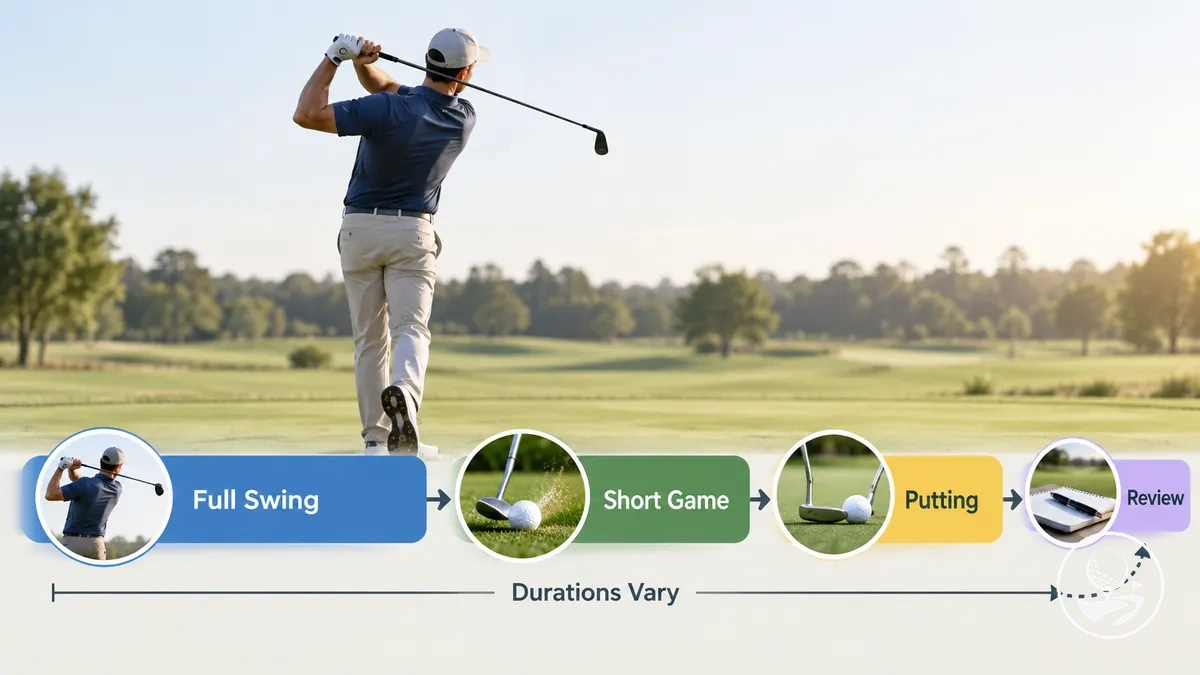
No universal percentage split applies to every beginner or every session: the current skill priority can change while the other core skills still need maintenance.
A shorter session may require fewer or smaller practice blocks, while a longer session allows broader skill coverage; if fatigue reduces the quality of later repetitions, the remaining allocation can be shortened or shifted to a less demanding block.
- Full swing: allocate more practice time when it is the current priority, or retain a smaller maintenance block when recent performance is stable.
- Short game: increase its practice emphasis when chipping or pitching is the selected priority, while keeping the block proportionate to the available session length.
- Putting: include a focused block when putting needs priority work or maintenance rather than letting it disappear because another skill receives more attention.
- Adjustment and review: leave a small part of the session for observing results, accounting for fatigue, and deciding whether the next practice block should continue or change focus.
These illustrative time splits move the longest block to the current priority. They are not prescribed formulas; adjust the blocks to your objective, facilities, time and fatigue.
| Session | Full swing | Short game | Putting | Review | Priority |
|---|---|---|---|---|---|
| 30 minutes | 7 min | 8 min | 12 min | 3 min | Putting |
| 60 minutes | 25 min | 15 min | 15 min | 5 min | Full swing |
Allocate Time to Full-Swing Practice
Full-swing practice should receive more or less practice time according to the session's practice objective, current ball-striking consistency, fatigue, and the need to preserve time for short game and putting.
When ball striking is the priority, full-swing work can receive greater emphasis; when it is relatively stable, a maintenance block can keep it represented without dominating the session.

This allocation decision is separate from how to practice at the driving range: range execution can address the details of the practice block, while this section only determines how much session emphasis full-swing work receives.
- Increase full-swing time: when improving ball striking is the current practice objective and inconsistent results form a recurring practice need, give the full swing greater session emphasis.
- Use maintenance time: when ball-striking consistency is relatively stable and another skill has higher priority, keep a smaller full-swing block for maintenance.
- Reduce full-swing time as fatigue builds: when fatigue makes focused repetitions harder to sustain, shorten the block rather than continue accumulating unfocused swings.
- Preserve time for other skills: full-swing practice should not consume the session when short game or putting also requires priority or maintenance work.
Allocate Time to Chipping and Short-Game Practice
Chipping and short-game practice should receive more practice time when shots around the green are a current weakness or the main practice objective, and remain at maintenance level when performance is relatively stable.
The amount of emphasis also depends on session length and whether the available facilities allow useful short-game repetitions.
Allocate session time to short-game work here; the technique of beginner chipping belongs in a dedicated skill guide.
- Increase short-game time: when chipping or other shots around the green are a current weakness and match the practice objective, give short-game work greater session emphasis.
- Use maintenance time: when short-game performance has a stable baseline and another skill has higher priority, keep a smaller maintenance block so the skill remains represented.
- Adjust for available facilities: when a suitable chipping area or practice green is available, reserve enough time for focused observation of landing area and roll outcome; when facilities are limited, reduce the block rather than force unrelated practice.
- Adjust for session length: in a shorter session, concentrate practice time on the current priority; in a longer session, short-game practice can remain alongside other priority or maintenance blocks without becoming a technique lesson.
Allocate Time to Putting Practice
Putting should receive deliberate practice time in a beginner session, with extra emphasis when repeated observations make putting the current priority.
When putting performance is relatively stable, a maintenance block can keep it represented without allowing it to consume the routine by default.
The putting allocation should reflect session length, access to a suitable practice surface, and the objective of the putting block.
Detailed guidance on how to practice putting basics belongs in a technique-focused context; here, the decision is how much session time putting should receive.
- Increase putting time: when repeated observations show that putting is a current weakness and the selected objective concerns an observable result such as start direction or pace, give the putting block greater emphasis.
- Use maintenance time: when putting performance is relatively stable and another skill has higher priority, retain a smaller putting block for maintenance.
- Adjust for the practice surface: when a suitable putting green or comparable surface is available, allocate time that supports focused repetitions; when access is limited, reduce the block rather than treat unsuitable practice as equivalent.
- Adjust for session length: a shorter session may require putting to remain at maintenance level unless it is the current priority, while a longer session can accommodate more putting work alongside other practice blocks.
Adjust the Practice Split to Your Current Needs
Adjust the practice split when repeated evidence shows that a current weakness, recent results, available time, or practice conditions have changed.
Rebalance practice emphasis only when the pattern is persistent enough to justify an adjustment, while keeping non-priority skills in maintenance rather than reacting to one unusually good or bad session.
Better range performance does not necessarily transfer to course performance because the practice and playing contexts differ.
Treat range results as one source of evidence for the practice split, not as proof that a technical problem has been diagnosed, solved, or transferred to the golf course.
- Persistent ball-striking difficulty: if repeated observations continue to show poor contact or inconsistent full-swing outcomes, give full-swing practice more emphasis while maintaining some short-game and putting work.
- Recurring short-game weakness: if recent results repeatedly show difficulty around the green, shift more practice time toward short-game work while keeping other stable skills at maintenance level.
- Reduced available time: when session time becomes limited, narrow the practice split around the highest current priority and keep essential maintenance blocks smaller rather than trying to cover every skill equally.
- Changed practice conditions: if facility access, fatigue, or the available practice environment changes what can be practised effectively, adjust the time allocation to suit those conditions while preserving some maintenance practice for non-priority skills.
How Often Beginners Should Practice Golf
There is no single ideal practice frequency for every beginner golfer.
A sustainable weekly practice schedule depends on available time, recovery, access to practice facilities, goals, and session length, so the practical cadence will differ from one beginner to another.
Practice frequency should be considered together with total practice volume rather than as a standalone target.
A beginner can increase weekly frequency when shorter sessions fit the schedule and remain manageable, or reduce frequency when longer sessions use the available time more effectively; consistency and continuity matter more than following a fixed number of sessions.
- Available time: when smaller periods of free time occur across the week, more frequent shorter practice may be feasible; when time is concentrated into fewer openings, a lower weekly frequency with longer sessions may fit better.
- Recovery: if repeated sessions leave the golfer too fatigued to maintain useful focus, reduce frequency, shorten session length, or allow more recovery before the next practice session.
- Access: reliable access to a driving range, short-game area, putting green, or other suitable practice space can support a more regular practice cadence, while limited access may require fewer planned sessions.
- Goals: a current goal can justify adjusting weekly practice toward the skill that needs attention, but the schedule should remain practical enough to continue rather than becoming a temporary unsustainable increase.
- Session length: shorter sessions can be distributed more frequently, while longer sessions usually concentrate more of the total practice volume into fewer visits.
For example, one beginner may prefer fewer longer sessions because practice access is limited but larger time blocks are available, while another may use more frequent shorter sessions because brief practice windows are easier to maintain.
Neither schedule is automatically superior; the better practice frequency is the one the beginner golfer can sustain consistently while allowing adequate recovery and useful practice continuity.
Prioritize Consistent Practice Over Occasional Long Sessions
The practical trade-off is between practice spacing, attention quality, fatigue, and feedback continuity rather than a fixed rule that one session length is always better.
Build a Weekly Practice Schedule Around Available Time
Build a weekly practice schedule from realistic available practice windows, not an idealised calendar.
Identify when practice can actually fit, then build the weekly schedule around those constraints so the plan remains repeatable.
Each scheduled session should have one main objective, a defined session duration based on the available practice window, a secondary maintenance need where time permits, and a simple completion check.
This keeps skill coverage present without forcing every session to include full swing, short game, and putting equally.
- Identify practice windows: mark the periods in the week when practice is realistically possible. Treat these windows as the boundaries of the weekly plan rather than adding sessions that available time cannot support.
- Estimate usable time: decide how much of each practice window can actually be used for focused practice. The resulting session duration determines how much work can reasonably fit into that session.
- Assign one main objective: give each session one priority skill or outcome to focus on. A shorter practice window may support a narrower objective, while a longer window can allow the same priority to receive more practice time.
- Preserve maintenance coverage: where session duration allows, reserve some practice time for a secondary skill that needs maintenance without distracting from the main objective. Maintenance keeps basic skill coverage present without turning every session into a full routine.
- Review and adjust: after using the schedule, check whether each practice window, session duration, main objective, and maintenance block was realistic. Adjust the next weekly schedule when available time or priorities change.
- Short weekday windowPutting as the main objectiveBrief short-game maintenance, if time allows.
- Another short weekday windowFull swing as the main objectivePutting maintenance, if time allows.
- Longer weekend windowShort game as the main objectiveFull-swing maintenance alongside the priority.
After each session, review whether the objective was completed and the planned duration was practical. Adapt the next week’s windows and priorities rather than treating this example as a fixed template.
Track Practice Progress and Adjust the Routine
Tracking practice progress is useful when it shows whether the current routine is moving in a meaningful direction and helps determine the next adjustment.
A beginner should compare repeated observations with the original practice objective rather than treat one unusually good or bad session as proof of progress.
- Establish an objective-matched baseline
Describe the current outcome for the selected practice task, using a clear observation you can repeat.
- Repeat comparable observations
Record the same type of result across multiple comparable sessions. A trend is more meaningful than one unusually good or bad attempt.
- Change emphasis when the pattern warrants it
Keep, increase or move the priority based on repeated results. If one weak area has become steadier while another has not, more time may move to the remaining need. Improvement need not be linear; range results do not automatically transfer to the course, and a trend does not diagnose its cause.
Record a Small Set of Repeatable Practice Measures
Choose a small number of repeatable measures that can be recorded the same way across comparable practice blocks.
Each practice measure should match the current objective, use a simple observation method, and support only the level of interpretation that the observation can reasonably justify.
- Task success rate: define success for the same practice task (for example, finishing in a chosen target area), then calculate successful attempts ÷ total attempts × 100 for a percentage. Compare the same task under similar conditions to see whether consistency is changing; the percentage does not explain why it changed.
- Directional pattern: observe where shots generally start or finish relative to the intended direction. Repeating the same observation method across comparable sessions can reveal whether the directional pattern is becoming more stable or remains variable.
- Contact quality: record a simple contact quality cue that can be observed consistently during the relevant practice task. The measure can track changes in the pattern of contact, but it should not be treated as a technical diagnosis of the swing.
- Distance control: observe how consistently shots finish relative to the intended distance or landing area when distance control is the practice objective. This can support comparison between sessions without requiring an exact performance score or complex statistics.
- Planned drill completion: record whether the planned repetitions or practice task were completed as intended. This tracks adherence to the session objective rather than assuming that completing the drill proves performance has improved.
Use only objective-matched measures and avoid adding indicators that are irrelevant, difficult to repeat, or more precise than the observation method supports.
For example, if the same directional pattern is recorded across several comparable sessions, the repeated observations can be compared for a trend before drawing a conclusion or changing the routine; one session alone is not enough to establish that pattern.
Use Progress Trends to Set the Next Practice Priority
Use a persistent trend from repeated observations, not a reaction to one session, to decide whether a skill remains the priority, moves to maintenance, or gives way to a higher-need area.
Stable improvement, no meaningful change, and regression can each support a different adjustment, but none of these patterns should be treated as proof of a technical cause.
| Repeated pattern | Possible next step | Important limit |
|---|---|---|
| Stable improvement | Consider shifting this skill towards maintenance and making room for a higher-need skill. | Improvement in one practice context does not guarantee the same result elsewhere or on the course. |
| No meaningful change | Review the objective and practice approach before adding more repetitions or time. | A plateau does not identify its own cause or prove that more practice volume is needed. |
| Repeated regression | Keep or restore the skill as a priority while reviewing practice conditions and the wider routine. | A declining pattern calls for attention, but does not by itself explain the technical cause. |
For example, if putting shows stable improvement across several sessions while short-game outcomes show no meaningful change, the next week's adjustment may move putting to maintenance and give short-game practice greater emphasis while keeping the broader routine balanced.
Re-prioritization should follow the relative pattern of need rather than defaulting to more total practice volume.