
Golf Rules and Etiquette for Beginners
The Rules of Golf determine how to play the ball, take relief and apply penalties; golf etiquette covers safe, considerate behaviour, pace of play and course care. For a first round, play the ball as it lies unless a Rule permits another procedure, check the ball’s status before taking relief, and follow the applicable playing format and Local Rules.
First-round reference
What should you do next on the golf course?
Match the situation to the relevant rule or conduct expectation. Each answer identifies the next action and the important penalty or safety boundary.
-
Rules 8 and 9
The ball has an awkward lie
Normally play it where it lies; a difficult lie alone gives no automatic relief. Do not improperly improve conditions affecting your stroke.
-
Rule 18
The ball may be lost or out of bounds
If eligible, announce and play a provisional. A ball lost outside a penalty area or out of bounds requires one penalty stroke plus a stroke from the previous spot; the search limit is three minutes.
-
Rule 17
The ball is in a penalty area
Play it as it lies without a relief penalty when permitted, or choose an available relief option for one penalty stroke. Red areas also offer lateral relief; yellow areas do not.
-
Rule 6.4
Another player is due to play
The honour applies on the tee; later the ball farthest from the hole normally plays first. Ready golf is encouraged in stroke play when safe and responsible; match play has different consequences.
-
Safety and conduct
Someone could be in range
Wait until everyone is safely clear before a stroke or practice swing. If an errant ball may endanger someone, shout “fore” immediately.
-
Etiquette and course care
You have finished your shot
Move on without unnecessary delay, avoid distracting others, repair pitch marks, rake disturbed bunkers and deal with divots according to course instructions.
This quick guide covers common beginner situations, not every exception. A formal ruling depends on the applicable Rule, playing format, Local Rules and facts of the situation.
Rules and etiquette can overlap: expected conduct may also be addressed by Rule 1.2 or by an applicable Code of Conduct, so not every etiquette lapse is automatically a rules penalty.
Table of Contents
How Golf Rules and Etiquette Differ
The Rules of Golf and etiquette guide different parts of a golfer’s on-course behaviour.
A formal rule determines how play proceeds and when a rules consequence or penalty can apply, while etiquette mainly governs conduct, consideration for other players, safety, pace of play, and course care.
The illustration shows a rule-governed playing procedure beside consideration-based behaviour so the distinction is clear in an on-course context.
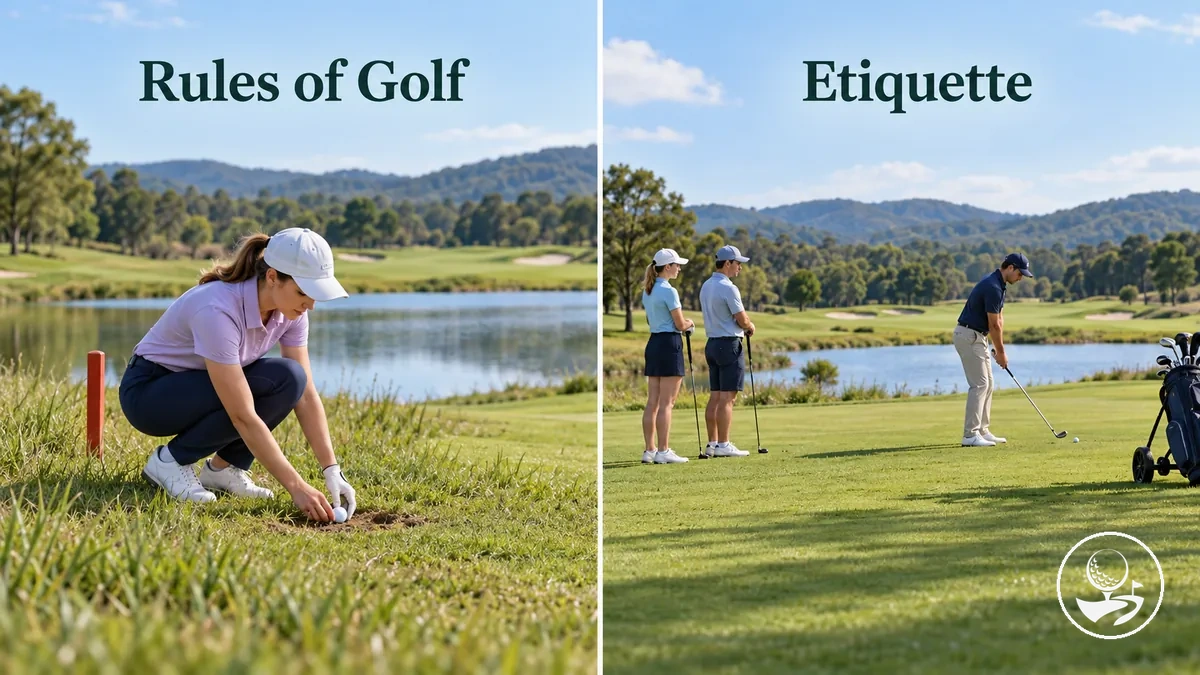
The comparison separates authority, typical consequence, representative situations, and primary purpose so a beginner can classify whether an issue is governed by a formal rule, etiquette, or both.
| Dimension | Rules of Golf | Etiquette |
|---|---|---|
| Authority | Formal Rules of Golf, including applicable procedures, restrictions, relief, and penalties. | Expected standards of conduct and consideration; some conduct is also addressed within the formal Rules. |
| Typical consequence | A breach can produce a rules consequence or penalty when the relevant Rule specifies one. | Usually a conduct issue rather than a rules penalty, unless the behaviour is also governed by a formal Rule or an applicable Code of Conduct. |
| Typical beginner example | Following the correct procedure for the ball or taking permitted relief. | Avoiding distraction, considering safety, maintaining an appropriate pace of play, and practising course care. |
| Primary purpose | Define how the game is played fairly and how rule-governed situations are resolved. | Support considerate, safe, and efficient behaviour toward other players and the course. |
The distinction is not absolute because formal rules and etiquette can overlap.
The R&A addresses standards of player conduct in Rule 1.2 of the Rules of Golf, including consideration for others, prompt pace, safety, and course care.
A beginner should therefore treat both formal rules and etiquette as necessary parts of competent on-course behaviour while checking the applicable Rule when a formal consequence is in question.
Rules for Playing the Ball and Taking Your Turn
Before making a stroke, a beginner should normally play the course as found, play the ball as it lies, and follow the normal order of play unless a Rule permits or requires a different action.
Relief can change where or how the ball is played, while the playing format can affect how strictly the normal turn order applies.
The image demonstrates the basic situation: one golfer addresses the ball where it lies while another player waits safely for their turn.

According to The R&A's Rules of Golf, Rule 1.1 establishes the default principles of playing the course as found and the ball as it lies, while allowing exceptions when another Rule permits or requires a different procedure.
Rule 6.4 sets the normal order of play according to the honour at the teeing area and, after play of the hole begins, which ball is farthest from the hole.
Permitted relief changes the default action only when the applicable Rule provides that procedure.
In stroke play, Rule 6.4 allows and encourages ready golf when playing out of turn is done safely and responsibly.
These conditions determine the correct action before the next stroke:
- If no Rule permits or requires a different procedure, play the ball as it lies and the course as found.
- If a Rule provides relief, follow that relief procedure rather than moving the ball simply because the lie is difficult.
- Under the normal order of play, use the honour on the tee and the farthest-from-the-hole principle after the hole has started.
- In stroke play, ready golf may change the turn when playing out of order is safe, responsible, and does not endanger, distract, or interfere with another player.
For example, during a first round, a player should first check whether the ball must be played as it lies or whether a relief Rule changes the action, then identify whose turn it normally is.
If the group is using ready golf in stroke play, the player may play before someone who would otherwise have the turn when doing so is safe and responsible.
Playing the Ball as It Lies
The default principle is to play the ball as it lies unless a Rule of Golf permits or requires another procedure.
According to The R&A's Rules of Golf, Rule 9.1 establishes this basic requirement, so a difficult lie by itself does not create an entitlement to relief.
The image shows a ball resting naturally in an awkward lie where the existing position remains the starting point for deciding what action is permitted.

Check the lie before touching the ball
- Awkward position or long grass
- Play the ball from its existing lie. Difficulty alone does not provide a right to relief.
- Conditions affecting your stroke
- Rule 8.1 restricts actions that improve those conditions. Do not alter grass, ground or other protected conditions merely to make the stroke easier.
- Relief permitted by another Rule
- Use that specific relief procedure instead of moving the ball at will; the applicable Rule determines whether relief is free or involves a penalty.
Order of Play and Ready Golf
On later teeing areas, the honour normally goes to the player with the lowest gross score on the previous hole in stroke play, or the player who won the previous hole in match play; a tie retains the existing order (Rule 6.4).
The image shows golfers in different positions so the normal playing order and a safe ready-golf situation can be distinguished.
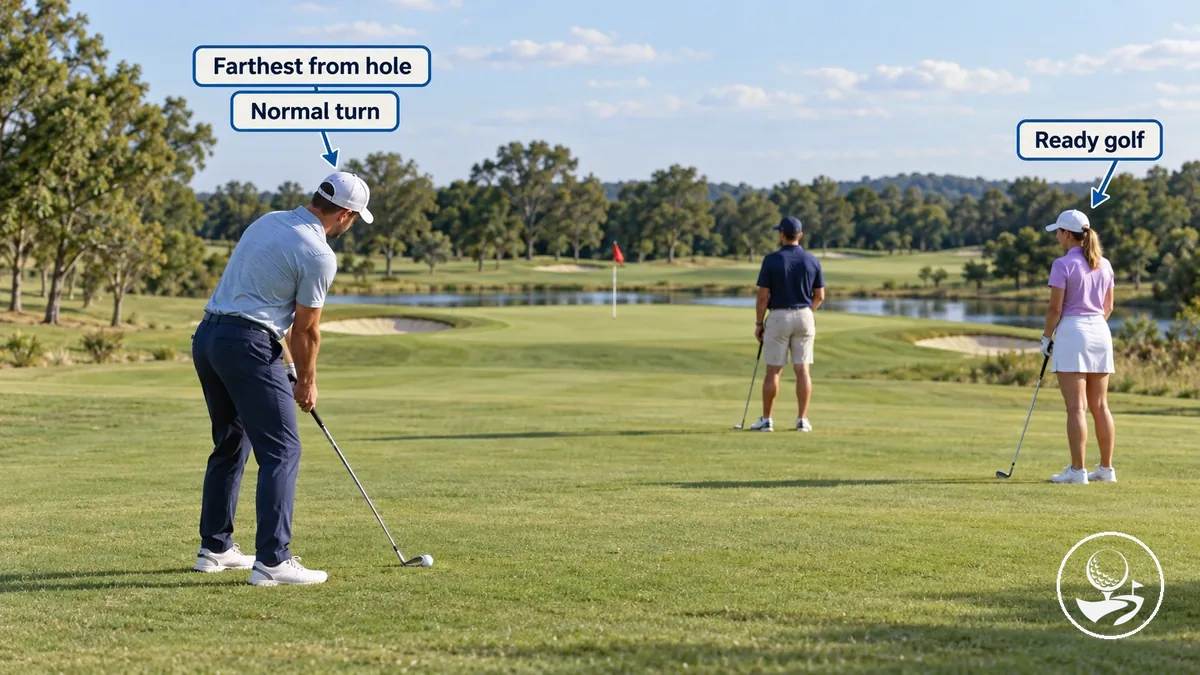
How the playing format changes your turn
Once a hole has started, the ball farthest from the hole normally has the turn. Playing out of turn has different implications by format:
- Stroke play
- Ready golf is allowed and encouraged when it is safe and responsible. Playing before someone else should not distract, endanger or interfere with them.
- Match play
- Order matters: an opponent may promptly cancel a stroke played out of turn and require it to be replayed in the correct order. Do not assume the stroke-play ready-golf approach applies.
Common On-Course Penalty Situations
Before choosing a penalty or relief procedure, identify the ball’s status: lost outside a penalty area, out of bounds, or in a penalty area.
According to The R&A's Rules of Golf, lost and out-of-bounds balls generally fall under Rule 18 and stroke-and-distance, while a ball in a penalty area is handled under Rule 17.
The image separates boundary status from penalty-area status, while the table organizes how each situation is identified, the basic next action, and its penalty or relief concept.
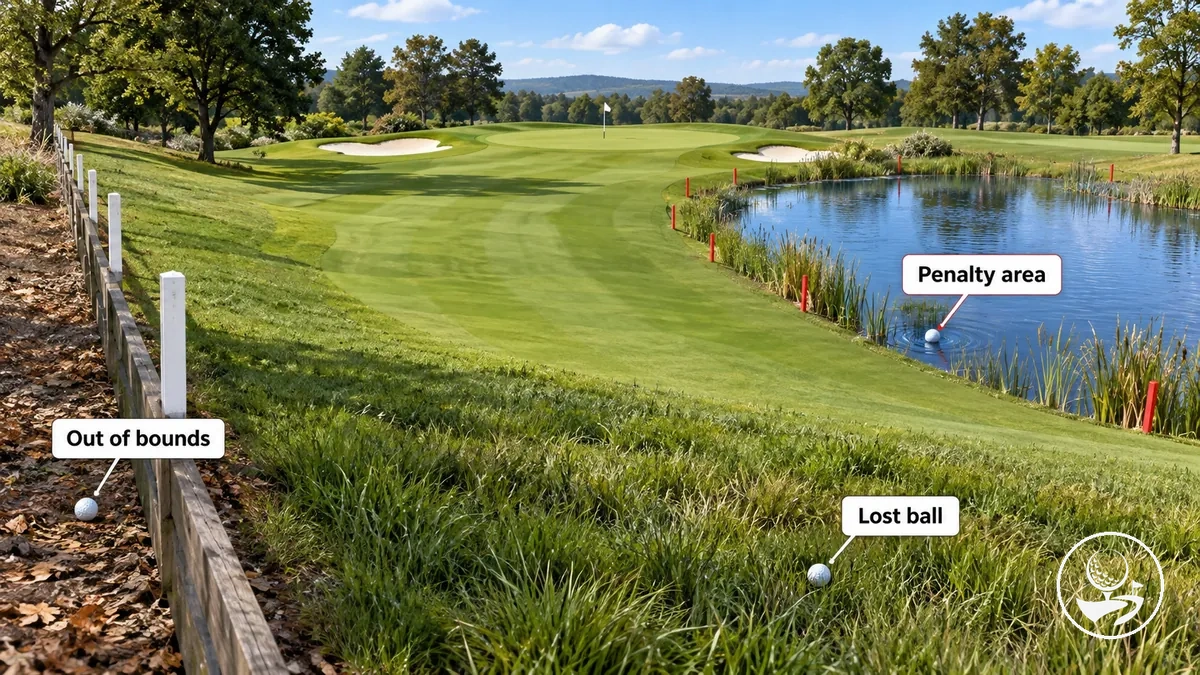
| Situation | How to identify it | Basic next action | Penalty/relief concept |
|---|---|---|---|
| Lost outside a penalty area | The ball is not found within the three-minute search time and it is not known or virtually certain that another Rule applies to the missing ball. | Take stroke-and-distance relief and play from where the previous stroke was made. | One-stroke penalty under the stroke-and-distance procedure. |
| Out of bounds | The entire ball lies outside the boundary edge of the course. | Take stroke-and-distance relief and play from where the previous stroke was made. | One-stroke penalty under the stroke-and-distance procedure. |
| Ball in a penalty area | The ball lies in a defined red or yellow penalty area, or it is known or virtually certain to have come to rest there even though it is not found. | Play the ball as it lies when permitted, or take an available Rule 17 relief option. | Playing it as it lies carries no penalty; taking penalty-area relief carries a one-stroke penalty. |
The key distinction is that a ball lost outside a penalty area or out of bounds normally requires stroke-and-distance under Rule 18, while a ball in a penalty area follows the separate Rule 17 relief framework.
Under Rule 18, stroke-and-distance means adding one penalty stroke and playing from where the previous stroke was made.
Rule 17 allows a player whose ball is in a penalty area to play it as it lies when permitted or take an available relief option for one penalty stroke; red and yellow penalty areas have different available relief options.
The scoring consequence needed here is limited: stroke-and-distance adds one penalty stroke and requires another stroke from the previous location, while taking penalty-area relief also adds one penalty stroke but may use a different permitted location.
These penalties affect the player's score, while detailed score calculation belongs in the guide to understand golf scoring.
Lost Balls, Out of Bounds, and Provisional Balls
If a ball might be lost outside a penalty area or might be out of bounds, a provisional ball may be played to save time while preserving the stroke-and-distance procedure.
Under The R&A's Rule 18.3, a provisional is not appropriate when the ball could only be in a penalty area.
The player must announce the provisional before making a stroke at it, then use the later search and ball status to determine which ball remains in play.
For example, after a tee shot that may have crossed an out-of-bounds boundary, a player can announce and play a provisional from the previous spot before going forward to search.
- Before playing another ball, announce to someone that it is a provisional ball, using the word “provisional” or otherwise clearly indicating that it is being played provisionally under Rule 18.3.
- Play the provisional using the stroke-and-distance procedure from the previous spot, then go forward to determine the status of the original ball.
- Search for the original ball. Under Rule 18.2, the three-minute search period begins when the player or their caddie starts searching; if the original ball is not found within that period, it is lost under the Rule.
- Verify the ball status before continuing. If the original ball is found in bounds outside a penalty area within the search period while the provisional still has provisional status, abandon the provisional and continue with the original ball; if the original ball is lost outside a penalty area or is out of bounds, continue under stroke-and-distance with the provisional as the ball in play.
A player does not make the original ball lost simply by saying that it is lost; its status follows the conditions in Rule 18, including the three-minute search limit.
A provisional must be abandoned if the original ball is found on the course outside a penalty area within the search time, or is known or virtually certain to be in a penalty area. Conversely, a provisional becomes the ball in play if it is played from a spot nearer the hole than where the original ball is estimated to be (Rule 18.3c).
A Committee may adopt an applicable Local Rule that provides an alternative procedure in specified circumstances, but that does not change the default lost-ball, out-of-bounds, or provisional-ball rules.
The provisional ball primarily saves the time of returning to the previous spot when stroke-and-distance is ultimately required.
For example, if an opening tee shot is out of bounds and a properly announced provisional is used, the provisional tee shot counts as stroke three: the first stroke, one penalty stroke, then the stroke made with the provisional.
Penalty Areas and Basic Relief Options
When a ball is in a penalty area, the available relief depends on whether it is a red penalty area or a yellow penalty area and, for some relief options, the point where the ball last crossed the penalty-area edge.
The player may play the ball as it lies without taking penalty relief, or may choose an available relief procedure for one penalty stroke.
According to The R&A's Rule 17.1d, stroke-and-distance relief and back-on-the-line relief are available for both red and yellow penalty areas, while a red penalty area also provides lateral relief.
Use the following sequence to choose a permitted procedure.
- Confirm that the ball is in the penalty area and identify whether the area is defined as red or yellow. If the player chooses to play the ball as it lies, no penalty-area relief is taken.
- If taking relief, add one penalty stroke. Stroke-and-distance relief allows the player to play from a relief area based on where the previous stroke was made and is available for either colour.
- For back-on-the-line relief, identify the estimated crossing point where the ball last crossed the edge of the penalty area and keep that point between the hole and the spot where the ball is dropped. This option is available for both red and yellow penalty areas.
- If the penalty area is red, the player may instead take lateral relief within two club-lengths of the estimated crossing point, not nearer the hole. This additional lateral relief option does not apply to a yellow penalty area under the standard Rule.
Use the penalty-area colour and boundary as defined or marked for the course, and apply any relevant Local Rule only when it changes the course-specific procedure.
For example, otherwise similar shots entering red and yellow penalty areas can produce different relief choices because the red penalty area provides the additional lateral option.
Pace of Play and Consideration for Other Players
Good pace of play means being ready to play, moving efficiently between shots, and avoiding unnecessary delay while still showing consideration for other players.
Faster play is not the goal by itself; each player should stay prepared without distracting someone who is making a stroke.
Ready golf can support group flow in stroke play when it is safe and responsible.
Follow any pace-of-play instructions set by the course or Committee. The appropriate pace depends on factors such as course conditions, the playing format and the group, rather than a universal recreational round-time target.
The most useful etiquette habits connect preparation and movement with reduced delay, while quiet and positioning help prevent distraction:
- Be ready to play: choose the club, assess the shot, and complete other preparation while another player is playing when doing so does not distract them, reducing unnecessary delay before your turn.
- Use ready golf appropriately: in stroke play, playing when ready can improve pace of play when it is safe, responsible, and considerate of other players.
- Move efficiently between shots: proceed toward the next ball or playing position when appropriate instead of waiting unnecessarily in a place that interferes with group flow.
- Manage a ball search promptly: begin the ball search without unnecessary delay and remain aware that searching can hold up both your group and players behind.
- Stay quiet and still during another player's stroke: avoid talking, sudden movement, or other distractions while the player is preparing and making the stroke.
- Respect the putting line: avoid standing on or unnecessarily disturbing another player's putting line, and position yourself where you are unlikely to distract them.
- Stay aware of surrounding groups: maintain the normal flow of play and avoid creating avoidable gaps through repeated delays.
If one golfer in a group is preparing while others move efficiently to their own balls and remain quiet during each stroke, the group can maintain a reasonable pace without rushing.
The practical standard is considerate, efficient play that limits avoidable delay while respecting other players and the conditions of the course.
Golf Course Safety Around Shots and Other Players
Golf-course safety around shots depends on confirming that players ahead are safely out of range, maintaining awareness of nearby players, keeping a safe position around another golfer's swing, and giving an immediate warning when an errant shot may endanger someone.
There is no fixed distance that makes every shot safe: wait until players ahead are beyond the possible reach of the shot, allowing for the club, the player's ability and course conditions.
Before every stroke or practice swing, check that no person is close enough to be struck by the club or ball.
If an errant shot may endanger people, shout “fore” immediately, rather than waiting to see where the ball lands.
The main shot-related risk conditions and immediate safety actions are:
- Players ahead may be within range: wait until they are safely out of range before making the shot rather than relying on an assumed distance.
- Nearby players are close to the swing: check the area around the club, including the backswing and intended swing path, and do not swing until everyone is in a safe position.
- Another player is preparing to swing: remain outside that player's swing area and avoid moving into a position where the club or ball could strike you.
- An errant shot may travel toward someone: give an immediate, loud warning of “fore” so people in the potential path of the ball have a chance to react.
For example, if a tee shot starts toward golfers on an adjacent hole, the immediate action is to shout “fore” as soon as the danger is apparent rather than waiting to see where the ball finishes.
The warning is a safety action; it does not by itself establish blame or create a rules penalty.
Broader shot-selection choices belong to learning how to make better decisions on the golf course, while this section remains focused on reducing the immediate risk created by a shot or swing.
Caring for Greens, Bunkers, and Fairways
Course care means leaving each playing surface in suitable condition for the groups that follow.
The R&A's Rules of Golf identify caring for the course as expected player conduct, including replacing divots, smoothing bunkers and repairing ball marks.
On a green, bunker or fairway, the practical responsibility is to repair or limit damage caused during normal play.
Course-specific instructions can determine how a divot is treated or where a cart or trolley may travel.
The appropriate course-care action depends on which playing surface was affected:
- Green — pitch marks: repair a pitch mark made by the ball so the putting surface is left in suitable condition for following players.
- Green — hole and putting surface: avoid unnecessary damage around the hole and putting line from shoes, equipment, the flagstick or careless movement.
- Bunker: rake footprints and other disturbed sand after playing so the surface is left reasonably smooth for the next group.
- Fairway: repair or replace a divot according to the course's local practice, because the appropriate method can differ between courses.
- Cart and trolley areas: follow posted cart or trolley restrictions, especially where traffic is directed away from greens or other vulnerable playing surfaces, so repeated movement does not unnecessarily worsen course condition.
For example, a player who repairs a fresh pitch mark and rakes the footprints left after a bunker shot prevents those marks from becoming an avoidable problem for the following group.
The goal is not to perform course maintenance, but to leave greens, bunkers, fairways and traffic areas in an appropriate shared course condition after play.
Common Rules and Etiquette Mistakes Beginners Make
Common beginner rules and etiquette mistakes usually happen when a player misapplies a rule or overlooks an on-course responsibility already needed during normal play.
Some mistakes can create a formal rules consequence, while others mainly affect pace of play, safety, consideration for other players, or course care.
The useful response is to recognize the situation, understand its likely consequence, and take the corrective action that matches the rule or etiquette issue.
Under The R&A's Rules of Golf, the applicable consequence depends on the specific Rule, playing format, and circumstances rather than every mistake producing the same penalty.
The following mistakes are easiest to prevent when you identify the warning sign, separate a possible rules consequence from a conduct issue, and act before moving on.
Recognise the mistake and correct it
- Improving a difficult lie
- Recognise: Deliberately changing grass, branches, ground or another condition affecting the stroke.
- Consequence: May breach a Rule where the improvement is prohibited.
- Correct action: Play the ball and course as found unless an applicable Rule permits a different action.
- Using the wrong ball-relief procedure
- Recognise: Treating a ball lost outside a penalty area as though it were known or virtually certain to be in one.
- Consequence: The player may proceed under the wrong Rule.
- Correct action: Establish ball status first, then follow Rule 18 or Rule 17 as applicable.
- Ignoring the playing format
- Recognise: Assuming ready golf removes turn order in every format.
- Consequence: May disrupt others; in match play, a stroke out of turn may be cancelled.
- Correct action: Follow the relevant order; use ready golf in stroke play only when safe and responsible.
- Delaying the group
- Recognise: Repeatedly being unprepared, moving slowly between shots or delaying a search.
- Consequence: Slower play for your group and potentially players behind.
- Correct action: Prepare while others play when safe, move efficiently and begin searches promptly.
- Standing unsafely or distracting others
- Recognise: Standing in a swing area, potential ball path, line of play or distracting position.
- Consequence: A safety risk, an etiquette lapse or both.
- Correct action: Move clear and remain quiet and still while another player makes a stroke.
- Neglecting course care
- Recognise: Leaving pitch marks, bunker footprints or divots unattended when course practice calls for care, or ignoring cart restrictions.
- Consequence: Worse playing conditions for later groups.
- Correct action: Repair, rake or follow the applicable course-care direction before moving on.
A formal rules breach is different from an etiquette lapse: improving a protected condition or applying the wrong relief procedure can involve the Rules of Golf, while unnecessary delay, distraction, or poor course care may primarily concern expected conduct unless a specific Rule or Code of Conduct also applies.
These corrections belong within the wider golf for beginners learning process, but the immediate goal here is to recognize rules-and-etiquette errors before they become repeated habits.