
Diagnosing Inconsistent Golf Contact for Beginners
Inconsistent golf contact means the club meets the ball or turf differently across shots. Compare repeated shots under similar conditions for ground-first or thin strikes, heel or toe impact marks, and whether one pattern keeps returning; then test a likely contributor rather than assuming a fault from one miss.

Beginner contact diagnosis
Which strike pattern keeps appearing?
Observe several comparable shots with the same club, lie and intention. Open the pattern that repeats most often to see what to check next—not a guaranteed swing diagnosis.
Contact patternRepeatable evidenceNext useful check
Fat contact: ground firstGround interaction
- Look for
- For iron shots from turf, the club repeatedly strikes the ground before reaching the ball.
- May suggest
- The swing's low-point relationship to the ball warrants closer examination.
- Check next
- Repeat with a consistent setup and compare where ground contact begins relative to ball position.
Limit: Ground-first contact does not identify the particular setup or body movement responsible.
Thin contact: a low-face strikeStrike height
- Look for
- Repeated contact low on the clubface, often with less turf interaction than intended for that shot.
- May suggest
- Variability in swing height, low point or other delivery conditions.
- Check next
- Compare face-impact height and turf evidence across similar shots; distinguish thin strikes from topped shots.
Limit: A thin result does not, by itself, prove that the golfer lifted their head or made any one movement error.
Heel or toe strikesHorizontal face location
- Look for
- Impact marks repeatedly cluster toward the heel or toward the toe, instead of near the face centre.
- May suggest
- A recurring club-to-ball spacing or delivery relationship worth investigating.
- Check next
- Compare setup distance, balance and impact marks over similar shots, testing one suspected variable at a time.
Limit: A heel or toe cluster is not proof of a particular posture or swing fault.
Fat, thin, heel and toe alternateMixed contact
- Look for
- Ground and face contact change from one side or height to another without one dominant, repeating pattern.
- May suggest
- The evidence is too variable to isolate one contact-related cause class yet.
- Check next
- Keep ball position, setup and swing intention comparable; gather more impact evidence before changing mechanics.
Limit: Scattered strikes should not be assigned one cause merely because one miss looked unusual.
Centred contact, but off-line flightContact versus direction
- Look for
- Impact marks near the clubface centre, even though the ball starts or curves away from the intended line.
- May suggest
- Contact location and ball-flight direction need separate checks; face orientation and club path matter for flight.
- Check next
- Keep the centred-strike evidence distinct from the directional pattern before choosing a correction.
Limit: Shot direction alone cannot establish where the ball met the clubface.
For shots struck from the turf, ground marks help assess contact. A teed driver generally needs a different check because a divot is not the intended reference. No single observation confirms a mechanical cause.
One poor shot can result from several setup or delivery changes. The useful question is whether similar shots produce a recurring contact pattern, not whether one swing felt different.
Fat and thin strikes direct attention towards ball-and-ground contact; heel and toe marks describe where the ball meets the clubface. These observations identify what to investigate, but they do not establish one movement fault on their own.
Table of Contents
How Inconsistent Golf Contact Shows Up
Inconsistent golf contact shows up as a repeated pattern of changing strike quality rather than as one isolated poor shot.
Across repeated shots, a golfer may alternate between fat contact, thin contact, heel contact, toe contact, or centred contact that changes in feel or distance.
The useful signal is the contact pattern that keeps returning, not a single unusual strike.
Recognising that repeated pattern defines the problem before any cause is assigned.
Contact quality and ball-flight direction are separate diagnostic dimensions: poor contact can occur on a shot that also starts or curves in a particular direction, but direction or curvature does not identify strike quality.
For golf for beginners, grouping the main contact states by ground interaction and clubface impact location makes the recurring symptoms easier to recognise before possible causes are considered.
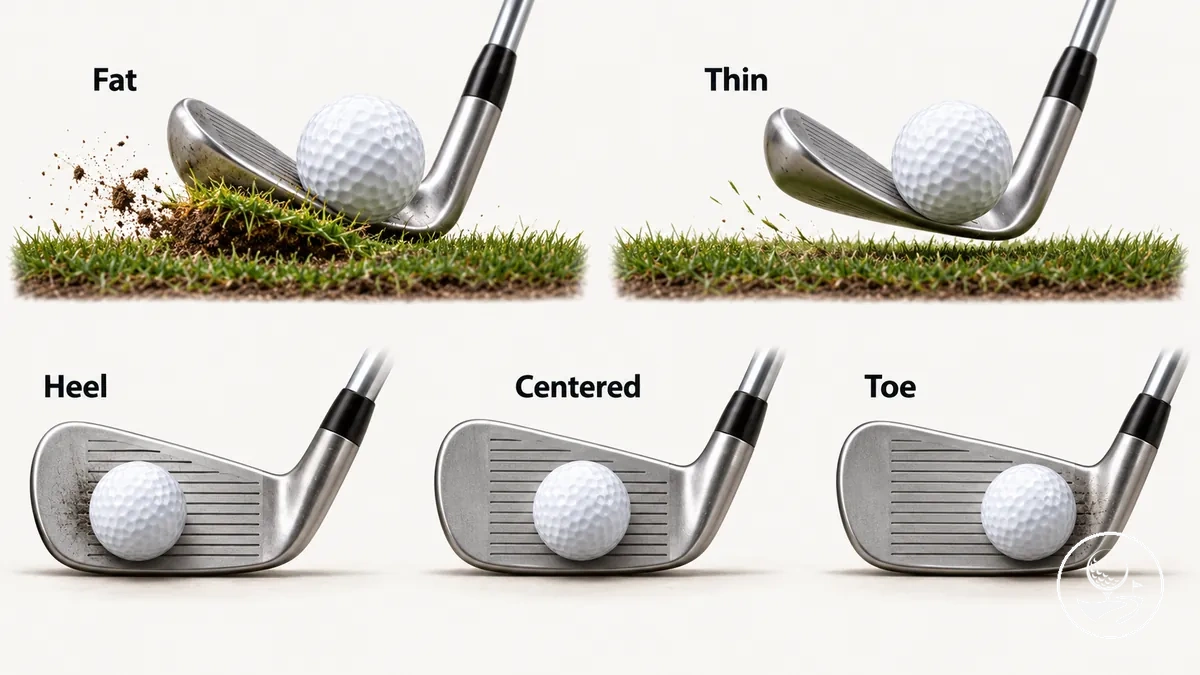
- Fat contact: the club reaches the ground before the ball, producing a recurring ground-first or heavy strike pattern that makes ground-contact consistency relevant diagnostic evidence.
- Thin contact: the club meets the ball with little or different turf interaction, creating a recurring thin strike that makes the ball-to-ground contact pattern worth distinguishing.
- Heel or toe contact: impact repeatedly appears toward the heel or toe rather than the centre of the clubface, showing that clubface impact location is shifting away from centred contact.
- Centred-but-variable contact: impact remains near the centre of the clubface while feel or distance changes across repeated shots, so clubface location alone does not describe the full inconsistency.
- Mixed contact: fat, thin, heel, toe, and centred contact alternate without one stable manifestation, indicating that the observable strike pattern itself is changing.
Changes in feel or distance are supporting evidence when they recur with the same contact pattern; an isolated change is less useful for diagnosis.
The repeated manifestation should be established before conclusions are drawn about what is producing it.
Why Golf Contact Becomes Inconsistent
Golf contact becomes inconsistent when the club-to-ball-and-ground relationship changes from swing to swing.
Low-point variability changes where the club reaches the ground relative to the ball, while changes in clubface impact shift strike location toward the heel, toe, or centre.
These changing impact conditions produce different contact outcomes, but they do not identify which setup or swing variable created them.
Repeatability of the delivered club is therefore more useful for diagnosis than assuming one universal swing fault.
The two main physical evidence dimensions are where the club meets the ground and where the ball meets the clubface.
The illustration separates these relationships so low-point variability and clubface impact location can be observed without assigning either pattern to one specific movement cause.
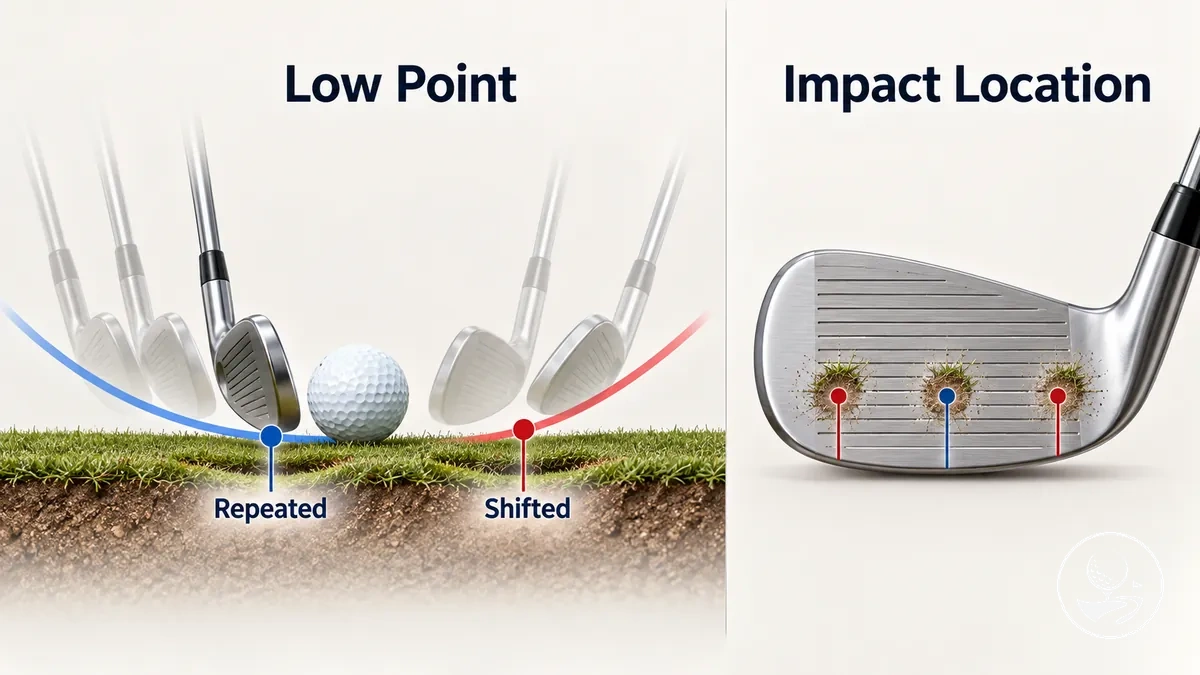
- Low-point variability: when the low point shifts relative to the ball, ball-ground interaction can change from shot to shot, contributing to different ground-contact outcomes.
- Clubface impact variability: when strike location moves across the clubface, contact can shift between centre, heel, and toe regions.
- Setup or swing variability: changes in setup, ball position, balance, rotation, timing, or other movement conditions can alter how the club is delivered, but each is a possible contributor rather than a confirmed cause without a repeated pattern.
The same visible miss can have more than one contributor.
For example, repeated fat contact may be associated with a changing low point, while the underlying reason for that change could involve setup variability, swing variability, or another delivery condition.
Diagnosis should therefore follow repeated impact evidence before a specific mechanical cause is selected.
Low-Point Variability Is a Common Cause of Fat and Thin Contact
The low point is the lowest part of the clubhead's swing arc. Its position relative to the ball helps explain turf contact, especially for an iron played from the ground.
When the low point shifts from one swing to the next, ground contact can occur earlier, later, or with less turf interaction relative to the ball.
The diagram visualizes these low-point relationships as diagnostic tendencies rather than proof of one specific body-motion fault.
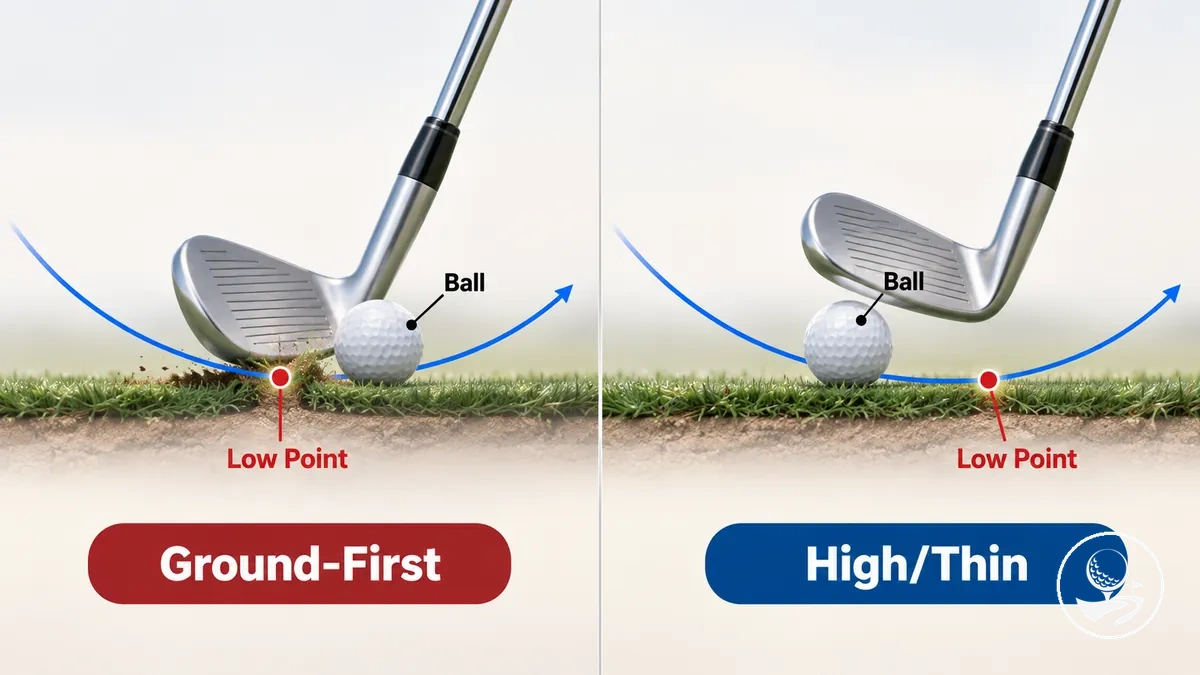
For a ball played from the turf, ground contact that repeatedly begins before the ball is consistent with ground-first, fat contact and warrants a low-point check. A turf mark offers an indirect clue: the beginning of a divot is not the exact low-point position.
By contrast, a swing delivered too high at the ball can produce a thin strike, often seen as contact low on the clubface. Thin shots may occur with little or no turf mark, so the absence of a divot alone is not enough to diagnose one.
These are diagnostic tendencies, not fixed rules for every club or lie. Ball-first, then turf is a useful reference for many iron shots from the ground; it should not be imposed on teed driver shots, where ground contact is not normally intended.
Low-point evidence can narrow the diagnosis, but it does not identify one body-motion cause by itself.
Setup and Swing Variability Can Shift the Strike Pattern
Setup and swing variability can shift the strike pattern when changes in address conditions or swing motion alter how the club is delivered relative to the ball.
Before the swing: setup
Differences in ball position, posture or spacing change the starting relationship between the golfer, club and ball.
During the swing: delivery
Differences in balance, rotation or timing may change how the club returns and where contact occurs.
The diagnostic issue is repeatability, not whether one setup or swing shape matches a universal ideal.
The illustration isolates setup variability by showing how changes in ball position or spacing can alter the clubhead-to-ball relationship without prescribing one correct pose.
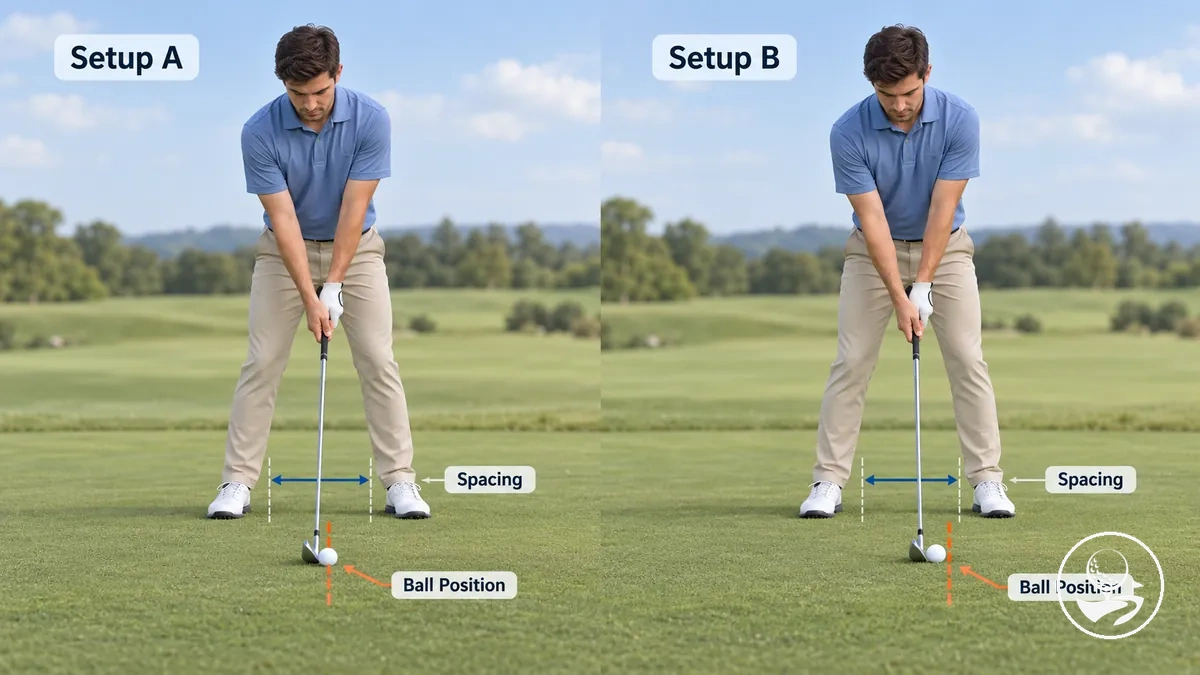
These differences may contribute to movement in the strike pattern, but a single miss does not establish which variable changed.
A repeated pattern across shots is needed before attributing inconsistent contact to one setup or movement factor, keeping the diagnosis focused on variability rather than technical correction.
How to Diagnose Inconsistent Golf Contact
Diagnose inconsistent golf contact by collecting observable strike evidence before changing swing mechanics.
Start with the contact pattern, then check ground contact and low-point evidence, clubface impact location, and whether the same pattern appears across repeated shots.
Each check adds evidence, but no single observation proves one mechanical cause.
Interpretation should come only after the strike evidence forms a repeatable pattern.
The diagnostic sequence separates observation from interpretation so an assumed swing fault does not determine the answer in advance.
The main evidence sources are the ball-and-turf contact pattern, the impact mark on the clubface, and consistency across comparable shots.
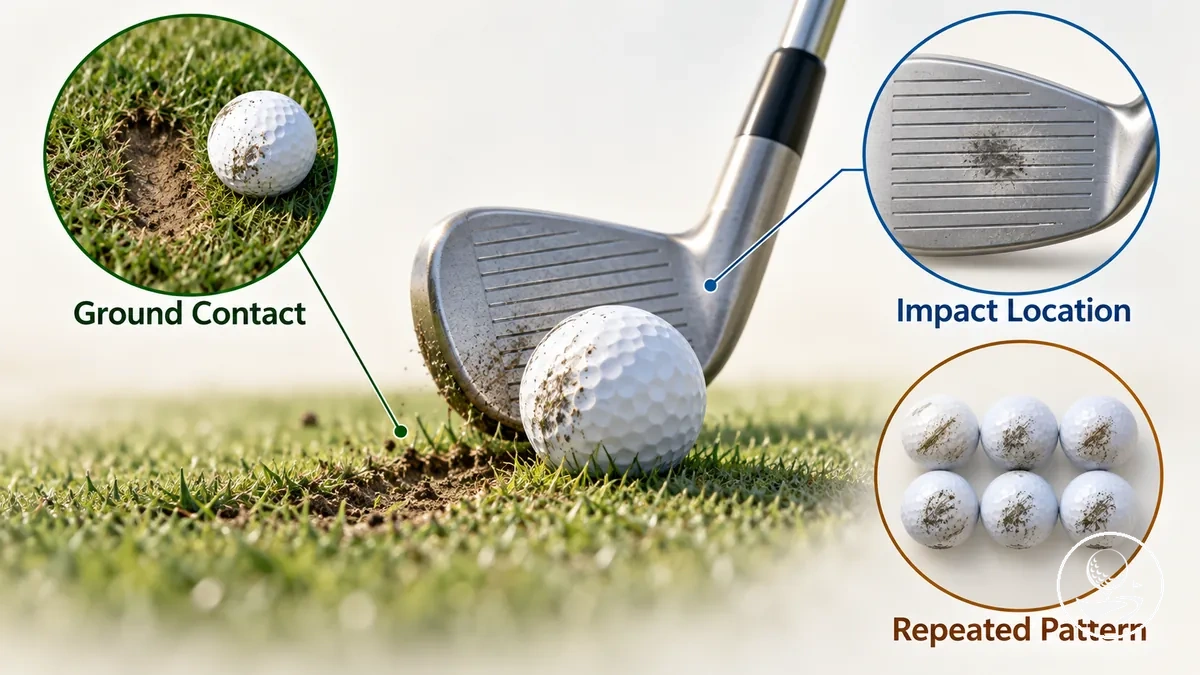 Use those observations together rather than treating one check as independent confirmation.
- Identify the recurring contact pattern: observe the type of contact that repeats and distinguish a recurring symptom from an isolated poor strike.
- Check ground contact and low point: inspect where the club interacts with the ground relative to the ball and record whether that relationship forms a repeated pattern.
- Check clubface impact location: inspect whether impact marks tend to appear near the centre, heel, toe, or move between locations across shots.
- Confirm the evidence across repeated shots: compare shots made under similar conditions and look for consistency in the contact pattern, ground contact, and clubface impact location before drawing a conclusion.
- Interpret the combined pattern: use the repeated evidence to narrow the likely cause class while keeping the interpretation conditional rather than treating it as proof of a specific swing fault.
The checks refine the diagnosis by combining signals rather than allowing one result to stand as proof.
When the evidence is mixed or does not repeat, the appropriate next action is to gather more comparable strike evidence rather than apply a mechanical fix.
Check Where the Low Point Falls Relative to the Ball
Assess the low point by observing where ground contact occurs relative to the ball position on comparable shots.
Ground contact that repeatedly begins before the ball is consistent with an earlier low point, while contact that occurs after the ball indicates that the club reaches the ground later in the swing arc.
For relevant iron shots, a repeated ball-then-turf pattern can therefore provide useful low-point evidence.
Keep the interpretation tied to the club, lie and intended shot. On a practice mat, turf-divot location is unavailable; use appropriate strike-feedback equipment or supervised observation rather than assuming the ball flight shows exactly where the arc bottomed out.
Use repeated shots under similar conditions to decide whether the ground-contact relationship is stable enough to interpret.
A single turf mark can describe one strike, but it does not confirm a persistent low-point pattern.
The following checks separate observable ground-contact evidence from the implication drawn from it.
- Locate the ground mark: note whether the turf mark begins before the ball, near the ball position, or after the ball.
- Check repetition: determine whether the same ground-contact location appears across repeated shots rather than relying on one mark.
- Keep conditions comparable: compare shots with a similar club, lie, ball position, and intended shot type because these conditions can change the observed ground-contact pattern.
- Interpret the pattern: repeated ground-first evidence suggests an earlier low point relative to the ball, while a stable ball-then-turf pattern is consistent with the low point occurring farther forward for that type of shot.
Check Where Impact Occurs on the Clubface
Read the impact marks
- Near the face centre
- The shot made approximately centred contact; one mark does not show whether that location is repeatable.
- Heel or toe cluster
- Repeated marks on one side show a horizontal impact bias, which may invite a check of spacing, balance or club delivery.
- High or low cluster
- Repeated marks above or below the usual strike area show a vertical bias; compare delivery and shot conditions.
When a mark is difficult to see, use club-appropriate impact tape or another face-safe marking method. Compare several similar shots.
The location of one mark is observable evidence, but repeatability determines whether it represents a useful diagnostic pattern.
These patterns can narrow the diagnosis because the strike location remains biased in a recognizable direction across comparable shots.
However, clubface impact location alone does not identify the exact setup or swing fault responsible for the pattern.
Treat the repeated impact marks as diagnostic evidence to interpret alongside other strike information rather than as a complete mechanical diagnosis.
Separate Strike Location From Clubface Direction
Strike location and clubface direction are different impact variables and should be diagnosed separately.
Strike location describes where the ball contacts the clubface, such as a centred strike or an off-centre strike, while clubface direction describes the face orientation at impact.
Confusing the two can lead to a wrong conclusion about contact quality because shot direction and curvature can change even when the impact location is centred.
The comparison below separates what each variable shows from what it cannot establish on its own.
| Variable | What You Observe | What It Mainly Informs | What It Does Not Prove |
|---|---|---|---|
| Strike location | Impact location on the clubface, such as centre, heel, or toe | Where contact occurred on the face and whether the strike was centred or off-centre | The exact face orientation, shot direction, curvature, or mechanical cause |
| Clubface direction | Where the face is oriented at impact | The directional component of the shot, including start direction in combination with other impact conditions | Whether the strike occurred in the centre, heel, or toe of the clubface |
| Club path | The direction the clubhead is travelling through impact | Directional context for interpreting curvature and the face-to-path relationship | The quality or location of contact on the clubface |
A centred strike can still produce a shot that starts or curves off line when face orientation and club path create a different directional pattern.
Likewise, an off-centre strike can occur with a shot direction that does not reveal the impact location by itself.
Clubface direction and club path therefore help interpret ball flight, while strike location remains separate evidence about contact quality.
Directional misses do not automatically diagnose the quality or location of contact.
Confirm the Pattern Across Several Shots
Confirm a repeated strike pattern by comparing evidence across repeated shots rather than judging one swing.
A recurring tendency is more informative under comparable conditions. Make a short run of shots with a similar club, lie and intention, then extend the observation if results are scattered; no single shot count proves a lasting swing fault.
Look for consistency in the contact category, ground contact, and impact location without treating a short shot sample as definitive evidence of an enduring swing issue.
Use the following checks to keep the observations comparable before interpreting the pattern.
- Club and shot intention: use the same or a comparable club and keep the intended shot similar so changes in task do not obscure the recurring tendency.
- Contact category: record whether the same general contact category keeps appearing or whether the results vary from shot to shot.
- Ground-contact location: note whether the observed ground contact forms a recurring pattern under the comparable conditions.
- Clubface impact location: compare the impact location across shots and look for a consistent strike cluster rather than one isolated impact mark.
Interpret the observations as a cluster: consistency across the checks supports a more stable pattern, while mixed results indicate greater variation.
The pattern is more useful diagnostically when the contact category, ground contact, and impact location recur while the club, lie, and shot intention remain reasonably comparable.
Even then, the observations support further interpretation rather than certainty about one lasting swing issue.
A stable pattern justifies examining its likely implications, whereas noisy results call for more observation before assigning a cause.
What Different Strike Patterns Suggest About the Cause
A repeated strike pattern can narrow the likely cause class, but it does not prove one mechanical cause.
Repeated evidence matters because a recurring contact pattern provides a stronger diagnostic signal than an isolated strike.
Patterns such as fat, thin, heel, toe, or mixed contact can therefore support a diagnostic direction without identifying an exact fault.
The same visible pattern can still result from more than one contributing condition.
Mostly Fat Contact
Fat contact: evidence before correction
- Repeated sign
- The club meets the turf before the ball across comparable ground-played shots.
- Likely focus
- The ground-contact and low-point relationship, rather than a guessed movement fault.
- Next test
- Check ball position and ground-contact location under the same setup and club conditions.
- Not established
- Which posture, setup or swing-motion detail caused the early ground strike.
A repeated fat contact pattern may reflect variability in the low point, while setup variability or motion variability can be possible contributors to how the club reaches the turf.
Those contributors remain hypotheses until the same evidence persists under comparable conditions and the relevant setup or delivery variable is checked.
An occasional heavy strike among otherwise different contact outcomes is weaker evidence and should not be treated as the same diagnostic pattern.
Mostly Thin Contact
Mostly thin contact is a repeated pattern in which the club meets the ball higher on its surface than intended, often with limited or inconsistent ground contact.
Strike height and turf interaction together provide the observable evidence for distinguishing a recurring thin strike from an isolated miss.
When the pattern repeats, it may suggest that the low point or club delivery is varying relative to the ball.
That implication narrows the diagnosis without establishing one mechanical cause.
Thin contact is not the same as a topped shot
Thin strike
The leading edge or low part of the clubface meets the ball higher than intended; the shot can still get airborne.
Topped shot
The club meets the ball farther up its surface, often producing a ball that travels low or rolls. Repeated topping warrants separate troubleshooting.
Mostly Heel or Toe Contact
Mostly heel or toe contact indicates a repeated horizontal impact-location bias on the clubface rather than a pattern defined only by ground contact.
Repeated heel contact places impact marks toward the heel relative to centre contact, while repeated toe contact places them toward the toe.
When the same location recurs across comparable shots, the repeated bias provides stronger diagnostic evidence than one off-centre strike.
The comparison applies the same evidence criteria to both patterns so possible spacing or delivery implications are not mistaken for confirmed causes.
| Pattern | Repeated Impact Evidence | Possible Implication | What It Does Not Prove |
|---|---|---|---|
| Heel-biased contact | Impact location repeatedly appears on the heel side of the clubface rather than near centre contact | May suggest a recurring change in spacing, posture, balance, or club delivery | One specific setup or swing fault |
| Toe-biased contact | Impact location repeatedly appears on the toe side of the clubface rather than near centre contact | May suggest a recurring change in spacing, posture, balance, or club delivery | One specific setup or swing fault |
Heel-biased and toe-biased patterns therefore differ in where the impact mark repeatedly appears, not in having a guaranteed mechanical explanation.
Spacing, posture, balance, and delivery are possible contributors that require confirmation from other evidence before one is treated as the likely cause.
A stable heel-side or toe-side cluster supports a more focused diagnosis, whereas impact marks that scatter between heel and toe do not establish the same repeated bias.
Random heel-and-toe scatter is better treated as broader strike variability than as evidence of one stable face-location pattern.
Mixed Contact With No Stable Pattern
Mixed contact with no stable pattern—such as fat, thin, heel, and toe strikes alternating across comparable shots—suggests broader variability before it suggests one isolated contact fault.
The immediate diagnostic issue is whether the golfer can produce sufficiently repeatable conditions for a clearer pattern to emerge.
Setup repeatability, balance, timing, or changing swing intentions may contribute to the variability, but none should be treated as a confirmed cause from noisy evidence alone.
The next priority is to simplify what changes between shots and then observe the contact evidence again.
- Keep setup conditions repeatable: use a consistent ball position, stance relationship, and comparable shot conditions so setup variability is easier to separate from the strike result.
- Use one consistent swing intention: avoid changing the intended motion or shot from one attempt to the next, because changing intentions can add another source of variability.
- Re-check the evidence: observe ground contact and clubface impact location again to see whether the scattered results begin forming an emerging pattern.
- Interpret only after recurrence appears: narrow the diagnosis when one contact tendency starts repeating rather than assigning a cause while the strike pattern remains mixed.
A scattered pattern does not make diagnosis impossible; it means the evidence is not yet stable enough to support a specific mechanical conclusion.
If setup repeatability, balance, timing, or intention changes continue between shots, they remain possible contributors rather than confirmed causes.
Once ground contact and impact location begin recurring in a recognizable way, the diagnosis can become more specific.
Until then, simplification and further observation are more appropriate than experimenting with multiple mechanical corrections.
Correction Priorities After the Cause Is Identified
The first corrective priority should target the best-supported likely cause, one variable at a time.
If setup evidence is unstable, stabilize setup before changing swing fundamentals; if setup is repeatable and the strike evidence points to delivery, address the relevant swing-contact fundamental instead.
This keeps each adjustment tied to the diagnosis and makes its effect easier to evaluate.
The correction is a testable next action, not a promise of immediate consistency.
Use the symptom, likely cause, confirming check, and corrective direction as one troubleshooting sequence so several variables are not changed at once.
Setup repeatability or the relevant swing-contact evidence should determine which variable is tested first.
After the adjustment, re-check the strike pattern before deciding whether another change is justified.
- Name the recurring symptom: identify the dominant strike pattern that has repeated often enough to justify a specific diagnostic direction.
- Select the best-supported cause class: decide whether the evidence points first to unstable setup, a swing-contact fundamental, or another previously identified contributor.
- Use a confirming check: verify that the relevant setup or contact evidence still supports that likely cause before making an adjustment.
- Make one correction and re-check: change one variable at a time, then compare the new strike pattern with the original evidence before deciding whether another adjustment is justified.
If a persistent pattern does not respond as expected, or if conflicting evidence appears, return to further diagnosis rather than adding unrelated changes.
Reassessment determines whether the original corrective priority remains supported or whether a different cause class needs to be tested.