
Common Golf Mistakes Beginners Make
Common beginner golf mistakes include inconsistent grip, alignment or ball position, uncontrolled swing effort, aimless or one-sided practice, and overly difficult club or shot choices and poor on-course awareness. A single bad shot does not establish a fault: look for the same observable issue under comparable conditions. Correct one controllable habit at a time, then reassess before making another change.
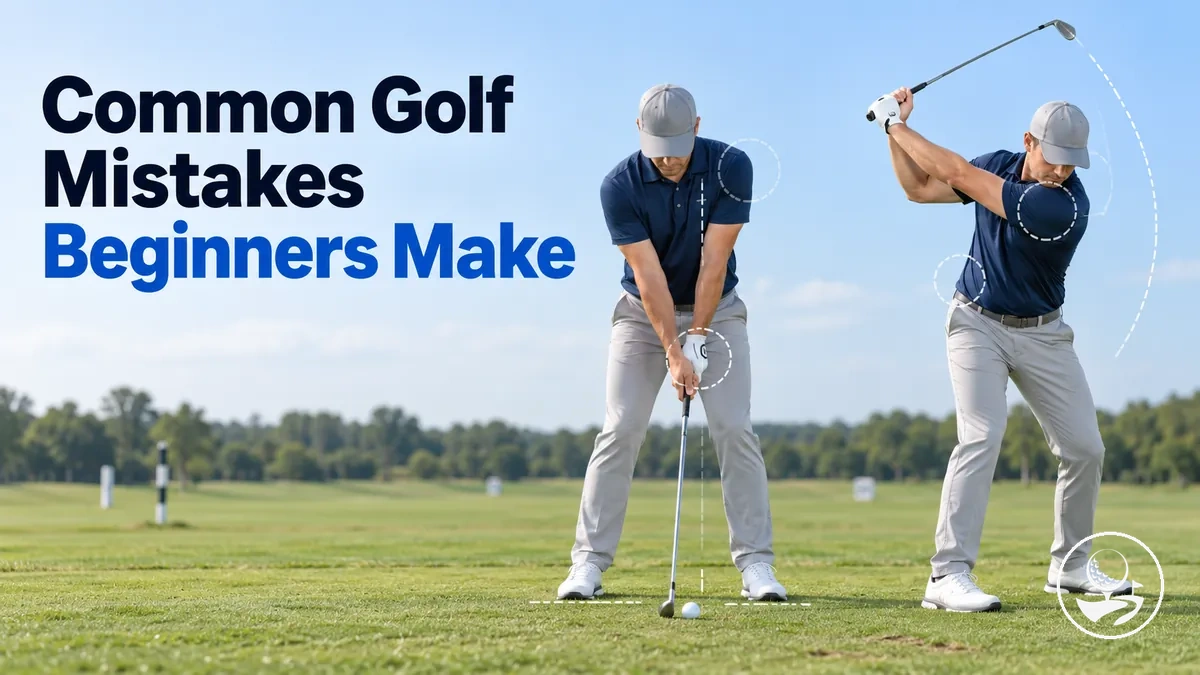
An observation-based guide
Find the mistake to check first
Choose an observation below to reveal a relevant first check and a next step. These are checks, not diagnoses: the same poor shot may have different causes.
At address My setup or shot direction keeps changing
- Check
- Compare grip pressure and placement, clubface and body aim, and ball position for the club and intended shot.
- Next step
- Look for a recurring mismatch in comparable setups; adjust one reference at a time, rather than guessing from ball flight alone.
During the swing I swing harder and lose balance or control
- Check
- Notice the transition, grip tension, balance at the finish and whether strike quality changes as effort increases.
- Next step
- Return to an effort level you can control and compare several swings. Swing speed alone is not proof of excessive effort.
During practice I hit balls but cannot tell what improved
- Check
- Is there one target skill, an observable cue and a consistent way to review the result?
- Next step
- Give the next attempts one purpose and useful feedback. Include putting, chipping or different targets when those skills need work.
On the course My club or shot choice makes the next shot harder
- Check
- Consider required carry, the current lie, how reliably you strike the chosen club, and whether the playing area is safely clear.
- Next step
- Choose a more manageable target or recovery when the difficult option relies on an unusually good strike; keep safety and pace in view.
Before correcting anything Was this one bad shot or a repeated habit?
- Check
- Does the same observable behaviour recur when the intention and relevant conditions are broadly similar?
- Next step
- If it recurs, try one proportionate cue and reassess the same result. If it is isolated or unclear, keep observing rather than making several changes.
Decision rule: Repeatable observations justify a closer check; they do not, by themselves, confirm a single underlying cause.
Table of Contents
Setup and Swing Mistakes That Reduce Consistency
Repeatable setup errors and swing mistakes can reduce consistency when the same pre-swing or movement pattern keeps influencing strike quality or direction.
A single poor shot, however, is not enough to diagnose a fault because contact can vary from one swing to the next.

- Before the swing: setup
- Compare grip pressure and placement, alignment and ball position with the selected club, target and intended shot. A recurring direction or contact pattern after a similar setup is a reason to examine the setup again.
- During the swing: movement
- Look for repeatable changes in tempo, effort, balance and tension. If poorer strikes repeatedly coincide with these changes, examine the movement without assuming tension or tempo is the only cause.
The same behaviour and miss appearing under similar conditions is a stronger cue than one isolated strike.
Comparing several shots made with similar intent and conditions helps separate repeatable behaviour from random variation.
Recognition should come before correction: identify the recurring setup or swing pattern first, then address the specific error in its relevant context.
Grip, Alignment and Ball-Position Errors
Grip pressure and grip placement, alignment and ball position are pre-swing conditions that can influence contact or direction before the club starts moving.
Each can be checked through a visible or felt cue at address rather than inferred from one poor shot.
Appropriate alignment and ball-position references can change with the club and intended shot, so the useful check is whether the setup matches the shot being attempted.
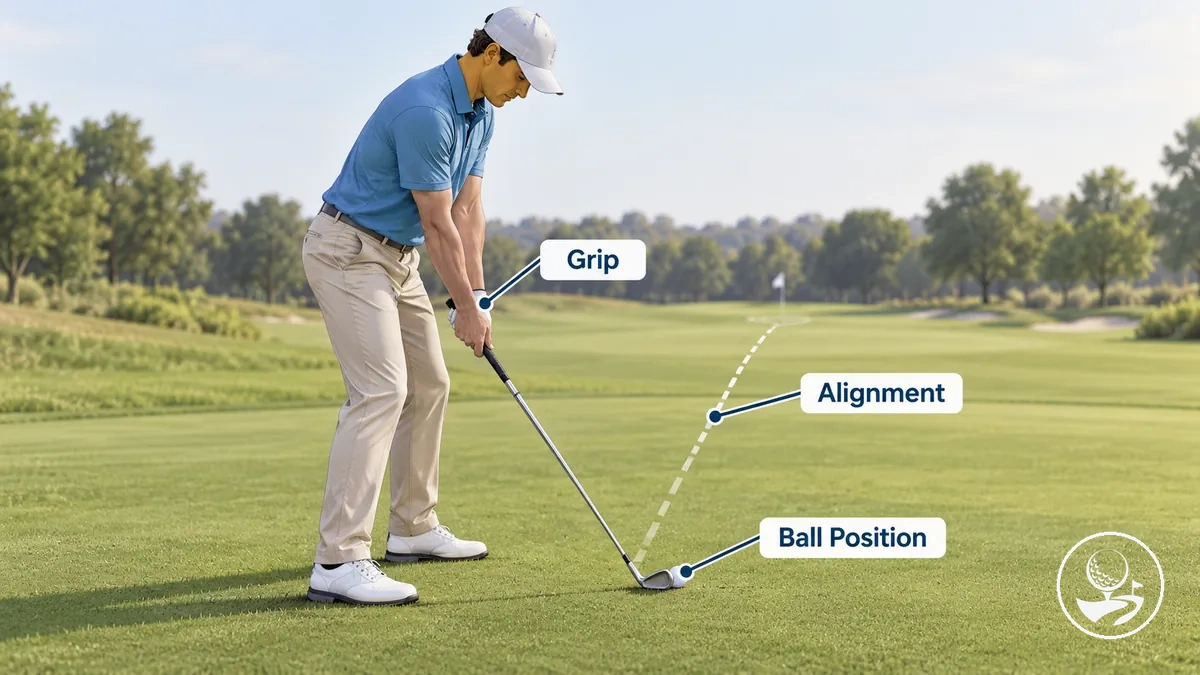
- Grip pressure and grip placement: A hold that feels excessively tight or sits awkwardly in the hands is a cue to check how the club is being held. Excess pressure or unsuitable placement may interfere with comfortable club control, so adjust the hold while avoiding the assumption that one contact pattern proves a specific grip error. A useful grip feels secure without needing a rigid squeeze; keep enough control of the club that your wrists and forearms are not unnecessarily braced.
- Alignment: Feet, body or club aimed differently from the intended target line provide a visible cue that the setup direction may not match the shot intention. That mismatch can influence starting direction, so compare the clubface and body references with the chosen target line and correct a repeatable misalignment. For a simple straight-shot setup, the clubface points towards the intended starting line while the body is aligned broadly parallel to it; an intentionally curved shot may call for a different setup.
- Ball position: A ball positioned unsuitably within the stance for the club and intended shot is a cue that the pre-swing contact conditions may be mismatched. Because ball position can alter where the club meets the ball in its swing path, adjust the position for the shot being attempted rather than using one universal reference for every club. For a typical shot from a level lie, short irons are commonly played nearer the middle of the stance, while a teed-up driver is generally played farther forward near the lead heel. The club, lie and intended flight can change the reference.
Swinging Too Hard or With Too Much Tension
Excessive swing effort and muscular tension can interfere with tempo, sequencing, balance and centred contact when a beginner tries to create more distance.
The problem is not swing speed itself; it is uncontrolled effort that reduces control of the motion or strike.
Tension may also make an otherwise coordinated swing feel hurried or restricted.

- Loss of balance: stepping, falling toward the ball or struggling to hold the finish can suggest that effort is exceeding the golfer's ability to control the motion.
- Hurried transition: an abrupt change from backswing to downswing can indicate that the golfer is forcing effort rather than maintaining controlled sequencing.
- Tight grip pressure: noticeable tension in the hands and forearms can accompany excessive effort and may restrict free movement of the club.
- Inconsistent strike pattern: contact that becomes less centred as effort increases can be a cue to compare controlled swings with harder attempts, without assuming effort is the only possible cause.
A fast swing can still be controlled, balanced and well sequenced, so speed alone does not identify this mistake.
Excessive effort is more useful to examine when cues such as balance loss, a hurried transition, tension or poorer contact repeatedly appear as the golfer tries to swing harder.
The corrective direction is to regain controllable effort and balance rather than simply trying to swing slowly.
Practice Mistakes That Slow Improvement
Beginner golf practice can slow improvement when repetition has no clear goal, useful feedback or enough skill variety to show what is changing.

- Repetition that supports learning
- Choose a defined skill, make an attempt, observe a relevant result, and use that feedback to decide what to check on the next attempt.
- Repetition without useful feedback
- Hitting balls without a defined task makes it difficult to tell whether a change helped, made no difference or simply repeated an error.
The number of balls hit is not a substitute for a clear practice purpose and interpretable feedback.
Repeating the same full-swing pattern without useful feedback can reinforce an error, while neglecting putting, chipping or other short-game work may limit skill variety.
Useful repetition therefore combines purpose, feedback and appropriate coverage without requiring one universal routine or fixed practice schedule.
Practising Without a Clear Goal
Practising without a clear goal makes feedback difficult to interpret because the golfer has not defined what the repetition is meant to train or what change should be observed.
A usable practice goal identifies one target skill and a way to recognise whether the intended behaviour occurred, rather than relying on repeated shots alone.

- Target skill: Define one skill or behaviour for the session so each repetition has the same practice focus.
- Observable cue: Choose something that can be seen or felt during the attempt, such as the ball starting on the intended line or the intended contact pattern occurring.
- Simple success measure: Use a result that helps evaluate the chosen skill under the current practice conditions, without assuming one universal numeric target applies to every golfer or task. For example, a start-line drill checks where the ball begins, while a putting-pace drill checks where it finishes relative to the intended stopping area.
- Reassessment condition: Pause and review the feedback when the result repeatedly differs from the intended cue, or when the current measure no longer helps explain what is happening.
A defined practice goal turns repetition into a focused learning task because each attempt can be compared with the same objective and feedback signal.
Random repetition makes that comparison harder, while a single-session focus allows the golfer to decide whether the practice produced interpretable feedback without expanding the session into a complete practice schedule.
Neglecting Short-Game and Varied Skill Practice
Practice variety matters because repeatedly practising only one familiar shot type can leave other skills underdeveloped and make skill transfer to changing course situations harder.
Full swing, putting, chipping and varied targets or lies provide different practice conditions, so coverage should reflect the golfer's current needs rather than a fixed percentage split.
- Full swing: Full-swing practice develops contact and distance control toward a target, but concentrating on it alone does not expose the golfer to the different demands of the short game.
- Putting: Putting practice develops awareness of pace and start line on the green, providing a different feedback task from longer shots.
- Chipping: Chipping practice develops control of contact and landing area for short-game recovery situations without requiring the same motion or distance as a full swing.
- Varied targets and lies: Changing targets, distances or lies exposes the golfer to different conditions and supports adaptation and skill transfer beyond one repeatedly practised shot.
The useful mix depends on the golfer's current weaknesses and available practice context rather than a universal allocation.
Common Non-Swing Mistakes Beginners Overlook
Non-swing beginner mistakes often come from club choice, etiquette, awareness and simple course decisions rather than from swing technique itself.
- Club and shot suitability
- If required carry or launch is unreliable with the chosen club from the current lie, look for a more manageable club, target or recovery.
- Awareness, safety and pace
- Check where others are before playing, keep a safe hitting area and be ready when it is appropriate to play.
- Risk of the next shot
- If an attempted shot has little margin for error or a difficult recovery, consider a safer line or simpler option.
A golfer can make the hole harder without making a faulty swing. No single decision is best in every situation: the lie, obstacle, playing conditions and present consistency all matter.
These behaviours matter because they affect play beyond technique, while detailed club selection, rules and course-management instruction belong in their dedicated contexts.
Using Clubs That Add Unnecessary Difficulty
A club choice can add unnecessary difficulty when the club or shot option demands more reliable contact, carry or launch than the golfer's current strike consistency supports in that shot condition.
Suitability therefore depends on both what the shot requires and how confidently the golfer can produce the needed result, rather than on brand, price or one universally correct club.
- Required carry: If the shot requires the ball to carry an obstacle or reach a specific area, consider whether the chosen club can produce that carry with the golfer's usual strike rather than only with an unusually good one. When the carry required to clear trouble exceeds the distance the golfer can produce reliably in those conditions, choosing a safer landing area is usually preferable to relying on an exceptional strike.
- Launch difficulty: A more demanding club or shot may require a launch that the golfer does not yet produce consistently from the current lie or situation, increasing the difficulty of completing the shot as intended. A shorter, more lofted option may be easier to launch and control than a longer, lower-lofted club when the lie and required distance allow it.
- Forgiveness: When strike location varies, a club choice with less tolerance for imperfect contact may make the outcome less predictable, so forgiveness should be considered in relation to the golfer's current strike consistency.
- Confidence and strike consistency: A club that the golfer can strike predictably under the current conditions may be more suitable than an option that creates doubt or depends on unusually precise contact.
A simpler option can be more suitable when it better matches the shot condition and the golfer's current consistency, without implying that one club is correct in every situation.
Ignoring Basic Etiquette and Simple Course Decisions
Etiquette and simple course decisions can create problems even when swing mechanics are not the main issue.
Poor awareness can affect safety or pace of play around other players, while an unnecessarily difficult shot choice can increase risk and shot difficulty.
The useful distinction is between behaviour that affects the group and decisions that make the golfer's own next shot harder.
- Etiquette and safety: Maintain awareness of other players before playing a shot or moving into an area where someone may be preparing to hit, because position and attention can affect safety. Wait until players ahead are safely out of range; shout “Fore!” promptly if an errant ball may endanger someone.
- Etiquette and pace: Being ready to play when it is appropriate can help maintain pace of play, while unnecessary delays may slow the group depending on the situation.
- Shot decisions: A shot with a narrow margin for error or a difficult recovery consequence can increase risk when a more manageable option is available.
- Recovery options: After a poor shot, consider whether the next attempt creates unnecessary difficulty or whether a simpler recovery option offers a more manageable route back into play.
These cues are broad awareness and decision principles rather than a full rules or course-strategy system, and the suitable choice still depends on the immediate situation.
When a Beginner Mistake Is a Habit Rather Than a Shot-Specific Problem
A beginner mistake is more suggestive of a habit when the same observable behaviour recurs under comparable conditions, while one poor shot is insufficient evidence of a repeatable problem.
Recurrence can indicate a pattern, but it does not by itself prove the underlying cause.
Start with the signal that can actually be observed, then check whether it appears again when the shot intention and relevant conditions are broadly similar.
A stable pattern across comparable situations gives more reason to examine a repeatable habit than a miss that appears only once or changes from shot to shot.
Because the same miss can arise from different causes, the pattern should guide the next check rather than be treated as confirmation.
| Signal | Check | Interpretation | Next decision |
|---|---|---|---|
| One isolated poor strike | Look for recurrence before assigning a repeatable cause. | Insufficient evidence of a habit. | Continue observing rather than diagnosing from the single shot. |
| The same behaviour recurs under comparable conditions | Compare the setup, intention and circumstances in which the pattern appears. | Suggests a repeatable habit worth checking. | Examine the recurring behaviour without assuming one specific cause. |
| A recurring contact pattern persists across similar attempts | Separate the observed contact result from assumptions about why it occurs. | Indicates that a more specific shot problem may be present. | Move to focused diagnosis of the contact pattern rather than treating it as a general habit alone. |
The next informational decision depends on whether the evidence points to a broadly repeated behaviour or to a recurring shot-specific pattern that warrants further diagnosis.
Keeping that distinction preserves uncertainty where the cause is not yet established and avoids treating a single miss as proof.
How to Correct Beginner Golf Mistakes Without Overcorrecting
Correct a repeatable error by making one proportionate change to one clearly observed behaviour, then evaluate the result before adding another adjustment.
A single corrective cue keeps the change controllable and makes later observation easier to interpret without assuming that improvement is guaranteed.
This correction method is most useful when the golfer can identify a repeatable behaviour rather than reacting to every poor shot.
Stacking several fixes at once makes it harder to tell which change influenced the result and increases the risk of overcorrection.
The sequence preserves cause-and-effect interpretability, while the detailed isolation and reassessment checks can be handled separately.
- Identify one repeatable error: Base the correction on a behaviour that has appeared consistently enough to warrant attention rather than on one isolated miss.
- Choose one proportionate corrective cue: Change one controllable cue that directly relates to the observed error instead of combining several unrelated adjustments.
- Observe comparable attempts: Watch the result under broadly similar conditions so the effect of the single change remains easier to interpret.
- Reassess before another change: Use reassessment to decide whether the observation supports keeping, adjusting or abandoning the cue before introducing another correction.
Correct One Repeatable Error at a Time
Correcting one repeatable error at a time makes feedback easier to interpret because one adjustment can be compared with the result that follows.
Isolate the recurring behaviour, apply one corrective cue and keep the observation conditions comparable rather than introducing several swing thoughts or other changes at once.
- Identify the recurring behaviour: Define the repeatable error from observation of the same behaviour rather than from one isolated poor shot.
- Choose one corrective cue: Apply one proportionate, controllable cue that relates directly to the observed error without changing other variables at the same time.
- Repeat under similar conditions: Make comparable attempts under similar conditions so the effect of the single adjustment remains easier to separate from unrelated variation.
- Observe the same outcome measure: Compare one consistent outcome measure across the attempts so the feedback remains interpretable rather than shifting the basis of evaluation.
One change may not explain every result when faults interact, so the observation should remain evidence for interpretation rather than proof of a single cause.
Reassess the Result Before Making Another Change
Reassess the result across several comparable attempts before introducing the next change, because one excellent or poor shot is weak evidence for judging a correction.
The verification should separate what remained constant from what changed so observation can distinguish a repeatable response from normal shot-to-shot variation.
- What stayed constant: Check whether the relevant setup, intention and practice conditions remained comparable enough for the results to be meaningfully reviewed.
- What changed: Confirm the changed variable was the intended correction rather than several adjustments occurring at the same time.
- Whether the original mistake recurred: Observe whether the original mistake continues to appear under comparable attempts, because recurrence provides more useful evidence than one isolated result.
- Whether a new pattern appeared: Note any recurring pattern that was not present before, as it may indicate that the adjustment changed the outcome without yet providing a clear basis for another correction.
When the evidence remains mixed, continue observation rather than adding an immediate next change.