
How to Diagnose and Fix a Golf Slice for Beginners
A golf slice curves excessively right for a right-handed golfer (left for a left-handed golfer) and is usually associated with a clubface open relative to the swing path at impact. To fix it, compare the ball’s starting direction and curvature over repeated shots, check the face, path and strike pattern, then change the specific condition responsible rather than guessing from the curve alone.
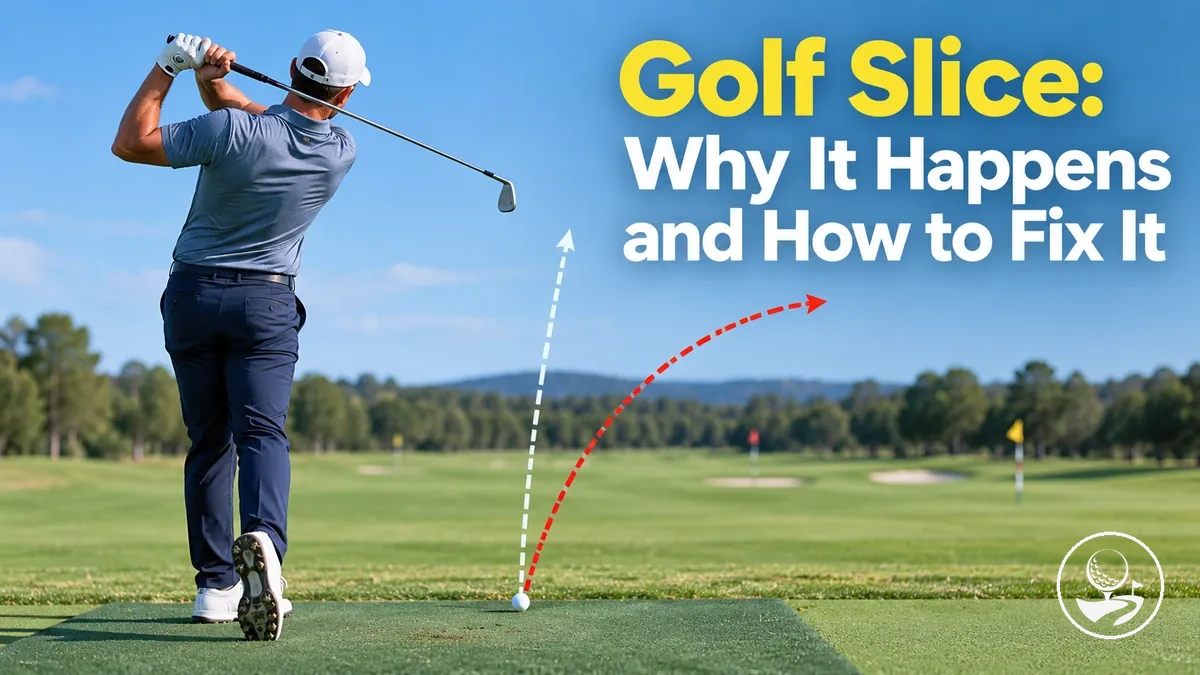
Read your slice. Choose the next check.
For a ball curving to the slice side, select your playing hand and where it first starts relative to the target. The result suggests an impact relationship, not a confirmed swing fault.
Pull slice — starts left and curves right.
- Likely face direction
- Face directed left of the target line at impact.
- Face relative to path
- Face open relative to a path farther left than the face.
- What to check next
- Check whether the path is excessively leftward and whether the face remains open to that path. Retest after one controlled adjustment.
Interpretation limit: This guide assumes a recurring slice with reasonably centred contact. Off-centre strikes—especially a heel strike with the driver—can change curvature. Use several comparable shots before choosing a correction.
Table of Contents
What Causes a Golf Slice
At impact, a conventional slice is primarily a face-to-path problem; it does not by itself identify the grip, setup or movement that produced that relationship.
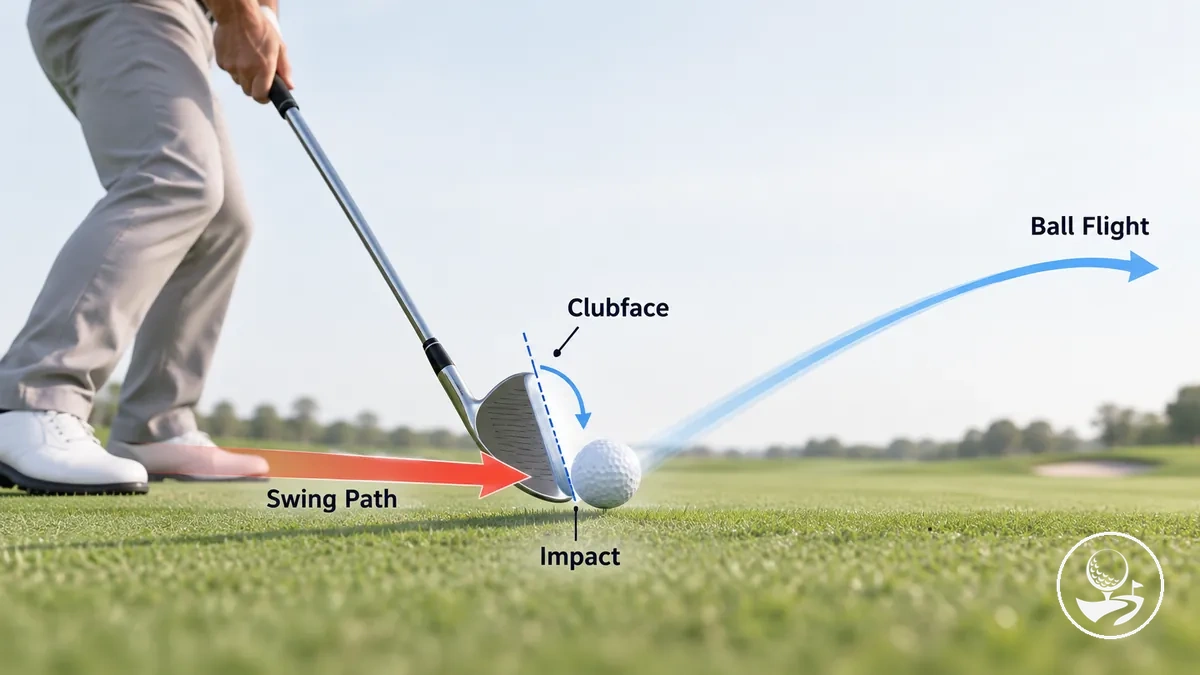
The key distinction
Impact condition
The clubface is open relative to the club path. Different combinations of face angle and path can create similar fade-side curvature.
Possible contributors
Grip, setup and swing motion can alter face delivery or club path. A grip or setup issue may leave the face open; a motion pattern may move the path farther across the face.
None of these upstream contributors, on its own, proves why an individual golfer slices.
Similar-looking slices can start on different lines because the face angle and swing path can combine in different ways.
Use ball flight to narrow the likely impact conditions, not to assume a specific grip or body-motion error.
The Face-to-Path Relationship at Impact
Face-to-path is the angle between where the clubface points and where the clubhead travels at impact; face angle is measured against the target line.
TrackMan defines Face to Path as face angle minus club path and distinguishes it from measurements referenced directly to the target line.
The impact illustration separates the target line, swing path, and clubface orientation so these directional references remain distinct.
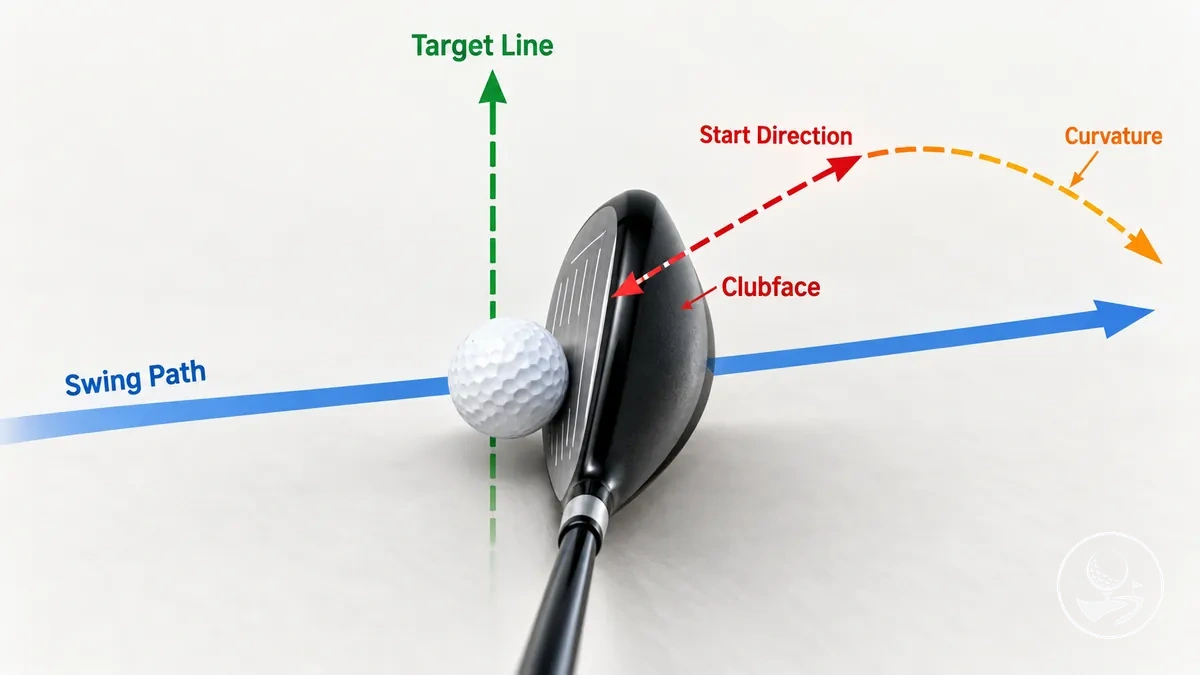
Clubface orientation relative to the target strongly influences start direction, while the face-to-path relationship is a key factor in expected curvature.
TrackMan states that, assuming centred contact, a ball with a non-zero face-to-path tends to curve toward the face angle and away from the club path.
A clubface can therefore point to one side of the target line yet still be open or closed relative to the swing path, so target-relative face position and path-relative face position are different measurements.
Strike conditions can also influence the observed ball flight, so face and path describe the main directional relationship rather than every detail of the shot.
Grip and Setup Conditions That Leave the Clubface Open
Grip and setup conditions can make an open clubface at impact more likely, but the address position does not prove how the clubface will be delivered dynamically during the swing.
Grip orientation, clubface aim, and ball position are therefore contributing conditions to inspect rather than automatic diagnoses.
The annotated setup image identifies where those three conditions are observed before the swing begins.
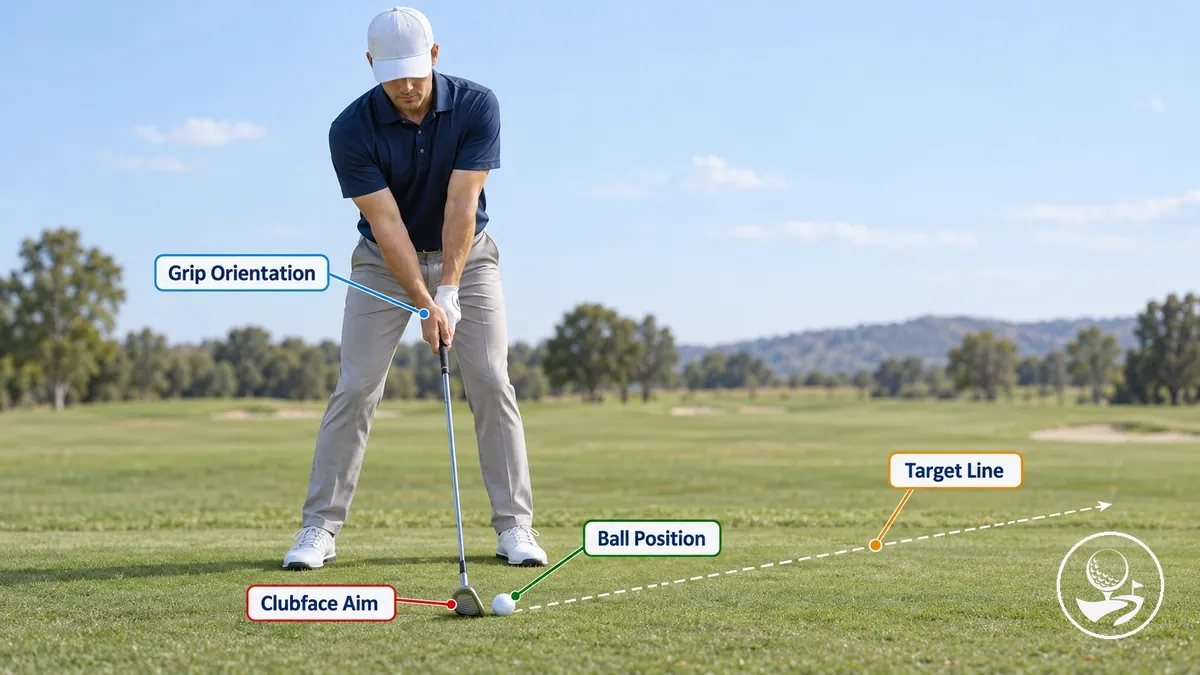
Three setup variables to check
- Grip orientation
- Can influence how the hands and wrists deliver the clubface; similar-looking grips can still produce different impact angles.
- Clubface aim
- Sets the face’s starting direction relative to the target, but the face may open or close before impact.
- Ball position
- Changes where the swing arc meets the ball; the effect on delivered face and path depends on the motion.
These address conditions are possible contributors, not diagnoses of where the clubface will point at impact.
A golfer can begin from a neutral-looking setup and still deliver an open clubface because of a dynamic swing condition.
Setup is therefore useful for identifying possible contributors, while the impact pattern provides more direct evidence of how the clubface was actually delivered.
Swing Motions That Create an Out-to-In Path
For a right-handed golfer, out-to-in means the club path travels left of the target line through impact; for a left-hander, the direction reverses.
If the clubface remains open relative to that path, the face-to-path relationship can increase fade-side curvature.
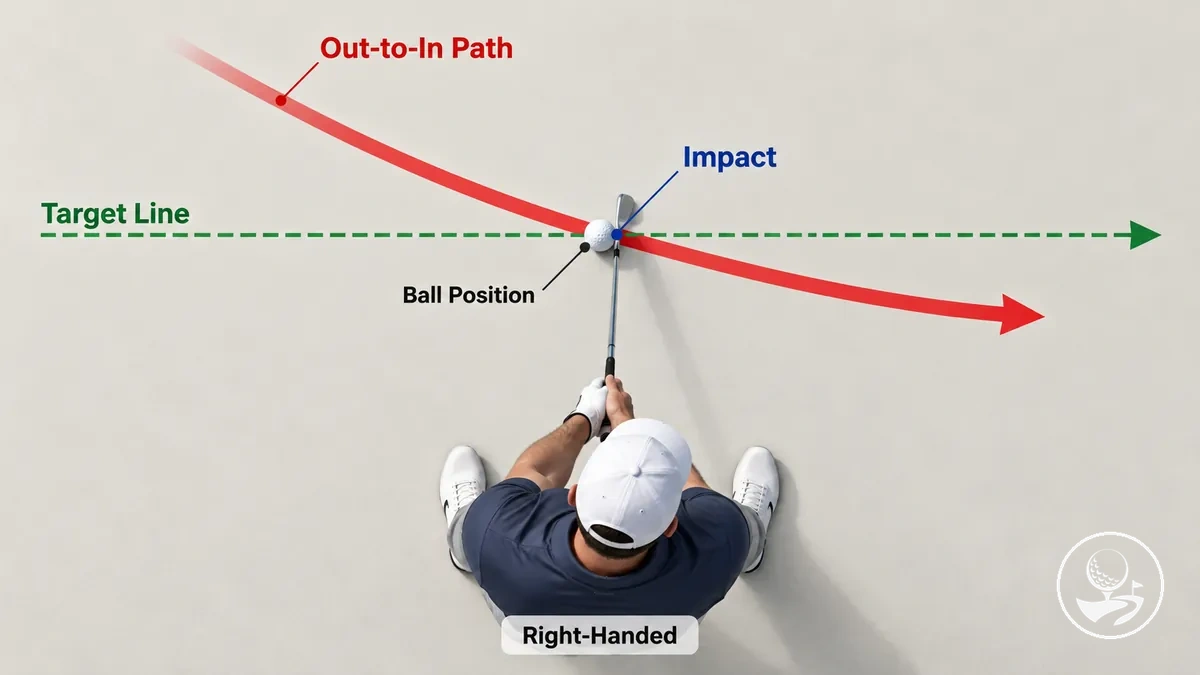
Two possible routes to an out-to-in path
Over-the-top transition
The club moves outward early in the downswing, approaches from outside the target line and continues across it through impact.
Upper-body-led transition
The shoulders and arms can send the club outward before it reaches the ball, contributing to a more across-the-ball delivery.
These motions can therefore produce a more leftward club path, but they are possible contributors rather than proof of the exact motion that created an individual golfer's path.
The same out-to-in path can produce different start directions because clubface orientation also matters: a clubface directed left of the target line can start the ball left, while a face directed right can start it right.
Path direction alone does not determine the full shot shape; curvature depends on how the clubface is oriented relative to the swing path at impact.
How to Diagnose Your Slice From Ball Flight
To diagnose a slice from ball flight, observe the start direction and curvature together before changing technique.
Start direction helps narrow the likely clubface orientation relative to the target line, while curvature helps form an interpretation of the face-to-path relationship between the clubface and swing path.
The image connects those two observable signals with the impact relationships they can suggest.
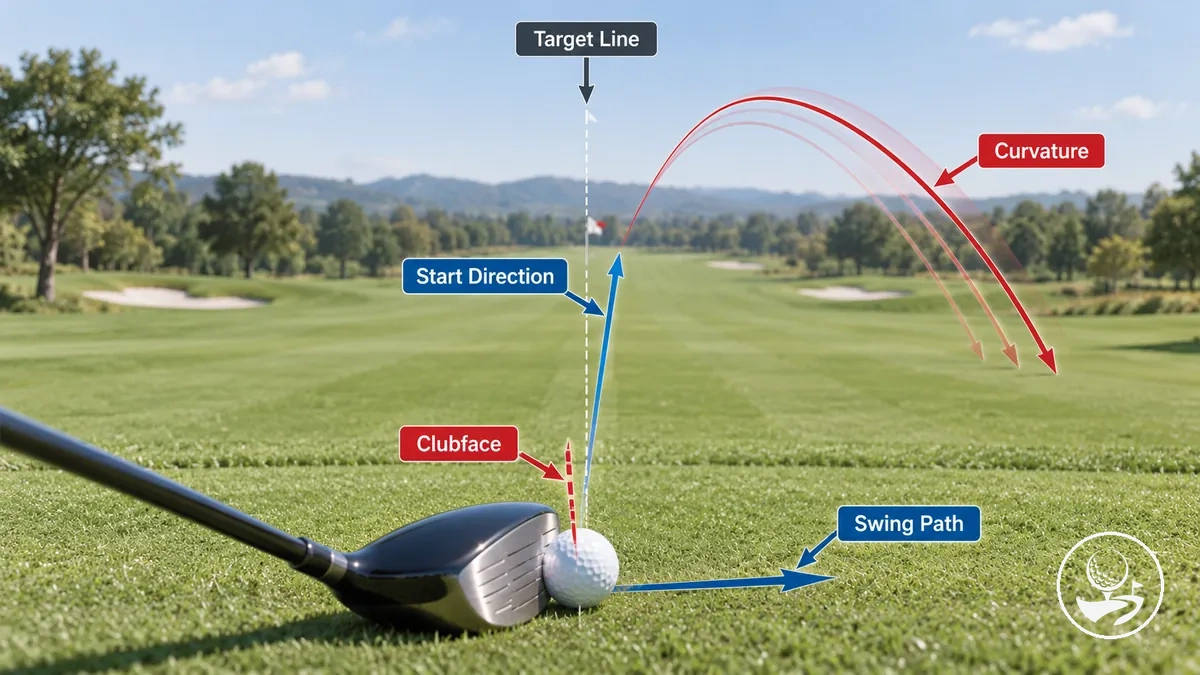
Read starting direction and curvature together; the curve by itself cannot explain the whole impact.
A change in start direction suggests checking clubface orientation relative to the target line, while a change in curvature suggests checking how the clubface is oriented relative to the swing path.
These signals suggest likely impact conditions; they do not prove one grip or swing-motion fault.
Club type can change how strongly a flight pattern appears, so compare like-for-like shots when possible.
Verify the pattern before changing your swing
- Observe several comparable shots. Note both the starting line and which way the ball curves; do not judge from one miss.
- Cross-check the delivery. When available, use slow-motion video to see whether the suspected face and path conditions recur.
- Separate contact from direction. If strike quality changes from shot to shot, diagnose contact rather than treating every miss as the same slice.
What Pull Slices and Push Slices Reveal
For a right-handed golfer, a pull slice starts left of the target line and then curves right, while a push slice starts right and continues with fade-side curvature to the right.
Both patterns are consistent with a clubface that is open relative to the swing path, but their different start direction changes the likely face and path interpretation.
For a left-handed golfer, the left-right directions reverse.
| Shot pattern | Start direction | Curvature | Likely clubface orientation | Face-to-path relationship | Likely swing path |
|---|---|---|---|---|---|
| Pull slice | Left of target | Right, fade-side | Left of the target line | Clubface open relative to the path | Path farther left than the clubface, consistent with an out-to-in tendency |
| Push slice | Right of target | Right, fade-side | Right of the target line | Clubface open relative to the path | Path left of the clubface; it may still be right, near the target line, or left of target |
The pull slice therefore suggests a leftward swing path that is even farther left than the clubface, whereas the push slice only establishes that the swing path is left of the clubface rather than fixing its exact direction relative to the target line.
These are impact interpretations, not proof of the exact swing fault or body motion that produced them.
Use repeated shots to establish the pattern before making a diagnosis, because a single miss can be unrepresentative.
The distinction is strongest when start direction and curvature recur together across several shots.
When the Driver Slices but the Irons Do Not
A driver slice with comparatively straight irons does not necessarily indicate a separate swing fault.
The same face-to-path delivery problem can appear more strongly with the driver because club length, loft, and ball position change the conditions under which the clubface and swing path reach impact.
Why the driver may show more slice
- Longer shaft
- A longer club can make small differences in clubface delivery more noticeable than with shorter irons.
- Lower loft
- With comparable delivery, lower loft can make face-to-path differences appear more pronounced in ball-flight curvature.
- More forward ball position
- The club often reaches the ball at a different point in the swing arc, potentially changing delivered face and path.
- Off-centre impact
- A heel-side driver strike can add fade-side spin through gear effect; check contact location before blaming swing path alone.
These conditions interact with the golfer's delivery; none is a sole cause of the slice.
When the driver repeatedly slices but irons fly relatively straight, compare the recurring start line, curvature and strike location for each club before treating it as a separate swing problem.
How to Fix the Slice Based on Its Cause
Slice correction should match the diagnosis rather than rely on one universal fix.
Use recurring ball flight and, where available, delivery checks to decide which variable to address first.
Match the adjustment to the confirmed condition
Face delivery
If the face stays too open: check grip, starting face aim and wrist delivery. Make a face-focused change, then watch the ball’s starting line and curve.
Club path
If the path crosses too far: rehearse a more neutral approach through impact. Retest the curve without assuming the face is now corrected.
Grip or setup
If an address condition contributes: adjust that specific grip, face aim, alignment or ball-position issue and keep the other variables stable.
For any branch, follow the same sequence: observe → check → adjust → verify.
Change one major variable at a time where practical so the effect of each correction remains identifiable.
Verification should come from repeated shots: a useful change should produce a consistent change in start direction, curvature, or both rather than relying on a single straighter shot.
Correcting an Open Clubface
Correcting an open clubface starts by checking where the face becomes open: at setup through grip orientation and initial face angle, or later through the swing into impact.
The correction should target the condition affecting face delivery rather than changing several swing variables at once.
Where does the face become open?
If it begins at address
Check grip orientation and initial clubface aim. Adjust the relevant starting condition conservatively, keeping other variables consistent.
If it opens during the swing
Check the associated wrist and hand delivery into impact. Work on the motion creating the open face rather than a last-second forced closure.
Retest comparable shots after each change: a repeatable shift in starting line and curvature is more informative than a single straight ball.
Correcting an Out-to-In Swing Path
Correcting an excessive out-to-in path means moving the club delivery toward a more neutral path through impact, not exaggerating the swing in the opposite direction.
For a right-handed player, this often means shifting a path that travels too far left closer to neutral through impact; a left-handed player makes the mirrored adjustment.
The clubface still matters because its orientation relative to the path influences the resulting ball flight and curvature.
Path-change practice sequence
- Rehearse a less across-the-ball delivery. Practise the transition that lets the club approach impact on a path closer to neutral, then make controlled swings.
- Compare ball flight. Check whether repeated starting lines and curvature change in the intended direction rather than relying on how the motion feels.
- Recheck the clubface. If the slice remains strong, see whether the face is still open relative to the revised path before making further path changes.
Verification comes from a repeated ball-flight response showing that the path adjustment has changed the shot pattern without creating an exaggerated opposite delivery.
Correcting Grip and Setup Faults That Reinforce the Slice
Change only the grip and setup faults that the earlier diagnosis shows are reinforcing the slice.
Use the same neutral reference for each check so the starting condition is repeatable before judging any change in dynamic delivery or ball flight.
- Grip orientation: Compare the current grip with the neutral reference you are using; adjust it only if its orientation is contributing to an open clubface condition.
- Clubface aim: Check whether the clubface is aimed as intended at address; correct a visibly open starting face before evaluating what happens through impact.
- Alignment: Compare body and target alignment with the intended starting line; correct a diagnosed alignment fault if it is influencing the delivered swing direction.
- Ball position: Check that the ball returns to the diagnosed neutral reference for the club being used; adjust it if the current position is changing the face or path condition being delivered.
After correcting the relevant setup variable, keep the other major conditions stable and retest the same shot pattern.
Use start direction and curvature in the resulting ball flight for verification rather than judging the adjustment from address appearance alone.
If the setup becomes repeatable but the slice pattern remains, the remaining problem is more likely to involve dynamic delivery than the corrected starting condition.
A neutral setup can support a better impact condition, but it does not by itself ensure that the clubface and path will be delivered neutrally.
Drills for Reinforcing Face and Path Changes
A slice-correction drill should reinforce the face or path change already identified by the diagnosis rather than act as a separate cure.
Choose the drill by training objective: use clubface control work when face delivery is the target, and path control work when the swing path is the target.
Choose the rehearsal by what needs to change
Face-control rehearsal
Keep setup consistent and rehearse a clubface that arrives less open. Hit a controlled shot and read the starting line and curve.
Useful sign: the intended face-related flight change appears without a new path problem.
Path-control rehearsal
Rehearse the diagnosed transition or delivery change. Hit a controlled shot and check the path-related change while monitoring face orientation.
Useful sign: the curvature changes as intended across repeated swings, not just once.
Progression means moving from the simplified rehearsal into increasingly normal practice only when the intended movement and ball flight can be reproduced.
Keep the same training objective during that progression so feedback remains attributable to the drill, then retest the full shot pattern to confirm that the reinforced change remains useful in regular practice.