
Golf Lessons vs Self-Taught Learning for Beginners
Golf lessons can be a better fit for beginners who need an instructor to identify mistakes and set clear priorities, while self-taught learning can work when a golfer can organise deliberate practice and review results reliably. A blended approach combines targeted coaching with independent practice; coaching quality, lesson access and consistency all affect the choice.
Which learning approach fits your situation?
Compare your need for feedback, your ability to organise practice and your access to lessons. The suggestion is a starting approach, not a prediction of progress.
Your starting route
Choose the three criteria above
Your feedback needs and practice habits matter more than a general claim that one learning route is always best.
Each route still requires purposeful practice and a way to check whether an adjustment is helping.
Learning needs can change: a self-directed golfer may seek feedback for a recurring problem, and a coached beginner may become more independent. Purposeful practice and useful feedback matter whichever route you choose.
Table of Contents
Golf Lessons vs Self-Taught Learning: Key Differences
Golf lessons and self-taught learning can be compared using the same beginner-learning criteria: expert guidance, feedback, learning structure, pace of progress, flexibility, financial commitment, accountability, and error recognition.
Golf lessons provide more externally supplied guidance and structure, while self-taught learning requires the golfer to manage more of these functions independently.
| Criterion | Golf Lessons | Self-Taught Learning | Why It Matters for a Beginner |
|---|---|---|---|
| Feedback access | Provides direct instructor feedback that can be personalised to observed performance. | Relies more on self-assessment, video review, peer input, or general learning resources. | Useful feedback can help a beginner identify what needs correction instead of relying only on trial and error. |
| Learning structure | Provides an externally organised learning structure and priorities through professional instruction. | Requires the learner to select information, decide priorities, and maintain a coherent learning order. | A clear structure can reduce uncertainty about what to practise next. |
| Pace dependence | Progress depends on the relevance of the coaching and how well the golfer practises between lessons. | Progress depends more heavily on choosing appropriate priorities, practising deliberately, and evaluating results accurately. | The learning route alone does not determine pace of progress; practice quality remains an important condition. |
| Flexibility | Requires instruction to fit scheduled lesson times alongside independent practice. | Allows greater control over when, where, and how often learning and practice take place. | Scheduling control can matter when a beginner has limited or changing practice time. |
| Financial commitment | Requires payment for professional instruction, with total commitment affected by local rates and lesson frequency. | Can avoid lesson fees, although practice facilities, equipment, and optional learning resources may still involve costs. | The practical difference is the type and frequency of costs each learning route requires. |
| Accountability | Can provide external accountability through scheduled sessions, agreed priorities, and instructor review. | Requires more self-directed motivation and responsibility for maintaining consistent practice. | Accountability matters when a beginner finds it difficult to maintain priorities or review progress independently. |
| Error recognition | An instructor can observe mistakes that the beginner may not recognise, although the usefulness of the correction depends on the quality and relevance of the feedback. | Requires the golfer to recognise mistakes through self-assessment or obtain useful external input from another source. | Unrecognised errors can be repeated during practice, so the ability to detect them affects the value of either approach. |
These differences matter because beginners do not all need the same balance of guidance and independence.
Expert feedback and external accountability can reduce uncertainty when a golfer struggles to recognise mistakes or choose priorities, while self-taught learning offers more flexibility when the golfer can organise practice and review results independently.
Financial commitment also changes with lesson frequency, local pricing, and the resources used for independent learning, so cost has no single universal value.
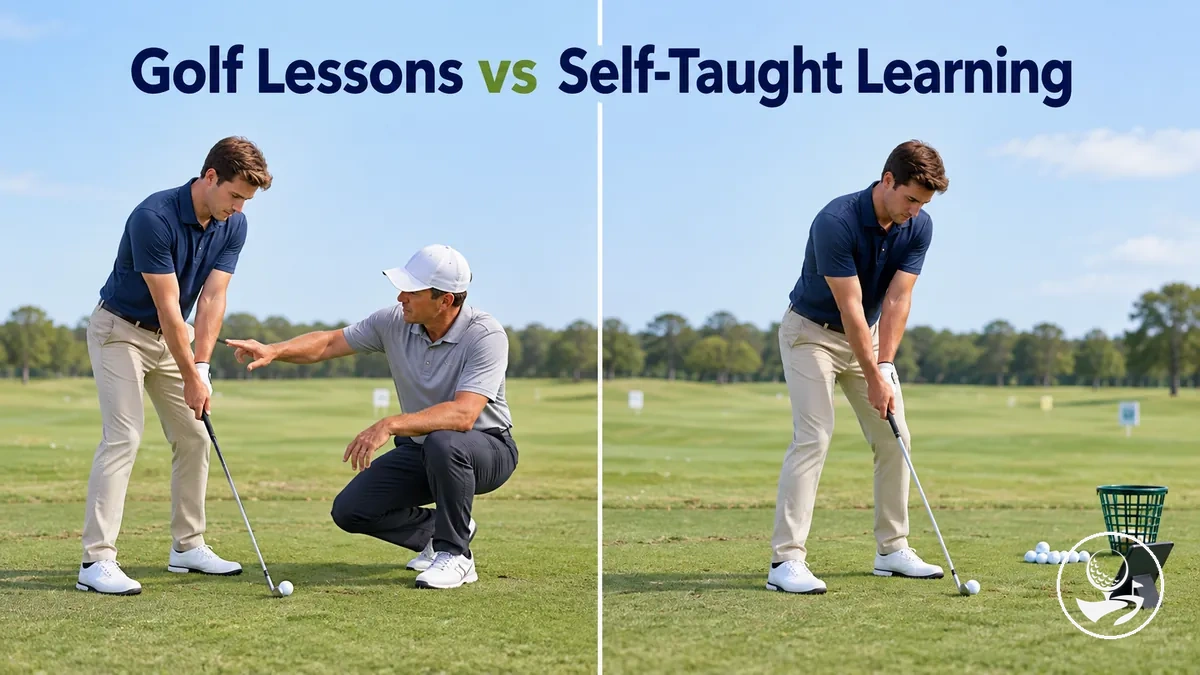
The image contrasts coached feedback and structured guidance with the flexibility and independence of self-directed practice.
It shows how responsibility for guidance and review shifts between the two learning routes without adding another comparison criterion.
Guidance, Feedback and Error Correction
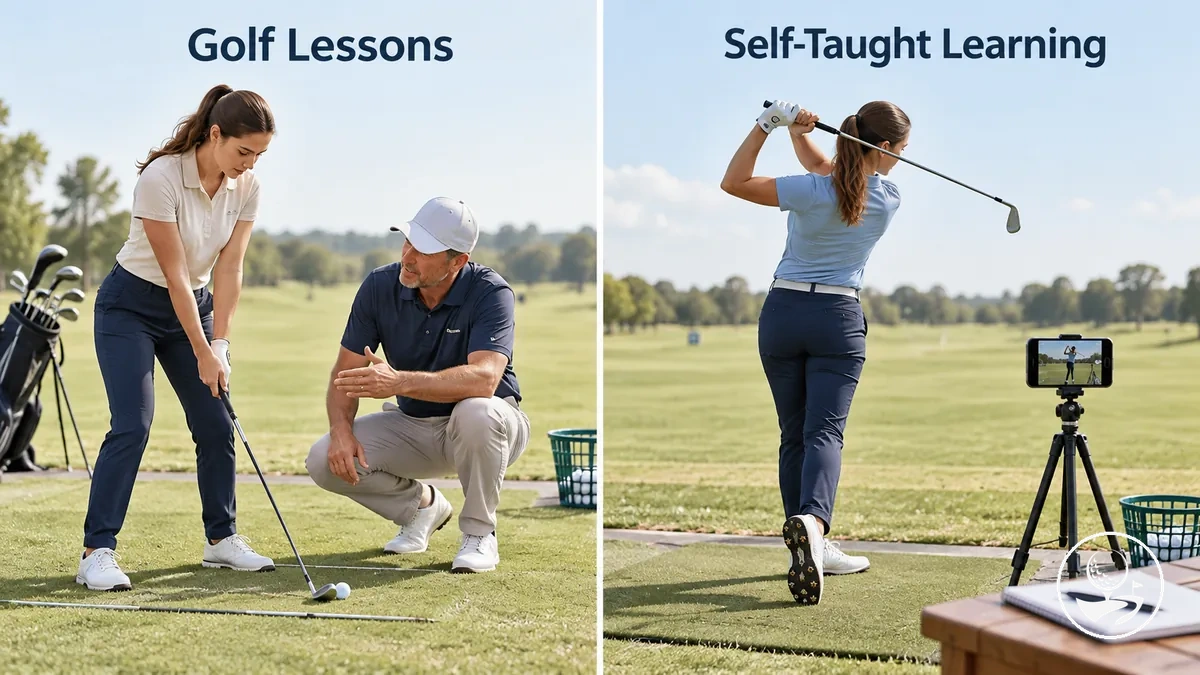
Feedback quality affects error recognition and the correction a beginner golfer chooses, but its usefulness depends on accuracy, timing, specificity, personalisation, and how well the golfer interprets it.
Coached feedback
Source: direct observation by an instructor. Use: feedback can be immediate and tailored to the golfer’s observed problem, provided the interpretation and correction are appropriate.
Independent review
Source: self-observation, swing video, peer input or delayed review. Use: it offers another view of repeated mistakes, but the golfer must still identify and interpret the relevant issue.
For example, a beginner who repeatedly gets an unwanted result without identifying its source may gain more from relevant external feedback than a golfer who can reliably recognise the same issue through self-assessment.
When an error goes unrecognised during practice, the golfer may continue repeating it instead of testing a more appropriate correction.
The image contrasts immediate coach observation with self-generated review so the difference in feedback source and timing is clear.

Learning Structure and Pace of Progress
Golf lessons usually provide an externally organised progression, while self-directed learners must create and maintain more of their own learning structure.
A clear learning order can reduce uncertainty about what to practise next, but structure alone does not determine the pace of progress.
Self-directed sequencing can also remain coherent when the beginner sets priorities and reviews results consistently.
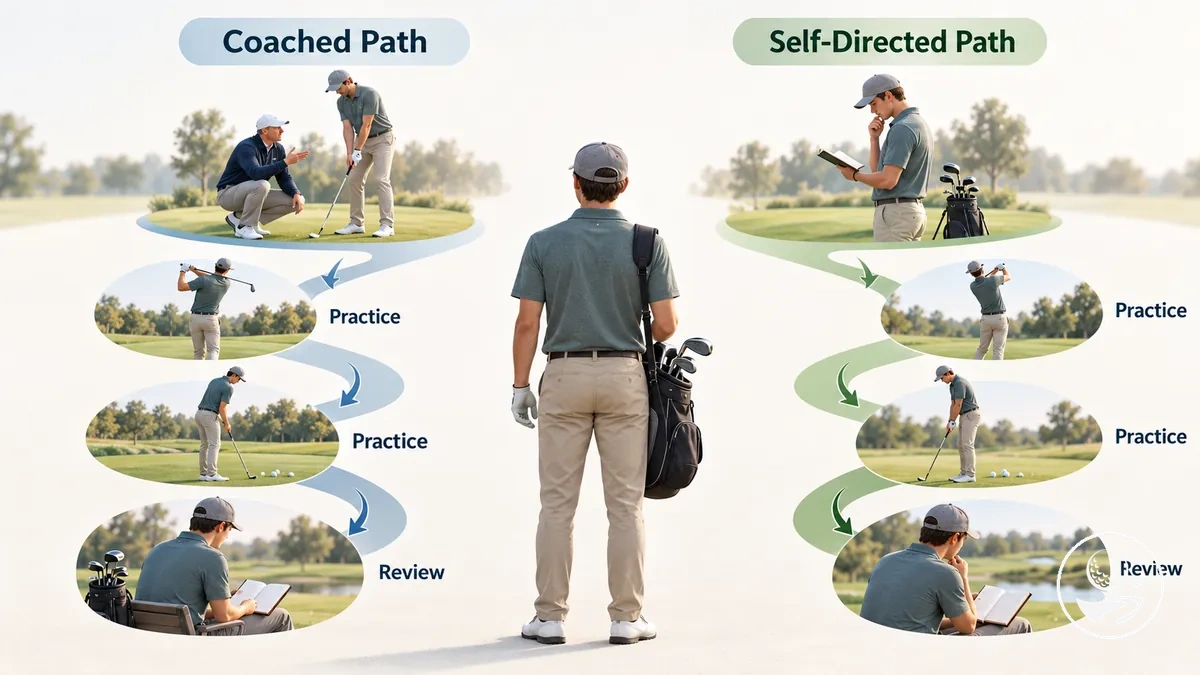
- Progression: Lessons can supply planned checkpoints, while independent learners need to decide how one learning priority connects to the next.
- Prioritisation: External instruction can narrow the next area of focus, while self-directed learning requires the golfer to choose what deserves attention and avoid fragmented practice.
- Accountability: Scheduled instruction can provide external checkpoints, while independent learning relies more on the golfer maintaining the intended progression.
- Practice between sessions: Either approach depends on applying the current priority consistently rather than changing focus without a clear reason.
- Review: Progression remains useful only when the golfer reviews results and decides whether to continue, adjust, or revisit the current priority.
These structural differences can affect perceived pace of progress because clearer prioritisation may reduce disconnected practice, while weak sequencing can leave a beginner unsure what to address next.
Accountability, practice between sessions, and review therefore influence how efficiently either learning route functions.
Structure can reduce wasted effort when it improves prioritisation, but it does not guarantee faster improvement.
The image shows externally planned checkpoints beside learner-selected checkpoints, making the difference in sequencing responsibility and review visible without prescribing a fixed curriculum.
Flexibility, Cost and Learning Independence
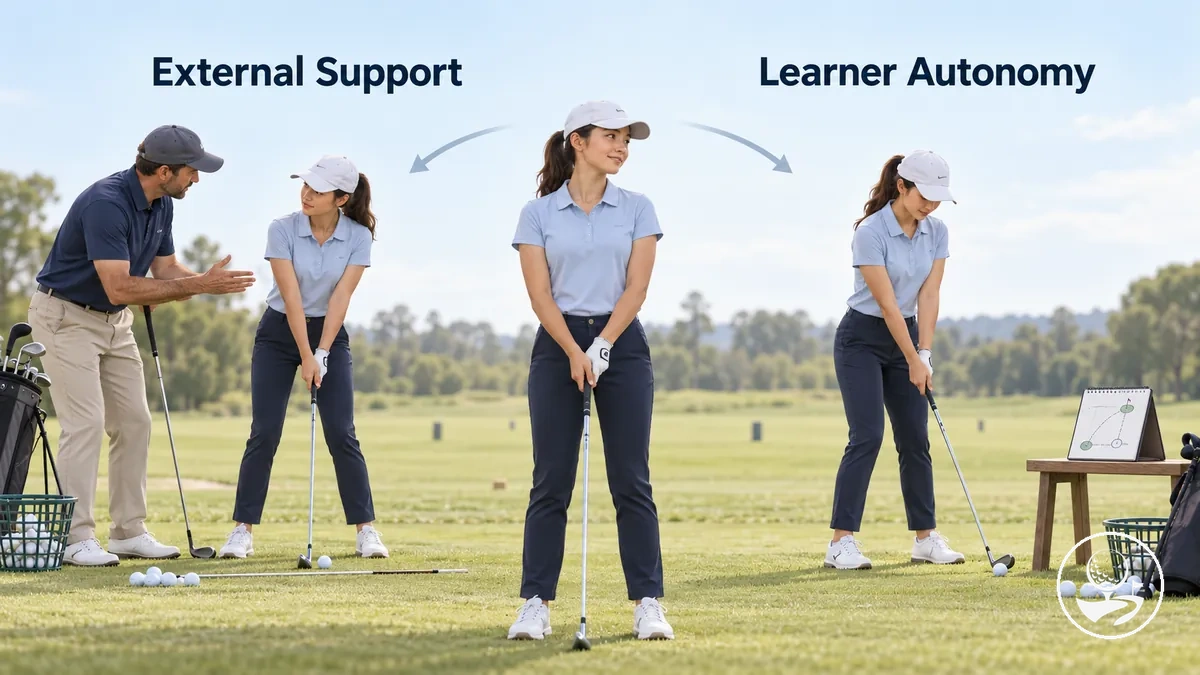
Self-directed learning allows greater scheduling flexibility and learning independence, while golf lessons require a beginner to fit practice around scheduled instructional commitments.
That autonomy can suit a learner who needs more control over when to practise, whereas fixed appointments can suit someone who values external structure and accountability.
The image represents this difference in schedule control and instructional commitment rather than suggesting a performance advantage.

- Schedule control: Self-directed learning allows the golfer to choose practice times more freely, while lessons require attendance at agreed appointments.
- Financial commitment: Lessons require payment for instruction, while independent learning can reduce the financial commitment to instruction; suitability still depends on the learner's budget and other practice costs.
- Access to guidance: Lessons provide scheduled access to an instructor, while independent learners must decide when and where to obtain useful external information.
- Repeat practice: Independent learning allows material to be revisited on the learner's own schedule, while lesson-led learning combines scheduled instruction with practice between appointments.
- Motivation: Greater autonomy places more responsibility on the learner to start, continue, and organise practice without a scheduled session prompting action.
- Accountability: Lessons can provide external checkpoints through appointments, while self-directed learning requires more personal responsibility for maintaining practice and reviewing progress.
Flexibility and a lower financial commitment to instruction can be useful when a beginner can maintain motivation, obtain appropriate guidance, and practise consistently.
A golfer with a changing schedule or tight budget may value self-directed freedom, while another beginner may prefer structured appointments because they provide predictable access to guidance and external accountability.
Learning independence therefore does not mean learning without outside information; it means carrying more responsibility for when to seek it and how to use it.
Suitability varies with the learner's schedule, budget, desired accountability, and ability to manage independent practice.
Benefits and Trade-Offs for Beginner Golfers
Golf lessons can reduce uncertainty through expert guidance, feedback, and structure, while self-taught learning can provide greater flexibility and autonomy but requires stronger self-evaluation.
Coaching support becomes useful when the feedback is accurate, relevant, and followed by consistent practice; independence becomes useful when the learner can organise practice and recognise when outside guidance is needed.
The image summarises this trade-off between external support and learner autonomy without implying that either approach produces better results by default.
Golf lessons: support with conditions
Potential benefit: an instructor can help a beginner recognise and correct mistakes and choose the next priority.
Main limitation: progress may be limited when guidance is misunderstood, feedback is poor or practice between lessons is inconsistent.
Self-taught golf: autonomy with conditions
Potential benefit: flexibility and independence can work with reliable information, disciplined practice and accurate self-evaluation.
Main limitation: the golfer must maintain motivation, select useful advice, recognise errors and revise an approach that is not working.
Neither learning route guarantees improvement. Both require the golfer to interpret results and adjust practice when needed; the relevant trade-off is external support versus responsibility for self-direction.
Benefits and Limits of Golf Lessons
Golf lessons are most valuable when personalised feedback, prioritisation, or accountability addresses a real gap in a beginner's knowledge or practice.
Professional instruction provides access to observation and correction that can help a golfer focus on a useful lesson priority.
The benefit remains conditional because coaching quality, instructor fit, and the learner's ability to apply the guidance can differ.
- Personalised feedback: An instructor can tailor correction to the golfer's observed needs, but its value depends on accurate guidance and a good instructor fit.
- Structured progression: Lessons can help prioritise what to address next, but the progression is useful only when the lesson focus matches the beginner's current knowledge and learning needs.
- Accountability: Scheduled instruction can support follow-through and review, but accountability does not replace the learner's responsibility to practise and apply what was discussed.
- Practice between lessons: Lessons can teach and correct concepts, while practice between lessons gives the beginner repeated opportunities to apply, test, and reinforce those changes.
The value of golf lessons therefore depends on more than simply taking more sessions.
Weak instructor fit, an unfocused lesson, or inconsistent practice between lessons can limit how useful the instruction becomes, even when the guidance itself is sound.
Beginner knowledge also affects what needs prioritisation, so useful professional instruction should respond to the learner's actual starting point rather than assume the same correction for everyone.
Lessons can support progress under the right conditions, but they do not guarantee improvement on their own.
Benefits and Limits of Self-Taught Golf
Beginners can learn golf without formal lessons, but self-directed learning works best when information quality, feedback access, practice discipline, and consistent review support the process.
It allows flexibility and autonomy, while placing more responsibility on the golfer to judge what to practise and whether an approach is working.
Deliberate independent learning is therefore different from random tip-hopping, where changing advice can make practice less coherent.
- Flexibility: Self-directed learning allows the golfer to choose when and how to practise, but that freedom requires enough practice discipline to maintain useful priorities instead of practising only when convenient.
- Autonomy: Independent learning gives the golfer greater control over learning sources and decisions, but the benefit depends on selecting information that is relevant and consistent rather than collecting disconnected advice.
- Feedback access: A self-taught golfer can use self-observation, video review, or outside input when available, but weaker feedback access may increase the risk that repeated mistakes go unrecognised.
- Self-assessment: Reviewing results can help the learner decide whether a practice approach is useful, but progress may stall when the golfer misidentifies the problem or continues an ineffective correction.
- Adjustment: Self-teaching can remain viable when the learner is willing to revise an approach that is not producing useful results, while rigidly repeating the same method can reinforce unproductive practice.
Self-taught golf therefore requires more than practising without an instructor.
The learner carries greater responsibility for source selection, self-assessment, review, and deciding when additional feedback is needed.
Strong information quality and disciplined practice can support progress, while inconsistent guidance or weak error recognition can make improvement less efficient.
The approach can work under suitable conditions, but it does not eliminate the value of outside guidance when the golfer cannot identify or correct a recurring problem independently.
Choosing the Right Learning Approach for Your Situation
The most suitable learning approach depends mainly on your feedback need, ability to self-correct, need for learning structure, practical constraints, and practice consistency.
Golf lessons are more suitable when a beginner needs external diagnosis or clearer priorities, while self-directed learning may be enough when the golfer can review results and adjust practice reliably.
A blended approach can fit situations where independent practice works for most learning but targeted coaching is useful for specific problems.
Feedback need and self-correction ability are usually more decision-relevant than age, talent, or handicap alone.
Persistent confusion or stalled progress can justify reassessing the level of coaching support, while reliable self-assessment makes greater independence more workable.
Motivation and practice consistency affect whether either approach remains useful, while budget and schedule influence how much external support is practical.
Learning preference also matters when it affects consistent engagement with structured instruction or independent practice.
The following branches organise these conditions into conditional learning-fit patterns rather than rigid rules.
- Needs frequent external feedback: Lessons may be more suitable when the beginner remains unsure why a problem is occurring, cannot self-correct reliably, benefits from stronger learning structure, or has stalled progress that is difficult to diagnose independently.
- Can self-direct reliably: Self-directed learning may be enough when the golfer can identify useful practice priorities, maintain motivation and practice consistency, review results realistically, and work within budget or schedule constraints without losing direction.
- Needs targeted coaching plus independent practice: A blended approach can fit when the golfer manages routine practice independently but wants coaching support for a recurring problem, a period of confusion, or an issue that self-assessment has not resolved.
Learning-approach suitability can change as beginner knowledge and self-correction improve or as new problems appear.
A golfer may begin with more structured coaching, become increasingly independent, and later use a blended approach when a difficult issue or stalled progress creates a new feedback need.
When Beginners Benefit Most From Coaching
Beginners benefit more from coaching when they cannot reliably identify, prioritise, or correct a learning problem alone.
The value comes from closing a specific feedback gap through diagnosis, prioritisation, personalised feedback, or structured progression.
A beginner who already has a reliable way to assess results and adjust practice may need less external guidance for the same situation.
- Unclear learning priorities: Coaching can support prioritisation when confusion about what to work on first makes practice fragmented or unfocused.
- Recurring error without a clear cause: External observation and personalised feedback may be useful when the same problem keeps returning and the golfer cannot identify what needs correction independently.
- Generic advice does not translate well: Coaching can help interpret broad instruction in relation to the beginner's own practice when general guidance is difficult to apply meaningfully.
- Weak accountability: Scheduled instructor support can add accountability when the golfer understands what to practise but struggles to maintain consistent priorities or review progress.
- Persistent plateau: Coaching may be useful when stalled progress continues despite deliberate practice and self-assessment, because an outside perspective can help identify whether the learning approach needs adjustment.
Recurring errors, persistent confusion, weak accountability, and stalled progress are useful signals because they can reveal a limit in the learner's current self-assessment or learning structure.
Coaching does not guarantee a solution, and its usefulness still depends on the relevance of the guidance and the learner's ability to apply it.
The key distinction is whether an external support gap is preventing the beginner from deciding what to change next.
When Self-Taught Learning Can Work
Self-taught learning can work when a beginner has reliable learning sources, a coherent learning order, deliberate practice, and a practical way to review results.
Independent practice becomes more viable when structure guides what to work on next and consistency keeps those priorities in place.
Self-directed learning therefore means taking responsibility for organising learning, not avoiding all outside instruction or feedback.
- Reliable learning sources: Consistent, relevant information gives the beginner a clearer basis for practice, while conflicting or disconnected advice can make prioritisation harder.
- Clear learning order: A coherent sequence helps the golfer connect one priority to the next and reduces random practice that changes focus without a clear reason.
- Deliberate practice: Independent practice is more useful when each session has a defined purpose and the golfer applies the current priority consistently rather than repeating actions without review.
- Feedback method: Video review, self-observation, or useful outside input can support error recognition when the golfer needs evidence beyond the immediate result of a shot.
- Self-review and adjustment: Reviewing results helps the learner decide whether an approach is useful, while willingness to change course limits the risk of repeating an ineffective method simply because it is familiar.
- Patience and consistency: Self-directed learning benefits from enough consistency to evaluate an approach over time, while persistent confusion is a reason to seek outside input rather than continue random practice.
Feedback and adjustment still matter when regular formal lessons are absent because self-assessment can miss a repeated mistake or misidentify what needs attention. A practical review compares repeated attempts against one practice objective, such as more consistent contact, and records what changed before switching advice.
A useful feedback method gives the beginner another basis for review, and willingness to revise an ineffective approach prevents independence from becoming rigid repetition.
Self-taught learning can therefore remain workable when the golfer combines structure, review, and adjustment with outside input when independent evaluation is no longer sufficient.
When Combining Lessons With Independent Practice Makes Sense
Combining a golf lesson with independent practice makes sense when coaching provides diagnosis or prioritisation and practice provides the repetition needed to apply and test that input.
- Get one clear priority. A lesson identifies a specific issue or correction that is relevant to the beginner’s current practice.
- Practise independently. Apply and test that priority between sessions; there is no fixed lesson-to-practice ratio that suits everyone.
- Review the response. Observe repeated practice results and decide whether the adjustment is becoming understandable and workable, or whether uncertainty remains.
- Choose the next action. Continue independent practice while progress can be assessed productively. If the issue remains unclear, seek clarification or further observation in a later lesson, timed to the learning need rather than a universal calendar.
Example in practice
A beginner receives one correction in a lesson and tests it during independent sessions. If contact or control becomes more consistent and the golfer understands what changed, they can keep practising. If the original problem remains and they cannot identify why, targeted follow-up feedback may be useful.
If You Choose Lessons: Timing, Format and Frequency
Plan golf lessons around the feedback you need, the format that suits that need and enough practice time to use the guidance. A lesson is most useful when it addresses a clear priority or a problem the beginner cannot yet assess confidently alone.
- When to start
- Seek instruction when you need a reliable foundation, clearer priorities or help with a recurring problem. Early or later lessons can both be appropriate; readiness and feedback gaps matter more than a fixed skill stage.
- Which format
- Private lessons favour individual observation and tailored guidance. Group lessons offer shared instruction and peer interaction, with less individual attention. Instructor fit, timetable and budget influence what is practical.
- When to return
- Allow time to apply the current correction, observe the results and identify what remains unclear. Add another lesson when targeted feedback would move the learning process forward, not merely because a package or preset interval says so.
Practice access is an important constraint: more instruction is not automatically more useful if earlier guidance has not yet been tested and understood. Reassess timing, format and frequency as the golfer’s goals, schedule and feedback needs change.
When Beginners Should Start Golf Lessons
There is no single required starting point for beginner golf lessons, but early lessons can be useful when a beginner lacks a reliable beginner foundation, cannot identify mistakes, or wants structured direction.
The timing becomes more relevant when readiness for instruction is high and a feedback gap makes independent correction difficult.
A beginner who is still exploring casually and can assess basic practice reasonably may choose some limited self-directed experience before deciding whether coaching is useful.
- Foundation uncertainty: Early lessons can provide structured direction when the beginner is unsure which fundamentals deserve attention first and lacks a reliable way to prioritise them.
- Recurring errors: Coaching may become more useful when recurring errors continue and the golfer cannot determine what needs correction through available feedback.
- Clear goals: A beginner with specific goals may benefit from earlier instruction when those goals create a need for more focused guidance, while broader exploratory goals may allow more time for independent learning.
- Practice access: Lessons are more useful when the golfer has enough practice access to apply and review the guidance; limited opportunities to practise can reduce how much value is gained from introducing new instruction immediately.
Early coaching is mainly useful for establishing direction and reducing uncertainty, whereas later corrective coaching can help when a learner reaches confusion or recurring errors that self-assessment has not resolved.
The decision therefore depends on readiness, feedback needs, goals, and practice access rather than age or a fixed timetable.
Starting later does not make instruction less legitimate; it simply changes whether the immediate learning need is foundational guidance or corrective support.
Group Lessons vs Private Lessons
Group lessons share instructor attention across several learners and add peer interaction, while private lessons concentrate individual attention and feedback on one learner.
The main comparison criteria are personalisation, peer interaction, pace, scheduling, and financial commitment because each affects which instructional format may fit a beginner's situation.
These criteria help distinguish shared learning from one-to-one instruction without treating either format as universally superior.
| Criterion | Group Lessons | Private Lessons | When It Matters |
|---|---|---|---|
| Instructor attention | Instructor attention is shared among participants. | Individual attention is concentrated on one learner. | More focused observation may matter when a beginner needs help with a specific persistent issue. |
| Personalisation | Instruction follows shared material and may offer less time for individualised feedback. | Feedback can be tailored more closely to the learner's observed needs. | Greater personalisation may suit a beginner who needs targeted feedback rather than broad introductory guidance. |
| Peer interaction | Provides peer interaction and a shared learning environment. | Focuses primarily on interaction between the learner and instructor. | Shared learning may suit a beginner who values a social, low-pressure introduction. |
| Pace | The pace is influenced by the needs and progress of the group. | The pace can respond more directly to one learner's questions and priorities. | Individual pacing matters when the learner needs more or less time on a particular issue. |
| Scheduling | Requires the learner to attend sessions arranged for the group. | Scheduling can be arranged around the availability of the instructor and individual learner. | Scheduling matters when availability limits which lesson format is practical. |
| Financial commitment | Shared instructor time often means a lower fee per participant than for a comparable private lesson, although class size, duration and local rates affect the cost. | One-to-one instructor time often has a higher fee per learner than group instruction, although the instructor, duration and location affect the price. | Compare the actual per-person lesson fee and the feedback each format offers alongside practice costs; there is no universal price difference. |
A complete beginner who wants a low-pressure introduction and values learning alongside others may find group lessons a suitable fit, especially when highly individualised feedback is not yet the main need.
A learner with a specific recurring issue may benefit more from private lessons because one-to-one instruction allows closer observation and more targeted feedback.
Suitability still depends on instructor quality, learner preference, scheduling, and how well the chosen format supports useful practice.
Neither format is universally superior.
How Many Lessons and How Often to Take Them
There is no single correct number of lessons or lesson frequency for every beginner because useful cadence depends on learning goals, starting point, feedback needs, practice time, and whether previous instruction has been absorbed.
Practice between sessions allows the golfer to apply a change, observe the results, and judge whether another lesson would add useful new guidance.
Practise and review the previous correction before booking the next session when you still have a workable focus; seek another lesson when repeated results raise a specific question you cannot resolve alone. Lesson cadence should respond to those learning needs rather than follow a fixed schedule or package size.
- Learning goals: Broader or more complex goals may justify additional instruction when the beginner needs help prioritising what to address next, while a narrower goal may require less frequent guidance.
- Starting point: A beginner with limited knowledge or an unclear learning structure may benefit from closer early feedback, while a learner with a clearer foundation may need instruction only when a specific gap appears.
- Feedback needs: Recurring errors or uncertainty that the golfer cannot evaluate independently may justify another lesson, whereas reliable self-assessment can support a longer practice interval.
- Practice capacity: Lesson frequency should allow enough practice between sessions for repetition, observation, and applying changes before new instruction is introduced.
- Absorption and reassessment: Another lesson becomes more useful when the previous correction has been tested and the results reveal an unresolved issue, a new question, or a need for further clarification rather than simply because a preset interval has passed.
The number of lessons should reflect whether each session is still addressing a meaningful learning need rather than act as a proxy for skill or progress.
If a beginner has not had enough opportunity to practise and review a previous change, adding new guidance may create more information without showing whether the earlier instruction was useful.
When the golfer has applied the prior change and can identify what remains unclear, another lesson may provide targeted feedback or clarification.
Lesson frequency should be reassessed as practice availability, learning goals, and feedback needs change.