
Putting Distance Control for Beginners
Putting distance control means matching a repeatable putting stroke to the ball speed needed to finish near your target. For a longer roll, generally use a larger controlled stroke; for a shorter roll, use a smaller one, then adjust for green speed and slope and calibrate from where several comparable putts stop—not from a sudden hit at impact.
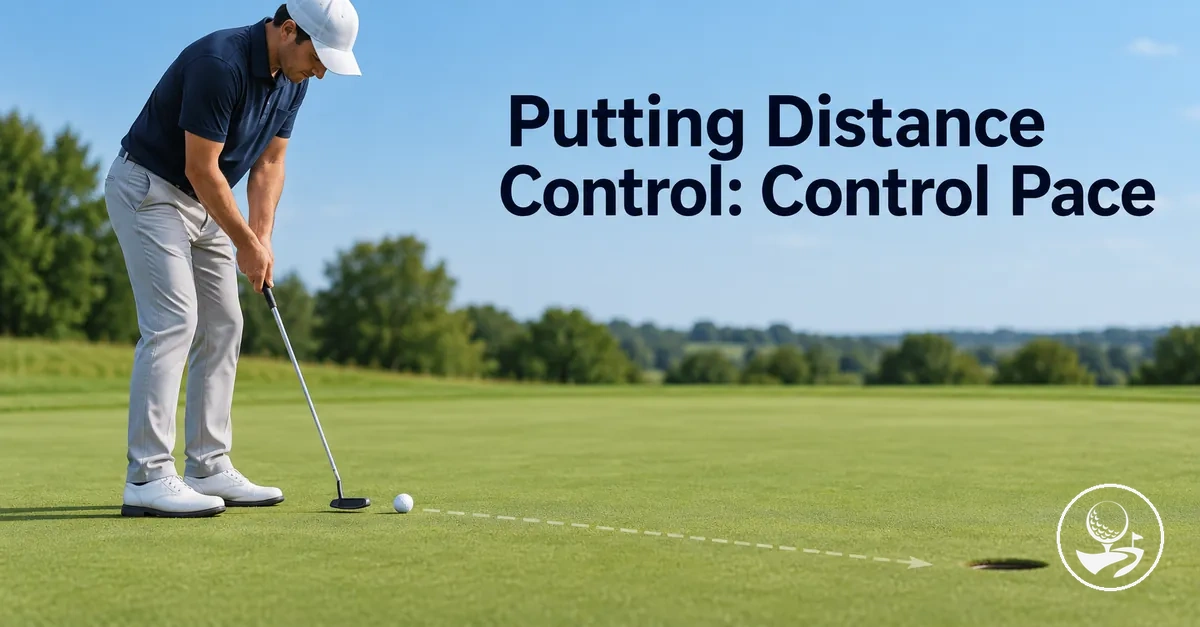
PUTTING PACE · AT A GLANCE
Read → stroke → recalibrate
Use the conditions to choose a starting stroke, then learn from the ball’s finishing distance. Keep tempo and contact repeatable while you change stroke size.
-
Read the putt
Estimate the roll to the target. A faster green or downhill slope generally needs less starting pace; a slower green or uphill slope generally needs more, all else being comparable.
-
Deliver the pace
Choose a controlled stroke size for the required rollout. Maintain a consistent rhythm and contact rather than adding a last-second jab.
-
Check the finish
Compare several putts from a similar starting position in similar conditions. A repeated finishing pattern is more useful than any single miss.
What the repeated result suggests
- Consistently short
- Try a slightly larger controlled stroke, then check the next set.
- Consistently long
- Try a slightly smaller controlled stroke, then check the next set.
- Scattered short and long
- Improve stroke repeatability and contact before assigning the error to stroke length alone.
Decision boundary: these are directional adjustments, not universal backswing lengths or percentages. Reassess the green, slope and your strike whenever conditions change.
Basic setup, aim and stroke mechanics make distance feedback easier to interpret. The aim here is a predictable relationship between stroke size, starting pace and rollout—not a fixed stroke length for every measured distance.
Table of Contents
What Controls Putting Distance and Pace
Putting distance and pace are influenced by stroke length or stroke size, tempo and delivery, green speed, and slope.
The golfer can adjust the stroke inputs, while green conditions change how the resulting ball speed translates into rollout and finishing distance.
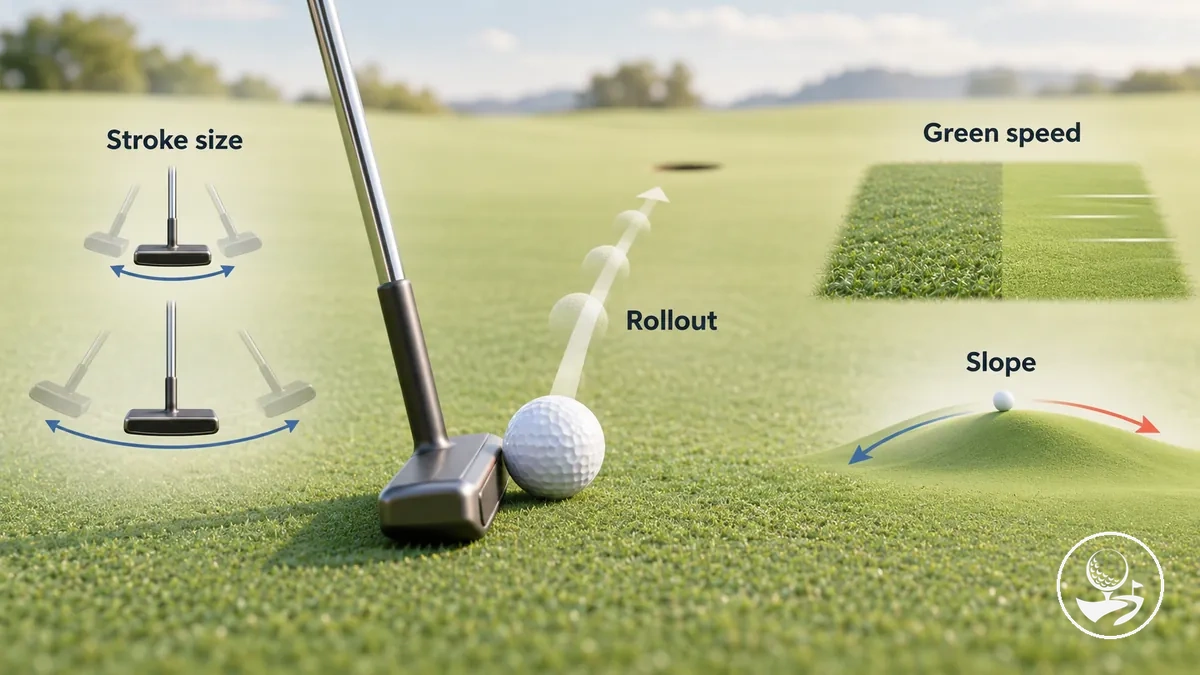
- Stroke size: A larger controlled stroke generally creates more ball speed and rollout than a smaller controlled stroke, although the exact finishing distance also depends on delivery and green conditions.
- Tempo and delivery: Repeatable stroke rhythm and centred contact help a similar stroke size produce a more consistent starting ball speed; changes in delivery can alter rollout even when stroke length appears similar.
- Green speed: A faster green allows more rollout from a similar starting ball speed, so less stroke size may be required than on a slower surface for the same intended finishing distance.
- Slope: An uphill slope reduces rollout relative to a comparable flat putt, while a downhill slope increases rollout, changing the required pace for the same measured distance.
Stroke size, tempo and delivery are inputs you can adjust; green speed and slope are conditions you must read. Because these factors interact, a single short or long putt does not identify one specific cause. Consistent setup, aim and strike make the effect of a stroke-size adjustment easier to interpret.
Here, putting pace means the ball’s speed and resulting rollout, while stroke tempo means the rhythm of the putter’s motion. Neither means the speed at which a round of golf is played.
Match Stroke Length to the Putting Distance
Longer putts generally require a larger controlled stroke, while shorter putts require a smaller stroke size under comparable conditions.
The exact stroke length cannot be assigned to a universal distance because green speed, slope and individual delivery change the resulting rollout.
The image shows relative stroke-size changes rather than fixed distance measurements.
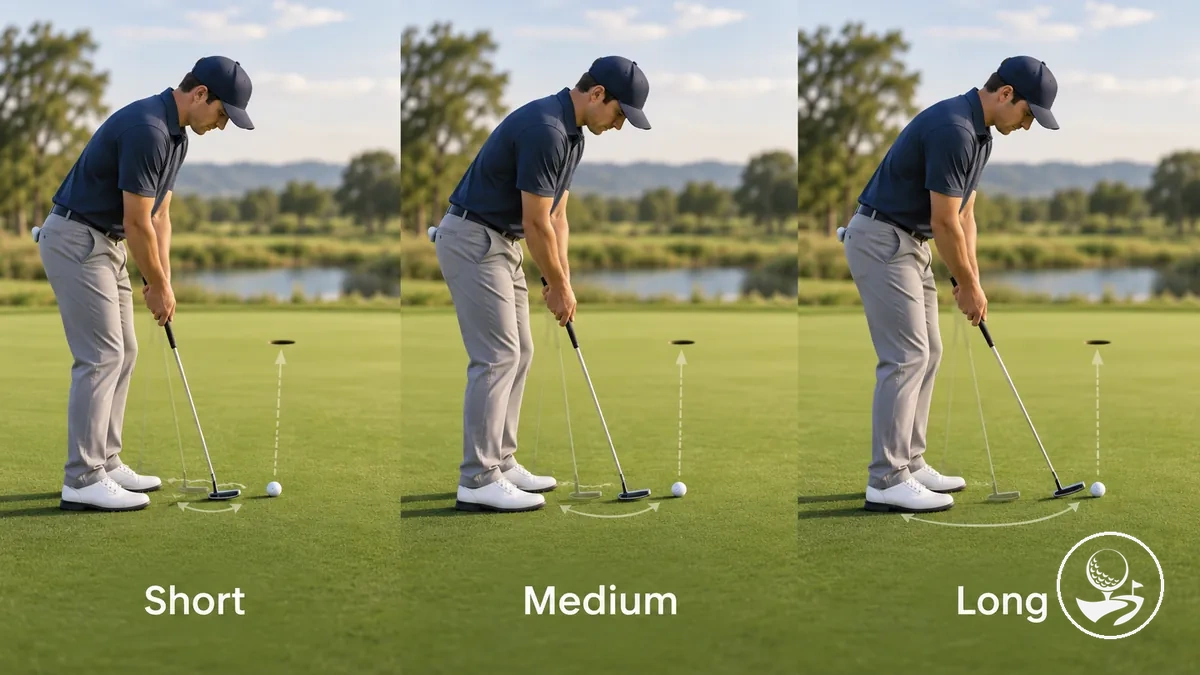
- Choose a target distance. Select one finishing area so the intended roll distance stays consistent during calibration.
- Make a repeatable stroke. Use a controlled stroke length and steady tempo rather than changing the motion at the last moment.
- Observe the finishing distance. Note whether the ball finishes short of, near or beyond the target distance under the current conditions.
- Adjust stroke length. Increase stroke size when more rollout is needed or reduce it when the ball consistently travels too far, while keeping the delivery controlled.
- Repeat and confirm. Make several comparable strokes and use the observed finishing distance to establish a more predictable relationship between stroke length and rollout.
A larger controlled stroke increases the overall motion used to create the required pace; a sudden hit or jab changes the delivery near impact instead.
Keeping tempo and delivery repeatable makes stroke length the clearer adjustment variable, although the exact rollout still changes with green speed and slope.
For a shorter putt, a golfer may use a compact controlled stroke, while a longer putt on the same green may call for a larger controlled stroke with similar tempo.
If the longer stroke still finishes short or rolls too far, use the observed finishing distance to recalibrate stroke size rather than relying on a fixed backswing formula.
Judge the Required Pace Before You Putt
Required putting pace depends first on the roll distance and then on conditions that change rollout, especially green speed and slope, together with the intended finishing area.
Because those conditions vary, the same measured distance does not require one universal ball speed or stroke size; the criteria below organize the decision before the stroke.
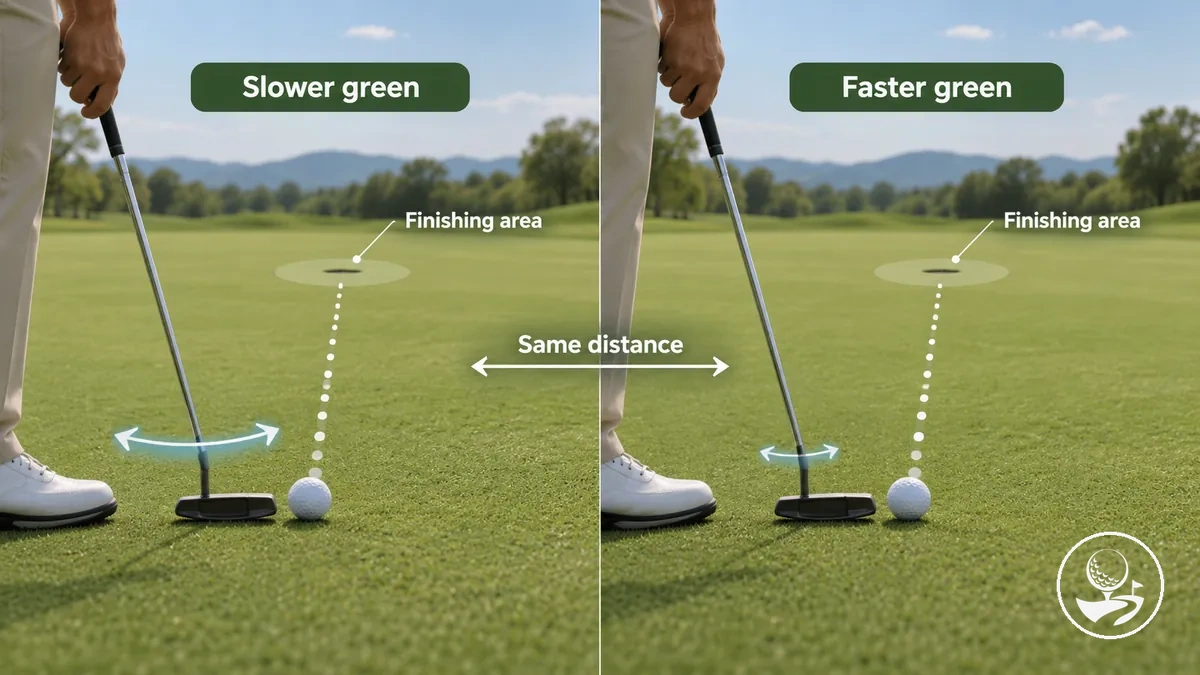
- Assess the roll distance. A longer required roll generally calls for more starting ball speed than a shorter roll under otherwise similar conditions.
- Account for green speed. A faster surface allows more rollout from a similar starting ball speed, so the required pace can be lower than on a slower surface for the same roll distance.
- Account for slope. An uphill putt generally requires more starting pace than a comparable flat putt, while a downhill putt generally requires less because slope changes the ball's rollout.
- Choose the finishing area. The intended finishing area defines how much rollout the stroke needs to produce, so stroke size should match that target rather than the measured distance alone.
These criteria work together: roll distance defines the task, the finishing area defines the intended stop, and green speed and slope change how the required ball speed translates into rollout. There is no universal numerical adjustment across all greens.
Faster green
The ball generally rolls farther at a similar starting speed, so less starting pace and a smaller controlled stroke may reach the target.
Slower green
The ball generally rolls less far at a similar starting speed, so more starting pace and a larger controlled stroke may be needed.
This is a directional comparison at the same measured roll distance. The exact adjustment also depends on slope severity and individual delivery.
Judge the required pace from distance and conditions together, then refine it from where the ball actually finishes.
Adjust Pace for Uphill and Downhill Putts
An uphill putt generally requires more starting pace than a comparable flat putt, while a downhill putt generally requires less because slope changes rollout.
The size of the adjustment depends on slope severity, green speed and putt length, so the comparison below shows direction rather than a fixed compensation.
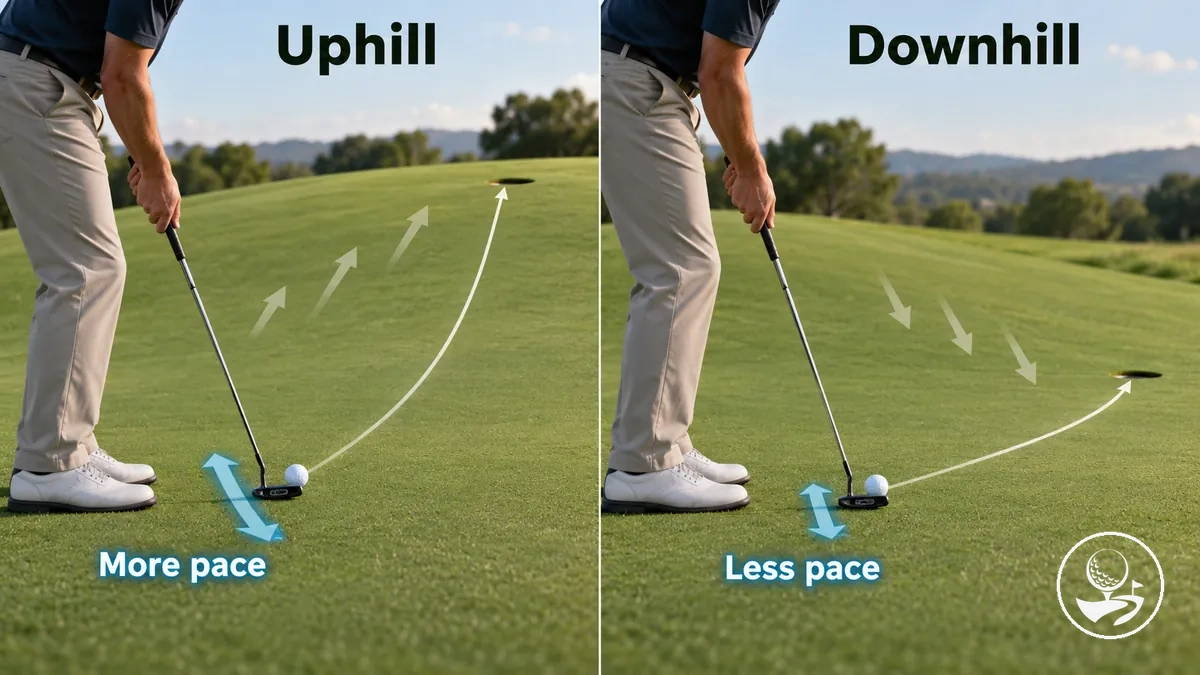
- Uphill putt: Use a larger controlled stroke size when more starting pace is needed to reach the intended finishing distance; under-adjusting can leave the ball short because the uphill slope reduces rollout.
- Downhill putt: Use a smaller controlled stroke size when less starting pace is needed; over-adjusting can send the ball beyond the intended finishing distance because the downhill slope increases rollout.
For two putts with the same measured distance, the uphill putt may need more starting pace and the downhill putt less, even though the target is equally far away.
The exact stroke-size adjustment should remain conditional on slope severity and green speed rather than follow a universal percentage rule.
Control Distance on Long Putts
On a long putt, prioritize a predictable finishing distance and a manageable next putt rather than trying to force the ball aggressively toward the hole.
Lag putting applies the same distance-control principle over a longer roll: choose a practical target zone and adapt stroke size to the distance and conditions, with the image illustrating the intended finishing area rather than a fixed leave distance.
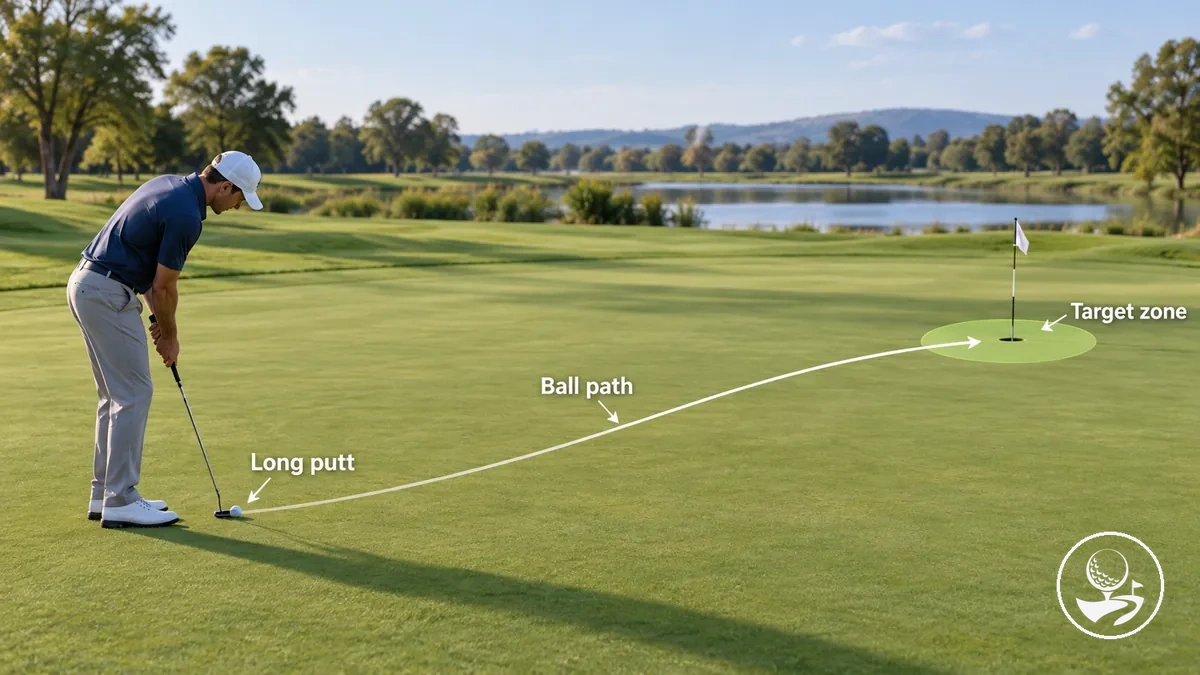
- Choose the controlled stroke. Consider the long roll, current green speed and intended finishing zone when selecting stroke size.
- Observe the finish. Compare where the ball stops with the target zone rather than judging distance control only by whether the putt is holed.
- Recalibrate from repeated misses. If comparable putts repeatedly stop short or long, adjust stroke length in that direction instead of adding sudden acceleration near impact.
To create more starting pace, increase the size of a controlled stroke rather than introducing an abrupt hit, which can make the resulting pace less predictable.
For example, a long putt on a faster green may need a smaller stroke than a similar putt on a slower green because the faster surface allows more rollout. On the slower green, use a larger controlled stroke if needed, observe the result and adjust again—without assuming a universal leave distance or fixed long-putt formula.
Use Distance-Control Drills to Calibrate Pace
A distance-control drill should calibrate the relationship between stroke size and resulting rollout through repeated observation and feedback.
The goal is to make stroke length more predictable for a target distance or finishing zone, not to complete repetitions without evaluating where the ball finishes.
Choose the drill according to the variable you want to calibrate.
Fixed-distance practice is useful when you want to compare stroke length with rollout from the same target distance, while finishing-zone practice is useful when you want to evaluate the dispersion of several putts around a defined target area.
Read each drill as a pattern across comparable putts, not a pass/fail test: repeated short or long finishes call for a stroke-size adjustment, whereas a wide spread in both directions suggests improving repeatability first.
These drills teach pace calibration under current green conditions, not a complete practice plan. Green speed and individual consistency change the rollout produced by a given stroke length; broader practice scheduling is a separate decision.
Common Putting Distance-Control Mistakes
Putting distance-control mistakes become useful diagnostic signals when the same pace error appears repeatedly, rather than after one isolated miss.
Recurring problems often come from inconsistent calibration or pace decisions, so the recognition cue should be a pattern across comparable putts before choosing a corrective adjustment.
-
Adding a sudden hit on longer putts
A last-second burst can make finishing distance less predictable.
- Recognition cue
- a repeated pattern of long-putt rollout varying widely even when the intended stroke size is similar.
- Corrective action
- Try increasing stroke length in a controlled way instead of adding an abrupt hit near impact.
-
Changing stroke tempo unpredictably
Variable stroke tempo can change the delivered pace even when stroke length appears similar.
- Recognition cue
- inconsistent finishing distance across putts made from comparable positions and conditions.
- Corrective action
- Try keeping the motion repeatable and using stroke size as the clearer calibration variable.
-
Failing to recalibrate for green speed
Using the same pace decision when the surface is faster or slower can produce repeated distance errors.
- Recognition cue
- a group of putts consistently finishing long on a faster green or short on a slower green.
- Corrective action
- Try observing the current rollout and recalibrating stroke size to the present green speed.
-
Ignoring slope
Treating uphill and downhill putts as equivalent pace tasks can lead to systematic short or long finishes.
- Recognition cue
- repeated under-hitting uphill or over-hitting downhill at otherwise comparable distances.
- Corrective action
- Try accounting for slope direction before choosing starting pace and stroke size.
-
Judging success only by whether the ball is holed
A made or missed putt does not by itself show whether pace control was repeatable.
- Recognition cue
- focusing on the result at the hole while overlooking whether the ball's finishing distance and rollout pattern were controlled.
- Corrective action
- Try evaluating the observed finish and consistency of pace as well as the final outcome.
One poor result does not prove which mistake occurred. A misread, unusual contact or changing condition can produce a similar finish. Compare finishing distances, rollout and conditions over several comparable attempts before attributing a repeated error to one cause.
Correct recurring pace errors through observation and recalibration, rather than adding a new technique after every miss. Use the pattern to decide whether to adjust stroke size, tempo or your pace decision for the current green speed and slope.