
Diagnosing Why You Hit Better at the Range Than on the Golf Course
Golfers often hit better on the driving range because repeated shots and familiar conditions allow quick adjustments, while the course demands first attempts from changing lies, targets and clubs, sometimes under pressure. If the same misses appear on the range and the course, broader swing or contact inconsistency is more plausible; if performance falls mainly on the course, a range-to-course transfer issue is more plausible. Compare first-ball results, hitting surfaces, decisions and pressure over repeated, comparable attempts before changing your swing.

Start with the pattern
Find what is failing to transfer
Use the pattern you can observe repeatedly to choose the next check. This map suggests plausible explanations, not a confirmed swing diagnosis.
Misses mainly on the course
Course-specific conditions may be exposing a transfer gap. Check which changed condition repeatedly accompanies the drop.
Similar misses in both settings
Broader contact or execution inconsistency may be more relevant. Compare the same club and shot in similar conditions first.
If the gap mainly appears on the course, follow the recurring clue
- First ball is worse Check: compare the first attempt with later shots after feedback, using the same club and target.
- Contact changes on grass Check: compare ground-first contact and ball flight on mat and turf in otherwise similar shots.
- New lie, club or target Check: vary one on-course condition at a time where practical, rather than attributing the miss to every change.
- Wrong choice or poor strike? Check: separate the intended target and club from how the ball was actually struck and started.
- Misses when the shot matters Check: compare tension, tempo, attention and outcomes with and without a perceived consequence.
Diagnostic rule: repeat a comparable check, change one useful variable where possible, then confirm the pattern before choosing a correction. If no trigger repeats, keep observing instead of assuming a cause.
Table of Contents
How to Tell a Range-to-Course Transfer Problem from General Swing Inconsistency
First compare where the same type of miss occurs: mostly when you move to the course, or in both practice and play. Then look at first-shot quality, contact and shot decisions under conditions as similar as practical.
A miss that follows a change in lie, surface, target or perceived consequence supports a possible transfer explanation. An equivalent miss across both settings points more towards broader inconsistency, but neither pattern identifies an exact swing fault.

- Mainly worse on the course: a transfer problem is more consistent with the pattern when range performance remains stable but the first shot, contact pattern or result changes with the lie, target or pressure; next check which course-specific condition repeatedly accompanies the decline.
- Inconsistent in both settings: general swing inconsistency is more consistent with the pattern when similar contact or directional misses appear during repeated shots on the range and during course play; next check whether the pattern remains when lie, target and pressure conditions are made as comparable as possible.
If neither pattern repeats reliably, collect more comparable first-shot and contact observations before selecting a corrective drill.
What Changes Between the Range and the Golf Course
The range typically offers more repetition, consistent surfaces and immediate adjustment opportunities; the course changes the lie, target, club, consequence and often the time between comparable shots. Each difference can affect how well practice transfers.

| Condition | Typical Range Pattern | Typical Course Pattern | Possible Performance Implication |
|---|---|---|---|
| Repetition | Several similar shots may be hit in succession. | Comparable shots are usually separated by other shots and situations. | Immediate adjustment from the previous attempt may support steadier range performance. |
| Lie | The hitting surface is often relatively consistent within a practice session. | Ball position and surface can change from shot to shot. | Changing lie conditions can alter contact demands and the feedback a golfer receives. |
| Target | The same target may be used for repeated attempts. | The target and required shot can change with each playing situation. | Target variability can increase the need to reset aim, attention and commitment. |
| Club | The same club may be used for a sequence of shots. | Club changes commonly follow changes in distance, lie and intended shot. | Frequent club changes can reduce the opportunity to refine one repeated movement from the previous attempt. |
| Consequence/pressure | A poor shot can usually be followed immediately by another practice ball. | A poor shot affects the next playing situation and may carry a scoring consequence. | Greater consequence can change tension, attention or decision-making for some golfers. |
| Feedback | Ball flight and contact feedback can be followed by an immediate similar attempt. | Feedback is followed by a different playing situation rather than an automatic repeat. | The range may provide a faster adjustment loop, while course feedback may be harder to test immediately. |
| Time between shots | Similar shots can follow one another with relatively little delay. | Walking, waiting and other shots can separate comparable attempts. | Longer separation can reduce reliance on the feel and adjustment from the previous similar shot. |
These differences are possible contributors to a range-to-course performance change, not proof that any single condition explains the pattern for a particular golfer.
Repeated Shots Let You Adjust from the Shot Before
Repeated range shots form a short feedback-and-adjustment loop when the club, target and general hitting conditions stay similar.
- First attempt: hit a shot without immediate feedback from a comparable prior attempt.
- Read the result: observe ball flight, contact and feel while the club and target remain similar.
- Adjust and repeat: use that information on the next ball; subsequent shots may become steadier because feedback is immediately available.
Transfer limit: better later shots do not necessarily predict a reliable first ball after a delay, a different lie or a changed target.

For example, a golfer hitting repeated shots with the same club at the same target may adjust after the first attempt and produce more stable later shots, whereas a first shot taken later begins without immediate prior-shot feedback from an equivalent attempt.
Mats Can Hide Contact Problems That Grass Exposes
Heavy (fat) contact means the club reaches the ground before the ball. With iron shots, some forgiving range mats can conceal how much a heavy strike affects contact compared with natural grass.
Same ground-first strike, different surface feedback
On a forgiving range mat
The clubhead may skid or rebound towards the ball, allowing a relatively playable result even though ground contact came first.
On natural grass
The club can dig into the turf before reaching the ball, so similar ground-first contact may produce more obvious loss of strike quality or distance.
The actual result depends on mat construction, turf condition and the individual strike. This difference is a clue, not proof of a particular swing fault.
GOLF.com Top 100 Teacher Kevin Sprecher notes that some mats can mask fat contact because the club can bounce into the ball, although sound and feel may still signal a heavy strike.
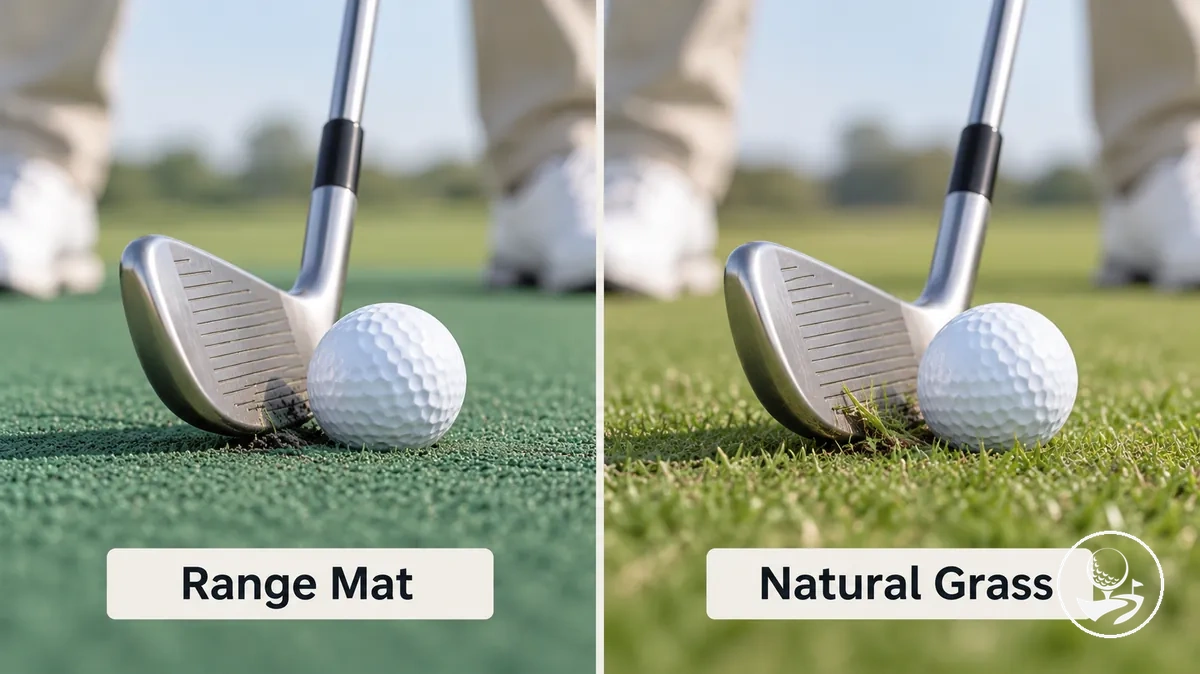
When comparing mat and grass shots, check ground-contact feedback and ball flight together; a playable ball flight on a mat does not necessarily mean the club struck the ball before the ground.
Each Course Shot Changes the Lie, Target, Club and Decision
On the course, lie, target, distance, club and shot choice can change from one attempt to the next; wind or slope may add demands when present. Not every variable changes on every shot.
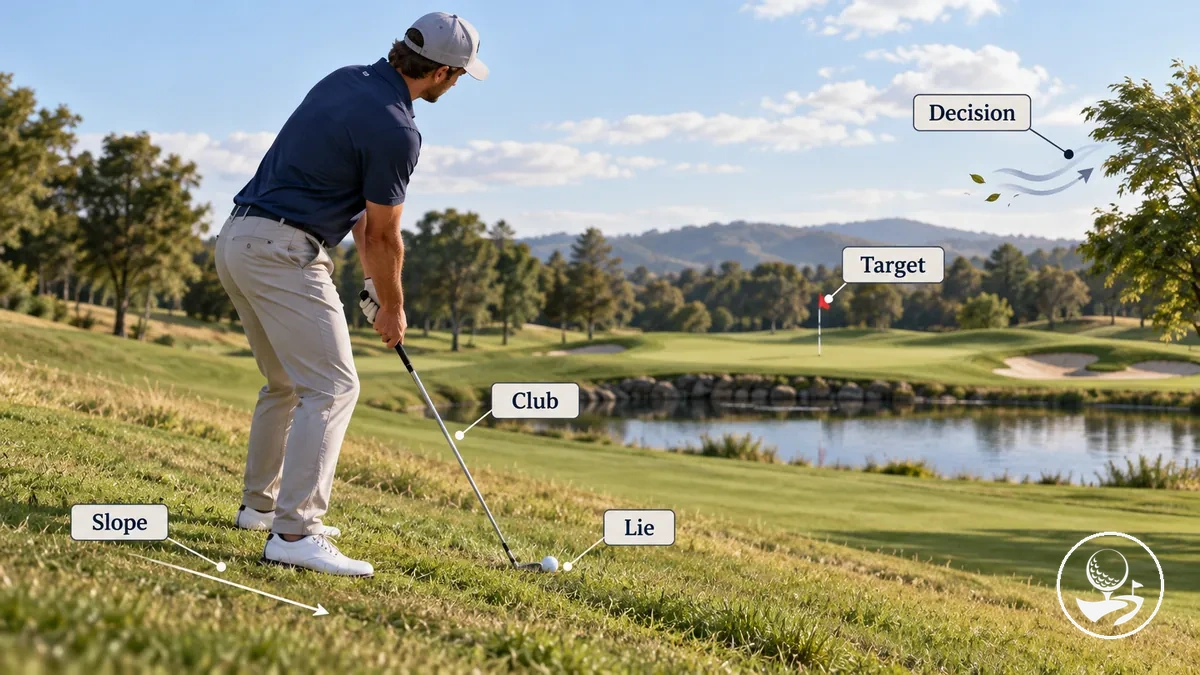
- Lie: a different ball position or ground condition can change how the club approaches and contacts the ball.
- Target and distance: a new direction or required distance can change the aim, setup and shot requirement.
- Club: changing clubs alters the equipment used for the next shot and may change the required setup and execution.
- Wind or slope: when present, these conditions may alter balance, setup or the intended shot.
- Decision: choosing the intended target and shot can affect commitment and execution before the swing begins.
For example, a golfer may move from a level fairway shot with one club and a clear target to a course shot from a sloping lie, at a different distance, with another club and a new target decision.
When several inputs change together before a single one-ball shot, it becomes harder to identify which variable contributed most if execution deteriorates, which can make performance transfer more difficult to interpret.
Pressure Can Change Tension, Tempo and Attention
Perceived pressure can change a golfer's physical tension and attention, which may alter execution without showing that the underlying swing has fundamentally changed.
A scoring or other perceived consequence can contribute to a different physical or attentional state, but golfers do not all respond in the same way.
- Grip and body tension
- Grip pressure or general muscle tension may increase.
- Tempo and breathing
- The swing may speed up or slow down, and breathing may change.
- Attention and commitment
- Focus may narrow or become disrupted, or commitment to the intended shot may weaken.
These changes may alter movement or attention during the swing, but no individual sign proves that pressure caused a miss.
For example, a golfer may swing with relatively relaxed tension, steady tempo and clear attention on the range, then show tighter grip pressure, different breathing or less commitment when a similar course shot carries a perceived consequence.
To check a pressure-linked pattern, compare shots of similar difficulty with and without a meaningful perceived consequence while noting tension, tempo and commitment. Pressure becomes a more plausible contributor when the same behavioural change and performance drop repeatedly appear together, rather than after one isolated miss.
How to Diagnose What Is Failing to Transfer to the Course
Identify the changing condition most consistently associated with the miss before choosing a correction. Make a controlled comparison by changing one meaningful variable, when practical, while keeping the others similar.
Useful checks include first-shot versus repeated-shot quality, mat versus grass contact, shot decision versus execution, and a comparable shot with versus without perceived consequence.
- Observe the pattern: identify when performance changes and which condition is present when the drop appears.
- Isolate one condition: change one meaningful variable where practical while keeping the comparison otherwise similar.
- Repeat the comparison: look for the same difference across repeated observations rather than relying on one shot.
- Interpret the result: a difference that repeatedly follows the tested condition supports that condition as a plausible contributor; an inconsistent result requires another check.
- Choose the next check: verify the most plausible transfer condition or test another branch if the pattern remains unclear.
The goal is to identify the condition that most consistently accompanies the performance drop, not to diagnose an exact swing fault from one signal.
Compare One-Ball Performance with Repeated-Shot Performance
If shot quality consistently improves from the first shot to later repeated shots, the pattern can suggest that performance is benefiting from immediate prior-shot feedback and adjustment.
One poor first shot does not establish a transfer problem because normal shot-to-shot variation can produce an isolated miss.
Make the controlled comparison under similar conditions by using the same club and same target, recording first-shot performance separately, then observing repeated shots for a recurring pattern.
The key variable is whether prior-shot feedback becomes available after the first attempt and whether shot quality then improves across successive attempts.
| Condition | What to Observe | Possible Interpretation |
|---|---|---|
| First shot | Shot quality when execution begins without immediate prior-shot feedback from a comparable attempt. | Repeatedly weaker first-shot performance may suggest that isolated execution is less stable, but it requires further observation. |
| Repeated shots | Whether shot quality improves after feedback and adjustment become available across successive attempts. | Consistent improvement is consistent with reliance on immediate feedback; little or inconsistent change suggests another condition may need the next check. |
For example, if a golfer uses the same club at the same target and the first shot is repeatedly less controlled while later repeated shots improve after adjustment, that pattern supports feedback dependence as a plausible interpretation.
If the difference appears only once, or first-shot and repeated-shot performance remain similarly variable, the comparison does not establish repetition as the failing transfer condition.
Compare Contact on Mats with Contact on Grass
A consistent difference in contact quality between a mat and grass can suggest that the hitting surface contributes to the range-to-course performance gap, but it does not identify a specific swing fault by itself.
The useful diagnostic signal is a repeated pattern in which strike feedback or ball flight changes when the surface changes.
For a controlled comparison, keep the club and target as similar as practical while changing the hitting surface, then observe contact quality, ground-contact feedback and resulting ball flight.
Compare repeated observations rather than one strike because mat construction, turf condition and the individual strike can all affect the result.
The table separates a surface-linked pattern from inconsistency present on both surfaces without treating either pattern as proof of a technical fault.
| Observed Pattern | Surface Check | Possible Interpretation |
|---|---|---|
| Surface-linked pattern: a heavy strike remains relatively acceptable on the mat but contact quality or ball flight degrades on grass. | Repeat the comparison with the same club and target under otherwise similar conditions. | A repeated difference suggests a surface contribution to the performance gap and supports another surface-focused check. |
| Inconsistency present on both surfaces: poor contact or unstable ball flight appears similarly on mat and grass. | Check whether the same contact pattern persists across both surfaces under comparable conditions. | A similar repeated pattern is more consistent with general contact inconsistency than a surface-specific contribution. |
Interpret the mat-versus-grass comparison by asking whether the contact difference reliably tracks the surface change.
If the same heavy-strike pattern produces different results repeatedly between the two surfaces, surface feedback is a plausible contributor; if contact remains similarly inconsistent on both, the surface alone is less likely to explain the transfer gap.
Separate Shot-Decision Errors from Swing-Execution Errors
The same poor outcome can originate in the shot decision before the swing or in execution after a clear decision.
The diagnostic distinction is to identify whether the target, club choice, commitment and intended shot were clear first, then judge how well the swing execution matched that intent.
Start by separating what was decided from how it was executed.
Check target clarity, club choice, commitment and intended shot before the swing, then compare contact, start direction and outcome with that intent.
The table organizes those signals because identical outcomes can have different origins.
| Signal | Decision-Error Indication | Execution-Error Indication | Diagnostic Meaning |
|---|---|---|---|
| Target clarity | The target is unclear or changes late before the swing. | The target remains clear before execution begins. | An unclear target suggests the error may originate in the shot decision; a clear target makes execution the next stage to assess. |
| Club choice | The club choice remains uncertain or changes late relative to the intended shot. | The club choice is clear and accepted before execution. | Persistent uncertainty supports a decision-related interpretation, while a settled choice shifts the diagnostic check toward execution. |
| Commitment and intended shot | The intended shot changes during setup or commitment to it remains unclear. | The intended shot remains clear and commitment is maintained through the swing. | Late indecision suggests the error originates before execution; clear commitment does not rule out an execution error. |
| Contact quality | Contact may be sound even when the chosen target or intended shot leads to a poor outcome. | Poor contact or an unintended start direction appears despite a clear decision. | Sound execution with a poor decision points more toward a decision error, while poor execution after a clear decision suggests an execution error. |
| Outcome relative to intent | The ball follows the intended shot reasonably well, but that intended shot produces a poor result. | The ball does not match the clearly intended shot because execution breaks down. | The same poor outcome requires separate interpretation according to whether the result matched the original intent. |
For example, a golfer can finish in trouble after striking the intended shot cleanly toward a poorly chosen target, or reach a similar position after choosing a clear target but making poor contact.
The first pattern suggests a shot-decision error, while the second suggests an execution error; deeper treatment of target and club decisions belongs to course management rather than this diagnostic distinction.
Match the Correction to the Cause Before Changing Your Swing
Match the correction to the repeatedly observed condition rather than defaulting to a major swing change. Adjust one variable, then repeat the same comparison to see whether it improves.
The most useful practice change is the one that addresses the specific failure to transfer, not simply the one that produces the best run of range shots.
- Repetition dependence: include more first-ball attempts with club or target changes between repetitions; verify whether first-shot performance becomes more consistent without needing several adjustment shots.
- Surface-feedback issue: use more representative contact conditions, including grass when practical; verify whether the surface-linked contact difference becomes smaller or remains a repeated pattern.
- Shot decision error: simplify the target or club choice enough to improve commitment to the intended shot; verify whether decision-related errors decrease while execution remains comparable.
- Pressure-sensitive execution: use a repeatable pre-shot routine or pressure-aware practice that introduces meaningful consequence without changing swing mechanics; verify whether the same consequence-sensitive miss pattern becomes less frequent or less severe.
When the pattern persists despite a bounded change, test another condition before assuming the swing needs rebuilding. The goal is more reliable first-shot performance on the course, not only better results during repeated range practice.