
How Golf Scoring Works
Golf scoring adds the strokes that count on each hole, including any applicable penalty strokes, to produce a gross round total. In stroke play, lower applicable totals are better; a score relative to par compares the total with the course’s par, while a net score reflects the relevant handicap adjustment.

Scorecard practice
Try a three-hole golf scorecard
Change the par, played strokes or applicable penalty strokes for each example hole. See how a hole score becomes a total and a score relative to par.
- Strokes counted
- Combined par
- Relative to par
Hole scores: 5 + 4 + 3 = 12 strokes across these three holes.
Enter at least 1 played stroke and 0 or more penalty strokes for each hole.
This is a three-hole practice subtotal, not a full round or a net handicap result. Only include penalty strokes actually required by the Rules. To calculate a net score, apply the handicap strokes permitted for that scoring format.
Table of Contents
How Strokes Are Counted to Create a Golf Score
A hole score counts the strokes made to play the ball plus any penalty strokes required by the Rules of Golf. A stroke made with the intention of striking the ball can count even when the club misses the ball; a practice swing is not a stroke.
Confirm the total once the hole is complete, then enter that number on the scorecard. Follow this sequence:

- Count each played stroke that contributes to the score for the hole.
- Include any penalty stroke required by the applicable rule.
- Confirm the total once the hole is completed; that total is the hole score.
- Carry the recorded hole score into the accumulating round total.
Penalty strokes are added to the score without representing another swing. For example, four played strokes + zero penalties = a hole score of 4; that recorded value then contributes to the round total.
Hole Scores and the Round Total
Every completed hole produces one score. A nine-hole round sums nine hole scores; an 18-hole round sums 18. The running total grows as each completed hole is recorded.
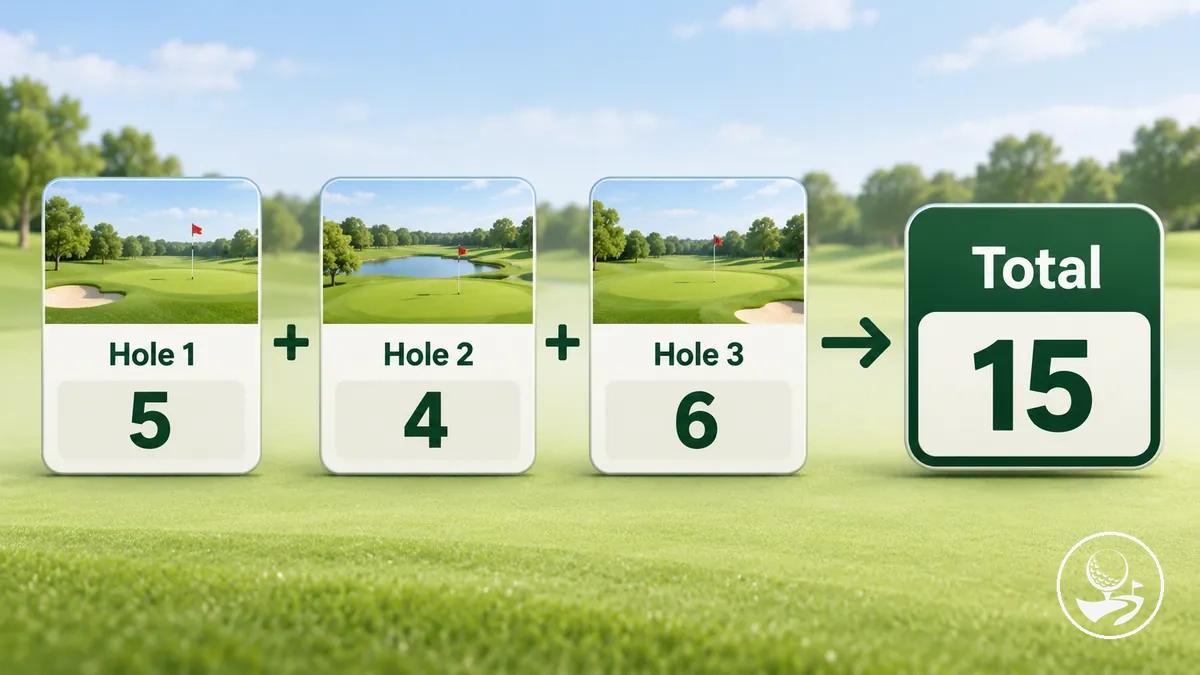
For example, hole scores of 5, 4 and 6 give a subtotal of 5 + 4 + 6 = 15 strokes after three holes. Keep adding subsequent hole scores to reach the final total for the round.
How Penalty Strokes Are Added to the Score
A penalty stroke increases a hole score when the applicable rule requires it, even though it does not represent another played stroke.
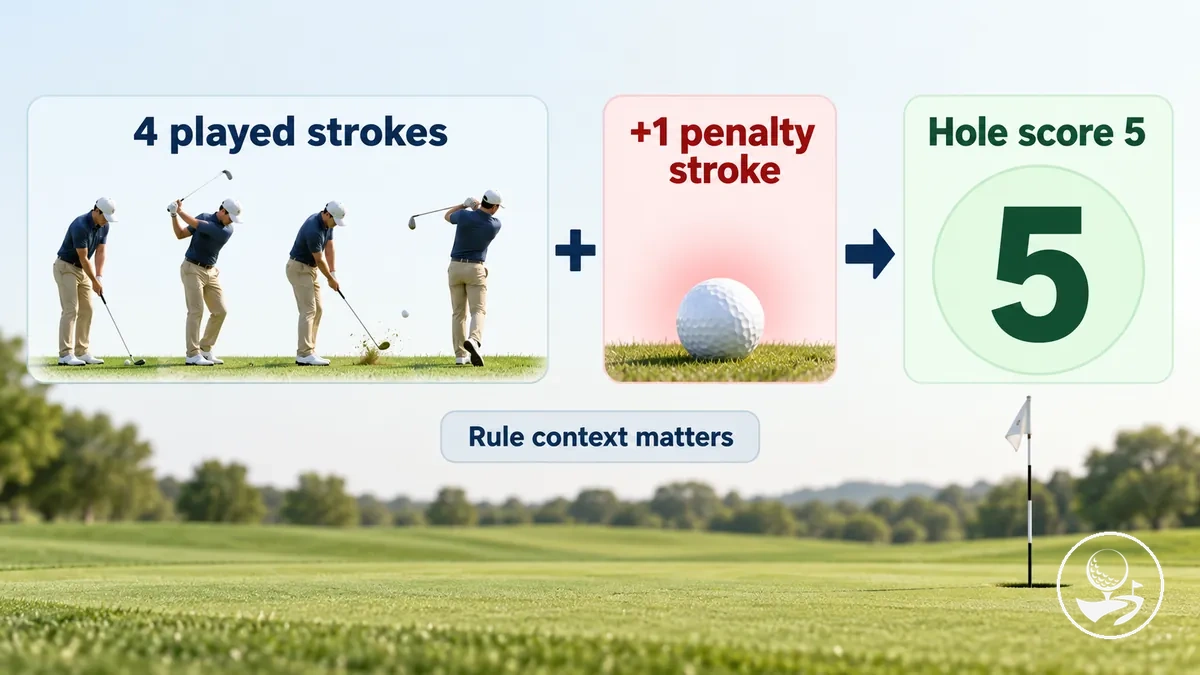
For example, 4 played strokes + 1 penalty stroke = a hole score of 5. The added penalty changes the recorded total, not the number of swings made.
What Par, Birdie, Eagle and Bogey Mean
Par is the assigned stroke benchmark for a hole. A player's hole score relative to par determines the label: birdie is one stroke under par, eagle is two under, and bogey is one over.
The table compares these terms using the same par-4 hole as the reference.
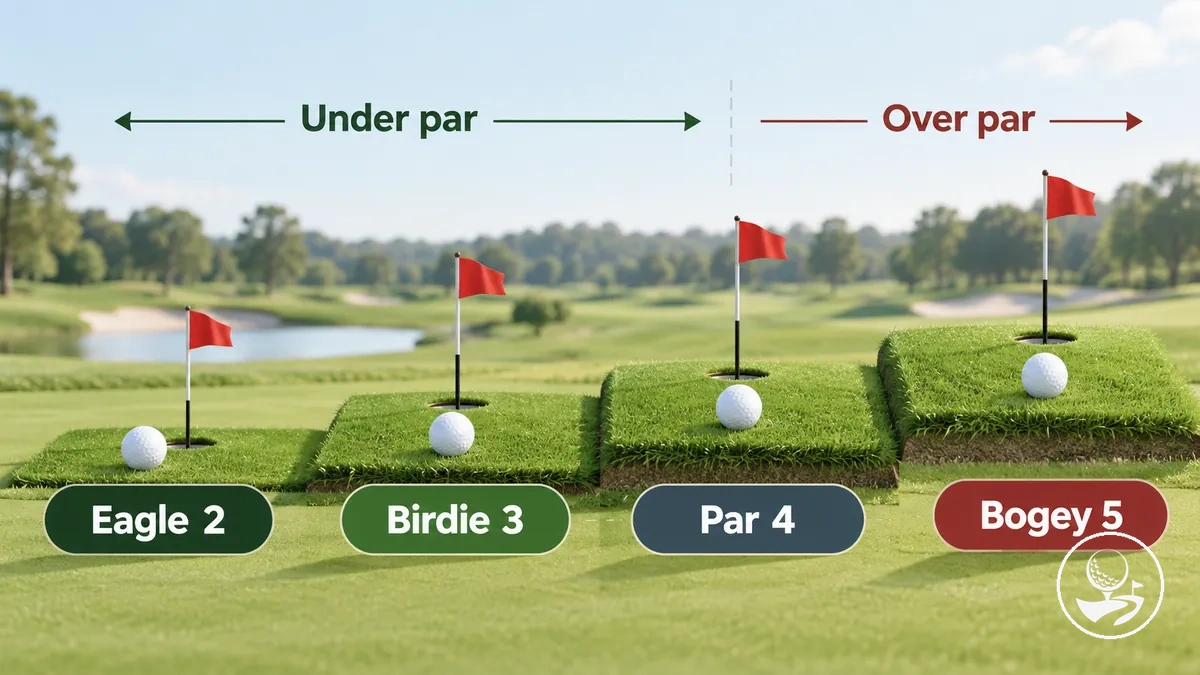
| Term | Relation to par | Example on a par-4 hole |
|---|---|---|
| Par | Equal to par | 4 strokes |
| Birdie | One under par | 3 strokes |
| Eagle | Two under par | 2 strokes |
| Bogey | One over par | 5 strokes |
Subtract par from the player's hole score to describe the difference. On a par-4, 3 strokes is −1 (birdie), 4 is even par and 5 is +1 (bogey). A negative difference is under par; a positive difference is over par.
How a Golf Scorecard Records the Round
A golf scorecard matches every completed hole with its printed par and the player's counted hole score. Its subtotal and total fields show how those individual values build the round's gross score.
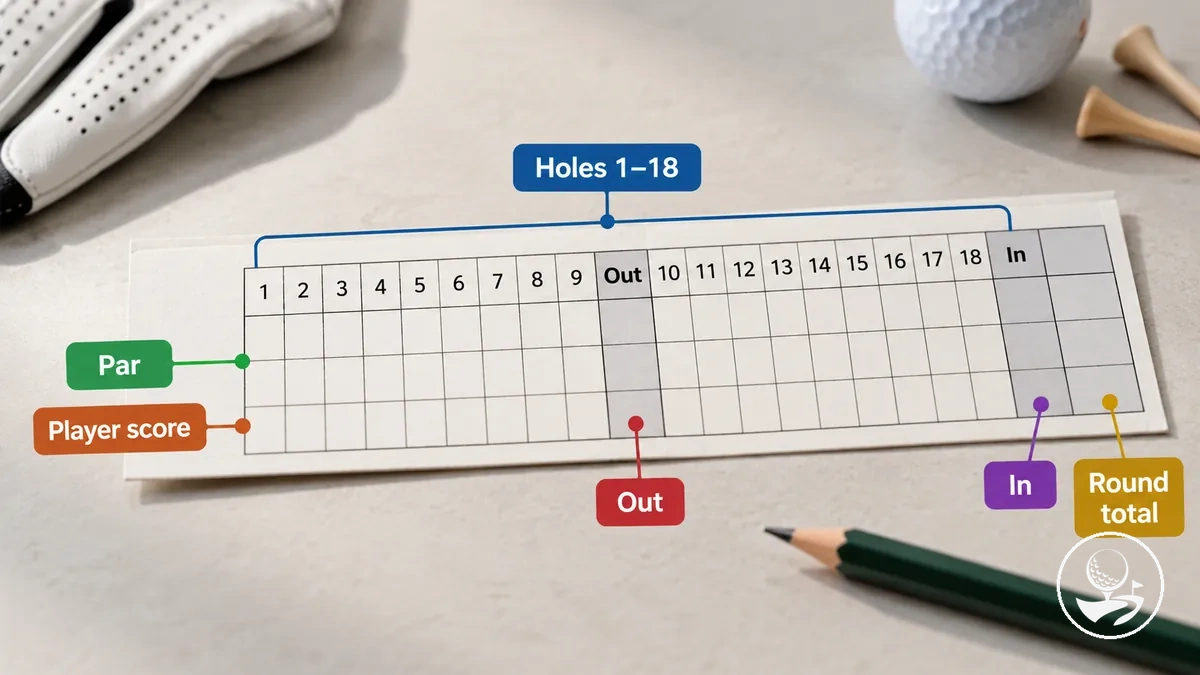
On an 18-hole card, Out normally means the subtotal for holes 1–9, while In means the subtotal for holes 10–18. These are group totals, not extra holes.
- Hole number: identifies the hole to which the recorded values belong.
- Par: shows the par value assigned to that hole.
- Player score: records the player's stroke total for the completed hole.
- Out / front nine: where shown, groups holes 1–9 and displays their subtotal.
- In / back nine and round total: where shown, In displays the subtotal for holes 10–18, while the final round total combines the completed hole scores for the round.
If a hole's par is 4 and the player records 5, the player score is 5 strokes, not the printed par of 4. That score contributes to its nine-hole subtotal and the round total.
Entering Scores for Each Hole
Once a hole is finished, enter its verified final hole score in the correct hole number and player's row. Do not copy the par value unless it matches the strokes counted.
- Identify the correct hole and player row: locate the matching hole number on the scorecard and the player's score row before recording the result.
- Verify the final stroke count: confirm that the completed hole score includes all strokes belonging in that score, including any applicable penalty strokes.
- Enter the final hole score: record the verified final stroke count in the score cell for that completed hole.
The entry must already include every stroke that belongs in the completed hole score, including any required penalty strokes. Check the number before moving to the next hole.
Adding the Final Round Score
The gross round score is the sum of all completed hole scores. On an 18-hole scorecard, add the Out (front nine) and In (back nine) subtotals, then verify the result against the 18 individual entries.
- Sum holes 1–9: add the recorded hole scores for the front nine to produce the Out or front-nine subtotal when shown.
- Sum holes 10–18: when applicable, add the recorded hole scores for the back nine to produce the In or back-nine subtotal when shown.
- Add the subtotals: combine the front-nine subtotal and back-nine subtotal to calculate the final total for the round.
- Verify the total: reconcile the final total with the sum of the individual recorded hole scores to confirm that the arithmetic agrees.
All applicable penalties should already be reflected in the individual hole scores. Adding those 18 scores separately must also produce 92 strokes.
How Stroke Play Uses the Total Score
Stroke play compares each player's counted strokes over the stipulated round or rounds. A hole's recorded score includes any applicable penalties and contributes to that total. When players are compared on the same scoring basis, the lower applicable total is better.
Gross stroke play uses actual stroke totals; net stroke play uses the handicap-adjusted totals permitted by the competition. This differs from match play, where holes won determine the match result, rather than simply comparing total strokes.
Gross Score and Net Score: The Basic Difference
Gross score is the total number of strokes counted during a round, including applicable penalty strokes. Net score is the handicap-adjusted result calculated from that gross score for the relevant format.
| Score type | What it represents | Handicap adjustment | How to interpret it |
|---|---|---|---|
| Gross score | The raw total of actual strokes counted for the round | No handicap strokes are applied to the gross score | The player's counted stroke total before handicap adjustment |
| Net score | An adjusted score based on the gross score and applicable handicap strokes | Applied according to the relevant handicap method and scoring context | The handicap-adjusted result for that scoring context |
The handicap strokes received depend on the applicable handicap method, tees and competition conditions. They are not automatically the same number as a player's Handicap Index, and some scoring formats use handicap strokes differently.
In a net stroke-play calculation where 18 strokes are received, a gross total of 92 becomes 74 net (92 − 18). The recorded strokes remain 92; only the adjusted scoring result changes.
How Handicap Strokes Change a Gross Score into a Net Score
To calculate a net total in ordinary net stroke play, subtract the applicable handicap strokes received from the player's gross score. Use the competition's allowed adjustment rather than assuming it equals the Handicap Index.
The player still took 94 counted strokes. The 12-stroke adjustment applies to this illustrative scoring context, producing a net score of 82.