
Why Basements Get Wet
Exterior basement seepage occurs when surface runoff or groundwater reaches the foundation and a crack, joint, opening or moisture-permeable material allows water or moisture to pass inside. A wet basement may instead result from condensation or a plumbing leak, so identifying the moisture source is the first step before choosing a remedy.

Why a basement becomes wet · At a glance
Water at the foundation → exposure conditions → entry path
For exterior seepage, water must reach the foundation and encounter a route indoors. Drainage and groundwater conditions change the duration of exposure and may increase pressure; sustained pressure is not required for water to enter an exposed opening.
-
Water arrives
Rain or snowmelt delivers surface runoff; groundwater can approach the walls or the slab from below.
-
Exposure can increase
Inward grading, downspouts, water-retentive soil or an elevated water table can prolong contact with the foundation.
-
Water finds a pathway
Cracks, window openings, service penetrations, wall–floor joints and permeable or deteriorated materials may let it through.
Different source, similar wetness
Condensation: humid indoor air meets a cold surface. Plumbing: a pipe or fitting leaks inside the building. Neither requires exterior water to pass through the foundation.
Interpretation boundary: a wet patch, visible crack or recent rainfall alone does not confirm the source. Compare moisture location and timing with rainfall, groundwater conditions and indoor water use.
Runoff, soil drainage, groundwater position and foundation condition determine how long water remains beside a possible entry point. The sections below separate water-loading conditions from the pathways through which water may travel.
Table of Contents
How Water Builds Up Around a Basement Foundation
Water builds up around a basement foundation when rainwater, snowmelt or groundwater arrives faster than the site can drain or disperse it.
Heavy rain or rapid snowmelt can increase the incoming water load, but whether that water persists beside below-grade walls and floors depends on drainage, soil conditions, and groundwater position.
The diagram organizes these surface-delivery conditions together with the subsurface conditions that determine how long water remains near the basement foundation.

Two different controls on water exposure
- Water delivered towards the foundation
- Rain or snowmelt adds runoff. Grading towards the house, flat ground that sheds water poorly, and gutters or downspouts that discharge near the walls can concentrate it.
- Water retained beside the foundation
- Soil with limited drainage can remain wet after a storm. Saturated layers or groundwater close to the basement may maintain exposure even after surface runoff has ended.
Rainfall is a trigger, not a complete explanation: the site’s ability to redirect and release water changes the duration of foundation contact.
For example, after the same rainfall, a site that sheds runoff away and allows water to drain through the surrounding soil may have shorter foundation exposure than a site where runoff collects and saturated soil retains water beside the basement.
Poor Surface Drainage Concentrates Water Near the Foundation
Poor surface drainage keeps runoff close to the foundation instead of carrying it away from the building.
When surface water is repeatedly directed or retained beside the foundation, local soil wetness increases and water remains in contact with below-grade surfaces for longer.
Where runoff can collect
- Ground slope
- Inward grading routes runoff towards the house; flat, poorly draining areas can allow water to linger beside the wall.
- Roof-water discharge
- Blocked gutters may overflow at the foundation. Short downspouts or outlets beside the building concentrate water at the discharge point.
- Pooling and obstructions
- Low spots hold surface water; blocked drainage routes prevent it from continuing away from the foundation.
The annotated example shows how these surface-routing conditions influence where runoff collects in relation to the foundation.

When grading and drainage routes lead water away from the building, the foundation generally experiences less prolonged runoff exposure.
Several drainage problems can act together, especially if runoff repeatedly reaches the same vulnerable area. No single drainage defect confirms the source of water inside.
Saturated Soil and a High Water Table Keep Water Against the Foundation
Saturated soil and a high water table can keep water in contact with below-grade foundation walls and the slab for longer periods.
Saturated soil is not the same as a high water table
- Saturated soil
- Water fills most available pore space, leaving little room for additional infiltration. A poorly drained layer may become saturated locally after rain.
- High water table
- The upper level of groundwater lies close to the basement, potentially keeping deeper soil or sub-slab areas wet over a longer period.
The two conditions may overlap, but surface waterlogging after a storm does not, by itself, establish a high groundwater table.
Soil drainage capacity affects how quickly water from rainfall or snowmelt can move away from the foundation, with free-draining soil dispersing retained water more readily than water-retentive soil that remains saturated.
The diagram separates the saturated-soil zone from the groundwater level and shows how both conditions can prolong water contact with below-grade surfaces.

Where water accumulates and is held against below-grade surfaces, hydrostatic pressure can develop and generally increases with the depth of standing water.
Pressure may drive water through a connected crack, joint or permeable area, but pressure alone does not establish that leakage is occurring.
Under similar rainfall, a foundation surrounded by free-draining soil may experience less persistent water contact than one beside water-retentive or already saturated soil because retention and groundwater position control how long water remains available at the foundation.
How Foundation Conditions Create Water Entry Paths
Exterior water does not automatically move indoors. There must also be an entry path through the foundation envelope—the walls, floor and their joints or penetrations.
A crack or other opening can interrupt continuity, while a wall-floor joint or another interface can provide a potential passage where adjoining components meet.
Material porosity can permit moisture movement through a foundation material, and the sealing condition around penetrations or other openings affects whether those interfaces remain continuous.
Deterioration can also change the condition of an existing surface or interface, but a visible defect does not by itself confirm that water is passing through it.
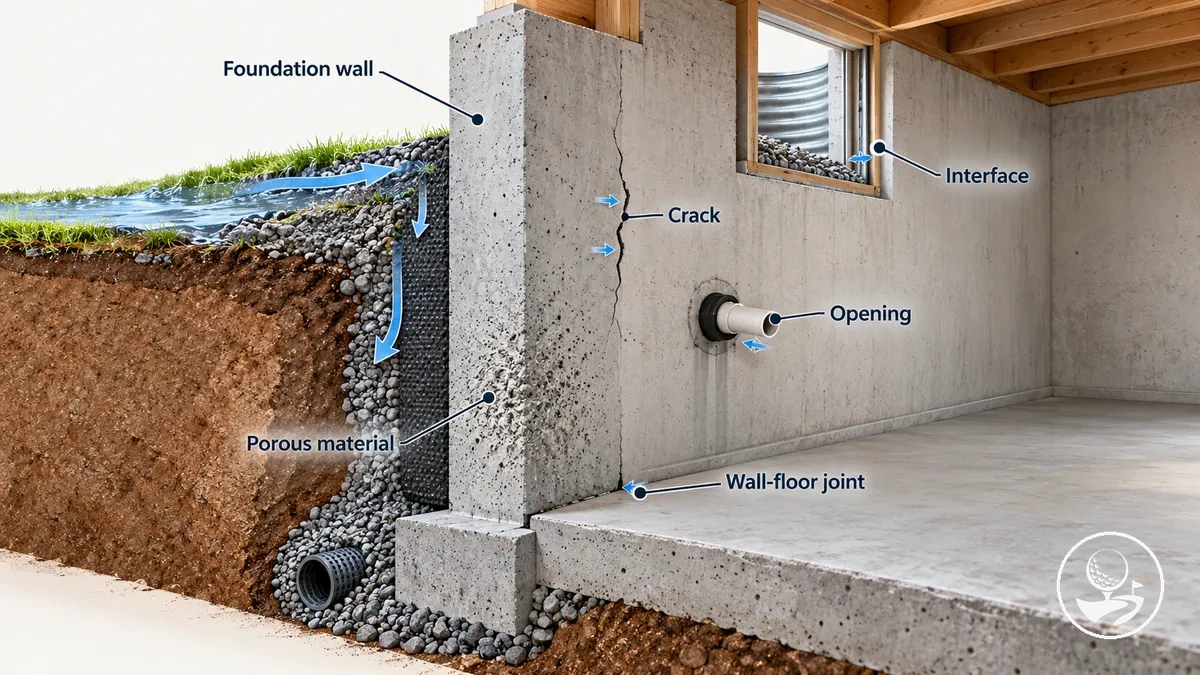
The water source or pressure mechanism describes why water is available and driven toward the foundation, while the entry path describes where that water can pass through the foundation envelope.
A damp patch inside therefore does not prove that the nearest visible crack or joint is the active leak; water may travel before becoming visible.
Specific pathway types differ in how they interrupt continuity or permit water passage, so cracks, joints, interfaces, openings, and porous materials need to be considered as distinct potential entry conditions.
Cracks, Window Wells, and Other Openings Create Entry Points
A foundation crack or other opening can become an entry point when exterior water reaches it and the discontinuity provides a path into the basement.
The visible opening identifies a possible pathway for seepage, but it does not by itself confirm that water is actively entering there.
Potential openings and their exposure conditions
- Foundation crack
- May admit water if runoff or groundwater reaches a connected crack in the wall or slab.
- Window well or door gap
- Becomes more relevant when collected water rises to the window or door interface and the seal or opening allows entry.
- Service penetration or other gap
- Water may enter where a pipe, cable or other service passes through a poorly sealed opening exposed to moisture.
The annotated example identifies these different opening classes as possible entry points rather than confirmed leak sources.

The location of observed water, the timing of seepage relative to exterior water exposure, and the surrounding conditions help determine whether a particular opening is consistent with the active pathway.
Wall-Floor Joints and Slab Interfaces Create Below-Grade Entry Paths
A wall-floor joint or slab interface can provide a below-grade entry path when surrounding soil, sub-slab moisture, or groundwater keeps water available against the basement.
The joint itself is the physical pathway, while persistent wet conditions supply the water that can move through it and appear as seepage inside.
The wall–floor joint is the interface between the foundation wall and the slab; a slab edge or construction joint introduces another connection between materials where water could travel.
Water from surrounding soil or beneath the slab may reach these joints, but the presence of an interface alone is not evidence of active seepage.
The same joint under different conditions
- Dry surrounding soil or sub-slab area
- A visible wall–floor seam may remain dry because little water is available to pass through it.
- Rising groundwater or persistent sub-slab moisture
- Water may move through a connected joint and appear indoors. A damp seam does not prove the joint is defective or identify the water source by itself.
The likelihood of seepage depends on both the available pathway and the persistence of water against it.
Porous, Unsealed, or Deteriorated Foundation Materials Can Admit Water
Concrete, masonry, mortar, and other foundation materials can transmit moisture or seepage without one large visible opening when their porosity, protective continuity, or material condition allows water movement.
Under sustained exterior moisture exposure, a more permeable or incompletely protected surface can admit moisture across a broader area rather than through one discrete entry point.
Concrete and masonry contain pores through which moisture can move. Pore connectivity, material permeability and the moisture gradient affect that movement; porosity alone does not tell you how quickly liquid water will pass through.
Mortar deterioration or surface deterioration can change the continuity and condition of masonry surfaces, creating areas where moisture movement becomes easier.
Sealing continuity also matters because gaps, incomplete coverage, or degraded protection can leave portions of the foundation more exposed to sustained water contact.
Moisture pattern: what it suggests and what it cannot prove
- Diffuse dampness across a wall
- Can be consistent with moisture moving through concrete, masonry or mortar over a broad area, particularly during sustained external wetting.
- Concentrated seepage at one point
- May be more consistent with a local crack, joint or other opening, especially when wetness coincides with outside water exposure.
Neither pattern establishes the cause on appearance alone. Consider moisture location, exposure, indoor humidity and the condition of the surrounding material.
How Drainage, Soil Saturation, and Entry Paths Combine
Wet basements often result from interacting conditions rather than one isolated defect.
Water load, persistence or pressure, and foundation vulnerability can combine so that an entry path becomes consequential only under particular site conditions.
The table organizes how these contributions can form plausible causal combinations without treating any row as a diagnosis.
| Water-loading condition | Persistence or pressure condition | Foundation vulnerability | Possible intrusion implication |
|---|---|---|---|
| Heavy rainfall or snowmelt combined with poor drainage | Soil saturation prolongs water contact near the below-grade foundation | A crack or opening exposed to the increased water load | Sustained exterior water and an available entry path can result in seepage |
| Persistent groundwater around or beneath the foundation | Continued groundwater contact can maintain pressure and water availability | A wall-floor joint or permeable foundation material | Persistent water exposure combined with vulnerability can permit intrusion |
Surface drainage changes how strongly rainfall or snowmelt affects a particular foundation.
Where poor drainage concentrates runoff and soil saturation persists, the same rainfall can produce a greater and longer-lasting water load at an existing entry path.
Where runoff disperses and the soil drains more readily, that pathway may receive much less sustained exposure.
Persistent groundwater creates a different interaction because water availability and pressure can continue even after surface conditions change.
A vulnerable joint, opening, or permeable material can become more consequential under that sustained below-grade exposure, but similar visible moisture could still arise from another combination of groundwater, persistence, and foundation vulnerability.
The presence of any one condition therefore does not establish which mechanism is active.
The same crack may remain dry where drainage is effective and soil saturation is limited, yet admit water where the surrounding water load persists.
Likewise, the same rainfall can have different consequences where one site sheds water quickly and another retains it beside the foundation.
These contrasts show that intrusion depends on how water load and persistence combine with an available entry path, not simply on rainfall or a visible defect alone.
Identify the water source and likely entry path before selecting a corrective method. Similar-looking moisture may come from different combinations of runoff, groundwater and foundation conditions.